A sermon preached at Calvary Presbyterian Church
May 10, 2026
Introduction to Worship
Good morning and welcome to worship at Calvary.
I am Marci Glass, Pastor and head of staff. Whether you’re here for the first time or whether you are here every week, I deeply believe that it is God who has invited you here today, and it is my privilege to welcome you as a guest in this place. In the music, in the liturgy, in the prayers, in the silence, I pray you will find what your soul needs this morning.
For the next few weeks, we’ll be hearing from some of the Apostle Paul’s letters from the New Testament. He wrote them to various congregations, some of which he had founded, others he had visited.
Today we’ll hear from Philippians.
Preaching from Paul’s letters is a challenge. Honestly, even reading them can be hard. We’re only seeing one side of the conversation. We can infer what caused Paul to write this particular letter to this particular congregation, but we don’t know for sure the entire context of their relationship.
I’ve been thinking about letters this past week. Author and Historian Doris Kearns Goodwin spoke last week at Calvary about the book she wrote after going through her husband’s correspondence from his time working in the Kennedy and Johnson White House in the 1960s. And she spoke of what a treat it was to read letters her husband had written before she knew him, or to read letters people wrote him. She spoke of how we are losing letters as a source for historians now that people don’t write as many as they used to, because letters are different than emails or text messages or tweets.
My sister has been going through the last of my mom’s storage unit and reuniting my brother and I with our preschool art projects and other treasures. Much of it is not treasure though. She’s recycled a lot more mail from the 1960s that we aren’t sure why mom kept all those years. But in the pile of mail that was bound for the shredder, we did find a letter my dad had written to my mom in November 1963, mailed from a hotel in Dallas, where he was at a conference, and where he had just taken his national licensing exam to become the first licensed inhalation therapist west of the Mississippi(now we would call it respiratory therapist).
We thought it was odd to send a letter from a conference, knowing you’d probably be home from the meeting before the mail would be delivered, but we think Dad wrote the letter to mom because long distance from hotels was really expensive and they didn’t have much money for such luxuries. He wrote the letter after he’d taken the test but before he’d gotten the results. His excitement was palpable in the reading of the letter. He was so hopeful for how this was going to be a big change for them, and how the financial security would relieve stress on their young marriage, so they could get pregnant and have another baby.
It is interesting reading letters 60 years after they were written. We know what happened next, even as it was all just possibility in that moment for my dad as he wrote. My sister was 5 when that letter was written. They’d been trying to have another baby for a while. It would be another 5 years of infertility before they would adopt me, and then 2 more years before mom would get pregnant with my brother. My dad did pass that exam that day, and it did shape our family’s trajectory. But in that moment, in that letter, it was all unknown possibility and hope.
As my sister and I were marveling over that letter, which felt like such a gift, and we realized it wouldn’t exist today. Dad would have called mom and they would have talked on their cell phones. A younger generation today wouldn’t even make the phone call. They would just send a text.
So we can be thankful that Paul didn’t send a text to the Philippians. And that someone kept his letter, and made copies of it, and shared it, so that we could read it, 2000 years later.
Write me a letter
You can make it short or long
It doesn’t matter what you say
There is no right or wrong.
Just tell me of your day
What made you laugh or ponder
Of places you would like to see
Out in life’s wide blue yonder.
What makes you tick
What thoughts would flow
When you put pen to paper?
I’d love to read what’s in your head.
On travelled page days later.
Write me a postcard.
A notecard.
Whatever you have to hand.
With crayon, or quill, or pencil
From over sea, or through the air,
Or maybe just on land.
I long to see your handwriting
Your swirls and whirls of ink
As personal as your favourite shoes
Of you, it makes me think.
So please. Write me a letter
Let your thoughts cascade like rain
Sent from down the road, or miles away
On foot, or by car, or by train.
As we enter worship this day, preparing to hear someone else’s letter, let us think about what letters we want to write in our own lives, and with our own lives.
In another letter, Paul says this: You yourselves are our letter, written on our* hearts, to be known and read by all; and you show that you are a letter of Christ, prepared by us, written not with ink but with the Spirit of the living God, not on tablets of stone but on tablets of human hearts.
What is God writing on your heart today?
Scripture:
Philippians 1:1-18a
Sermon
Philippi was a city in Macedonia, and a prominent Roman colony. The Book of Acts tells us that Paul founded a church there on his second missionary journey and that Paul and Silas were accused of disturbing the city with their preaching.
Because for Paul to proclaim that we have one Lord— and that our Lord is definitely not Caesar—that was a problematic message. What Caesars are we building golden idols to today? Paul is writing this letter from jail, imprisoned by Rome for being too political with his sermons. And even in his afflictions, he can see where God is at work in his life.
There’s a cartoon by Inherit the Mirth that is called St Paul’s Letter to the Bergmans and in it, Paul writes, “I Paul, a servant of Christ Jesus, greet you in the name of the Lord, and ask you to keep your dog out of my petunias”.
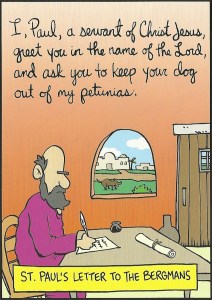
I love the idea of that letter from Paul. And it makes me want to elevate all of my correspondence. If I were to write a letter to someone whose dog was destroying my flower beds, I feel like I would be nicer to them if I first greeted them in the name of the Lord. Right? It would remind me of who I want to be, and how we are connected.
And Paul does that well in all of his letters. To the saints, he begins.
To call the Philippians saints is not to make a judgment about how perfect and Mother Theresa-ish they are. It is to ground the entire letter from the beginning with the reminder that God has made them holy and how they live and move and have their being is in the waters of God’s holiness which makes them holy.
He offers grace and peace and gratitude. And that frames the entire letter, and the relationship, in positive terms of connection and belonging.
How different would our interactions be if we started every argument with “Grace to you and peace from God our Father and the Lord Jesus Christ. I thank my God for every remembrance of you, always in every one of my prayers for all of you, praying with joy for your partnership in the gospel from the first day until now….”
It’s science, actually, what Paul is doing. Throughout this entire section, Paul is showing us how to cognitively reframe what is happening in our lives. He’s in prison, and not a club fed sort of prison where Caesar’s friends get sent. He’s undergoing hardship and persecution. And he still chooses to start with gratitude and connection. He continues to chose joy, when we could understand why despair would make more sense.
Comedian Pete Holmes has a strategy of saying “yes, thank you” to whatever happens in his life. He says, “If you can just say ‘yes’ to what is, that’s all you need. It short circuits your brain if you say ‘yes, thank you’ to it. Almost instantly. Flight is delayed. Yes, thank you. As if it is what you wanted. And then you realize you’re in an airport, and you’ll be in an hour later. And it can be a clean breath and a recognition you’re alive. And maybe you see the sun coming through the windows and maybe you realize people used to die in covered wagons on this journey you’ll take in 4 hours.”
All of a sudden, because of “yes, thank you”, the delayed flight is not the same source of negativity and anger. It is still an inconvenience, to be sure. But when it is a situation that is beyond your control—Rome has put you in jail. The FAA has reduced the number of flights into SFO. Etc.—it is a reminder that you have choices about how you want to exist in this world we’re in. Even in moments beyond your control, you still have a choice about who you want to be.
And so as we read these words from Paul, and I invite you to take the bulletin with you this week so you’ll have the readings from Philippians at your fingers, I invite you to hear Paul writing to Calvary, not just writing to First Presbyterian Philippi.
He’s writing to people in a Roman colony who have to be careful not to upset the whims of an insecure and tyrannical Caesar. He’s writing to people who know of the conflict created by living in anxious times and anxiety filled systems. He’s writing to people who don’t want to give into despair, but who are having trouble finding their way past the bad news in the news cycle. He’s writing to us.
And he writes to remind us of our connectedness and about how all good work, even work done by individuals, is done because of the support of a community. He lifts up gratitude. He reminds us of the good work and ministry we have already participated in. He points us to hope for and about the future. “I am confident of this, that the one who began a good work in you will continue to complete it until the day of Jesus Christ.”
Paul points the Philippians to that future hope we have in our faith. We cannot always see the finish line, but we run the race, one step at a time, confident in the one who calls us, who supports us, who equips us with community to run alongside us.
At our monthly session meeting this past week, the elders were talking about updated language for our vision and mission statements, to better reflect this particular moment in the life of the church. And one of the challenges of mission statements is that they are often so vague and generic that they could be describing any church in the country.
“To Welcome, Grow, and Serve in the Grace of Christ’s love” is one illustration of a vague statement that carries no flavor of the particular congregation, or honestly of what their vision is.
You also can’t be too long, or too specific. But it should give a sense of what separates one church from another. Not in a better or a worse comparison, but because each congregation is called to particular service. And one of the elders asked me what I thought differentiated Calvary from some other congregations.
And I’m not sure I have a fully articulated answer to that question. But I thought about it as I worked on this sermon, and so here’s a letter to you, Calvary, with thanks to Paul.
From Marci, servant of Christ Jesus,
To all the saints in Christ Jesus who are in Calvary, with the elders and deacons:
Grace to you and peace from God our Mother and the Lord Jesus Christ.
I thank my God for every remembrance of you, always in every one of my prayers for all of you, praying with joy for your partnership in the gospel from my first day in 2020 until now. I am confident of this, that the one who began a good work in you back in 1854 will continue to complete it until the day of Jesus Christ.
You have always been willing to speak God’s love to and for your community, being sure people outside these walls know that God’s love is for them, just as it is for you. You’ve also spoken God’s challenge to and for your community, standing in the public square and advocating for the things and the people that are close to God’s heart. You also have a heart for others, giving of your time and treasure to serve the community. And my challenge to you is that your witness must be expanded. More of you must participate in what some of you have been faithfully doing.
It is right for me to think this way about all of you, because I hold you in my heart, for all of you are my partners in God’s grace. I love the way you enjoy being together, and for the ways you are earnestly working to expand your welcome. I appreciate that many of you have leaned in to deepening and strengthening your faith this past year, by showing up for church nights, bible studies, choir practice, leadership and service opportunities in the middle of a busy, busy world. I don’t take it for granted. The investment of time and treasure you make for your faith is an investment in God’s dreams for the world.
And this is my prayer, that your love may overflow more and more with knowledge and full insight to help you to determine what really matters, so that the love you share, and the community you are building can strengthen the neighborhood outside these walls, bringing more and more people to know they are always and already loved by the God who calls us, who equips us, and who sustains us through the trials of this world.
Finally, beloveds, whatever is true, whatever is honorable, whatever is just, if there is any excellence and if there is anything worthy of praise, think about these things. Rejoice in the Lord always, again, I say rejoice.
Amen.


Your letter to Calvary parishioners struck a chord
LikeLike
A beautiful letter to the church. My church voted to close, as we have been one so few that we can’t pay even half of our pastor’s salary. I am relatively new to the congregation. My heart hurts for those bp have served faithfully at the church for two or more decades and did everything to try and save it. But in your letter, I am reminded that there are other churches where we can serve and completed the good work started in us until the day of Jesus Christ’s return. Thank you. I really have to reread Paul’s letters. As a female preacher, I sometimes miss his messages because I am too focused on whether Paul was for or against women preaching.
LikeLike
I’m sorry to hear about your congregation closing. Even when it is the right thing, it doesn’t make it easier.
Paul was supported by lots of women in his ministry, and he thanked them by name in his letters. He gets a bad rap.
LikeLike
Marci, I am thinking your sermon words also included those of us who love you in Boise @ Southminster. I know that distance does not seperate us from the community of God to which we all belong. And today we are anxious and full of anxiety and praying for one another is a must! Shalom, Kay H
LikeLike
Thank you. I miss Southminster. Such an important community for me.
LikeLike