A Palm Sunday sermon preached at Calvary Presbyterian Church in San Francisco
March 29, 2026
Scripture:
John 12:1-27
John 19:16b-22
Introduction to worship
Good morning and welcome to worship at Calvary.
I am Marci Glass, Pastor and head of staff. Whether you’re here for the first time or whether you are here every week, I deeply believe that it is God who has invited you here today, and it is my privilege to welcome you as a guest in this place. In the music, in the liturgy, in the prayers, in the silence, I pray you will find what your soul needs this morning.
Today is Palm Sunday, when we mark the beginning of Holy Week by remembering that Jesus entered Jerusalem to throngs of people crying “hosanna”, which means “save us”. If we’ve heard the Holy Week story before, we know that at the end of the narrative, that same crowd cries “crucify him”.
We’re a fickle bunch, we humans.
We want Jesus to save us from the crushing load of the oppressor and then we turn to the oppressor for salvation instead.
Later in worship, we’ll hear the story of Palm Sunday, but we’ll start before the parade, with Jesus gathered at the home of his friends, where he receives an amazing gift.
How many of you have received a gift that was so staggering and surprising that it caught you off guard?
I married into a family that gives generously, both in terms of gifts and of their time and presence. They showed me how to show up for the people and the issues that matter to me.
And their generosity taught me to trust in abundance. They have always lived simply but comfortably, and they modeled for me a trust that I could too be generous and still have enough. I am a more generous person because people were generous to me.
My own parents were generous in their own ways, but they were a few years older than my in-laws, and had lived through the depression. And the scarcity of that time in their early childhood made abundance harder for them to trust. They remembered being hungry, remembered their parents worried about how to put food on the table. I have great compassion for how stressful that inheritance of anxiety was for them.
As we enter worship this day, I invite you to think about what do we want our inheritance to be? Trust in abundance or the anxiety of scarcity? I invite you to think about a time you were surprised by generosity, or a moment when you encountered abundance in a way that quieted anxiety you didn’t even know you were carrying with you.
That is the grace of God, at work in our lives. And as we enter the Holy Week story, remember the abundance of God’s grace. Because it runs through the whole narrative of the crucifixion of Jesus. Where human anxiety and scarcity choose violence and death, God responds with love and life. Again and again and again. Our plotting and scheming never distracts God away from love, from grace, from abundant life.
Don’t look away from the pain of the story we’ll hear this week. But also don’t look away from the grace that is woven through it.
Let us worship this day in hope, with trust, and with cries of Hosanna.
Sermon
The last time we saw this family, a few chapters back, Mary and Martha were in deep grief because their brother Lazarus was three days dead. dead. dead. And Mary and Martha make some great affirmations of faith to Jesus as they talk to him outside their brothers’ tomb. “Lord, if you had been here, my brother would not have died. Yet, even now I know that God will give you what ever you ask of him.”
And our text this morning opened with “Jesus came to the home of Lazarus, whom he had raised from the dead.” John is reminding us that this family can talk to us about life after death.
Lazarus was buried and three days in the tomb, but is now hosting a dinner party. And Mary, perhaps in response to this new life Jesus has given her brother Lazarus, takes a pound of Nard and pours it all over his feet. Because this action is so foreign to us, I think we miss out on the extravagance. It isn’t often, I suspect, that someone washes your feet with their hair. With nard.
It was an extravagant gift from Mary to Jesus, an offering of love that was very personal. It was a sign, also, that during all of those times she sat at his feet and listened while he talked—she actually heard what he was saying about “coming that people might have new life and have it abundantly”—she understood when he said he was headed to the cross that he was heading to his death.
She understood there is no reason to hoard what we have in this life. We are to pour it all out, as a ridiculous act of generosity that signals our hope is not in earthly possessions but in new life offered by God. Because what we have is enough. And enough is enough.
Nard was a very expensive and concentrated resin that was used to anoint dead bodies. She is giving Jesus the gift that she didn’t have to give her no longer dead brother, Lazarus.
Judas’ comment gets us off track. “Why was this perfume not sold for 300 denari and given to the poor?”, he asks.
And when he puts it like that, thief and traitor that he is, we see his point. A Roman soldier at that time earned a little over 200 denari a year, so this one pound jar of Nard was worth around, what, 75 or 100 thousand dollars?
It was a gift of great value.
Judas sets up a false choice for us. It wasn’t that Mary won the lottery, had a lot of cash, and decided to go buy some really expensive perfume as she walked by the homeless people on the street. It would have taken a long time, I suspect, for her family to save up for that pound of Nard so that they could show love, honor, and respect to their loved ones as they died.
This gift she gives Jesus shows that she understands that new life is breaking into the world in the person of Jesus of Nazareth. This man who brought her brother back from the dead is changing everything.
How many of you have received a gift that was so staggering and surprising that it caught you off guard? Mary recognized that they were receiving that kind of gift in the life of Jesus Christ and she responds with the most extravagant gift she can dream up. And while having your feet washed with embalming ointment by someone’s hair may not be what you are asking for on your next birthday, Jesus recognizes the gift.
“Leave her alone,” he tells Judas. “She bought it so she might keep it for the day of my burial. You always have the poor with you, but you do not always have me.”
In other words, Jesus is letting Judas and the others know that the systems that keep people poor, homeless, and hungry will always be here. He isn’t saying it as a promise, to beat down the dreams of people who want to rise above their situations and those who want to help them. He’s not saying, “don’t worry about the poor, they’ll always be around.”
He says it with some degree of judgment, and causation. “Because of the way you steal from the common purse and pursue your own interests above those of everyone else, because of your complicity in wealth inequality—you will always have the poor with you, but you do not always have me.
These words from Jesus should call us to renewed purpose for the improvement of the lives of others. Rather than putting down the extravagant gifts that people bring to Jesus, we should all live our lives with Mary’s faith and gratitude.
This new life we recognize in the person of Jesus Christ can change lives, now, not just someday in the future. “I have come that you might have life and have it abundantly”, Jesus says in John’s gospel.
Mary, Martha, and Lazarus live fully into New Life. Martha prepares a dinner party with Jesus, even though eating dinner with him is seditious. Mary openly declares her abundant faith in Jesus’ words by anointing his feet with perfume. Lazarus walks out of his tomb and into new life with courage and confidence.
Lazarus probably could have told us that the decision to listen to Jesus and to walk out of his tomb gave him new life and also gave him a whole new set of issues. The raising of Lazarus was the final straw for the Jewish leaders about Jesus. They are actively plotting Jesus’ death from this point on.
And religious leaders weren’t big fans of Lazarus either. Everywhere Lazarus went, the people said, “Hey—there’s the guy Jesus brought back from death!” Our text even tells us this, “When the great crowd learned that Jesus was there, they came not only because of Jesus, but also to see Lazarus, whom he had raised from the dead. So the chief priests planned to put Lazarus to death as well, since it was on account of him that many of the Jews were deserting and were believing in Jesus.”
Living into New Life, walking out of the tombs in which we find ourselves is not without risk when the world wants to keep us in our graves. As Jesus watches people threaten to kill his friend, when the only crime he’s guilty of is not being dead—Jesus says enough is enough. And he leads a protest march into Jerusalem.
What we get before Palm Sunday in John’s gospel is the story of people who are ALL IN, saying enough is enough if a culture of violence wants to keep people in their graves. Enough is enough if generosity and abundance are scorned. Enough is enough if talking about new life is threatening to people in power . They lead us to the parade with the reminder to give it all away for love.
Frederick Buechner once wrote: “The life you clutch, hoard, guard, and play safe with is in the end a life worth little to anybody, including yourself, and only a life given away for love’s sake is a life worth living.”
The crowd at Palm Sunday is there for Jesus, there to greet a scandalous celebrity.
They are not all in, the way Lazarus, Mary, and Martha are. The crowd crying hosanna or “save us” is the same crowd who will shortly chant “crucify him!”.
They want an easy solution, someone to ride in like a king, the way Caesar would, and take on the Roman occupation, to make their lives easier. They want a new life too. They aren’t willing to go all in for it, though.
We are often like the crowd—wanting the easy solution—a hero to ride into town and just fix things already.
Listen again to that quote from Buechner: “The life you clutch, hoard, guard, and play safe with is in the end a life worth little to anybody, including yourself, and only a life given away for love’s sake is a life worth living.”
There was a palm sunday parade of sorts yesterday across the country as millions of people said no to having a king, no to having a caesar. Enough is enough. We’re through with cruelty, with ignoring the rule of law, with waging unjust wars just to distract us from the Epstein files. Enough is enough.
Hosanna, save us, we cry.
Because enough is also enough. We have enough resources to be able to feed and care for each other. We have enough capacity as a nation to welcome people to our shores. We have enough creativity to solve difficult problems if we choose to. We have enough to trust in the abundance of God and be generous in our welcome. Enough is enough.
The life you clutch, hoard, guard, and play safe with is in the end a life worth little to anybody, including yourself, and only a life given away for love’s sake is a life worth living.”
What are we willing to give away for love’s sake?
The crowd at the palm sunday parade includes Greeks, or gentiles. It is no longer a family dispute, it is no longer only an issue for the Jewish people. As the pharisees observe: “Look, the world has gone after him!”
The crowd says to one of the disciples: “Sir, we wish to see Jesus”. We hear their wish and remember the invitation at the beginning of the gospel as Jesus invites the disciples to “come and see”.
When the disciple tells Jesus the world has showed up in answer to the invitation, Jesus says,
‘The hour has come for the Son of Man to be glorified. Very truly, I tell you, unless a grain of wheat falls into the earth and dies, it remains just a single grain; but if it dies, it bears much fruit. Those who love their life lose it, and those who hate their life in this world will keep it for eternal life.”
The image of seeds, buried in the earth for a time, cracked open, emptied, as new life emerges, seedlings sprouting from the soil—we understand that part.
The next verse about loving and hating their lives—that is trickier. Listen to it from another translation:
If you love your life, you will lose it. If you give it up in this world, you will be given eternal life. (John 12:25)
The Contemporary English Version translation hearkens back to Mary’s gift of foot washing, giving up the things we value and possess in this life for love, in order to have new life. If we only love earthly values of prosperity, and victory through power, and selfish concern—we lose. If we give up those earthly priorities—we gain new life in Christ.
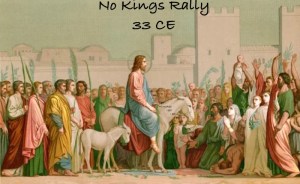
Today is Palm Sunday, which was a protest march to show the absurdity of military parades our leaders orchestrate for their own glory. Riding past into Jerusalem on a big white Roman horse with tanks and troops in formation, is contrasted to Jesus on a donkey. The Roman leader’s parades were to turn human adulation toward kingship.
Jesus’ parades shows that he is marching against human understanding of kingship, revealing God’s glory. As Jesus said after the parade, “the hour has come for the Son of Man to be glorified”. The glorification of Jesus will not be the glorification of violence and might we humans lift up. It will be the glorification of peace in the face of violence, and the glorification of love that is all in, committed to give up life in the pursuit of love.
Is enough enough?
It won’t be for the crowd.
Our second scripture passage this morning turns us toward the rest of our Holy Week journey and picks up where we ended last Sunday:
John 19:16b-22
Then Pilate handed Jesus over to them to be crucified.
So they took Jesus, and carrying the cross by himself he went out to what is called the Place of the Skull, which in Hebrew is called Golgotha. There they crucified him and with him two others, one on either side, with Jesus between them. Pilate also had an inscription written and put on the cross. It read, “Jesus of Nazareth, the King of the Jews.” Many of the Jews read this inscription because the place where Jesus was crucified was near the city, and it was written in Hebrew, in Latin, and in Greek. Then the chief priests of the Jews said to Pilate, “Do not write, ‘The King of the Jews,’ but, ‘This man said, I am King of the Jews.’ ” Pilate answered, “What I have written I have written.”
We’ll hear more of this story on Maundy Thursday at Church Night and on Good Friday. And I hope you can join us those nights. But what I want us to notice in this passage is what Pilate writes and what he says.
He proclaims Jesus’ kingship in every language needed so that everyone would see this was the King of the Jews. What I have written I have written, he said. Enough is enough. The religious leaders want to say their king is God at the same time they say they have no king but the emperor. Enough is enough, says Pilate. You had a king and you offered him as the lamb to be sacrificed for the passover meal.
Pilate, the Roman oppressor, sees Jesus perhaps more clearly than most people in the story, which is surely a condemnation for the people who had been studying their bibles looking for the messiah for generations.
As we journey during this Holy Week toward Easter, I pray that we will be willing, like Lazarus, Martha and Mary, to stay with Jesus when the crowds vanish, when the cheering crowds turn into a mob. May we invite him to our house for dinner when it is not the popular thing to do. May we wash his feet with nard, offering him a gift so extravagant that he sees our gratitude for this gift of New Life that we have been given. May we see Jesus as clearly as Pilate does, and be on the lookout for people from outside our traditions who may have truths to speak to us that we aren’t expecting.
We enter Holy Week, hanging on to hope that enough is enough. Hosanna, save us, Lord.

 Glass Overflowing