A sermon preached at Calvary Presbyterian Church in San Francisco, CA
January 12, 2024
Luke 3:1-22
Introduction to Worship:
Good morning and welcome to worship here at Calvary Presbyterian. Today is Baptism of the Lord Sunday, and we’ll hear Luke’s account of when Jesus was baptized by John in the Jordan River. We also remember our own baptisms, and we remember the baptisms we’ve witnessed, where we have made vows to support and care for the infant, child, or adult we are baptizing.
I don’t remember my baptism, exactly. I was 3 months old when I was baptized at Our Savior’s Lutheran Church in Spokane on Feb 9, 1969. Feb 9 is also my brother’s birthday.
A number of years ago, I found my baptismal certificate and I asked my mom, ‘why did you have me baptized on Brian’s birthday?’ Mom paused, and said, “I don’t know. I don’t remember that.”
And then it occurred to me I was baptized on his birthday 2 years before he was born. The little brat stole my baptism day for his birthday.
I kid. I’m glad to share my day with my brother.

Remembering my baptism, Feb 9, 1969
There’s a picture of that day that I treasure. The minister is holding me in the picture. My parents and my sister and grandparents surround me. Our next door neighbors were there as my godparents, a role they are still living out 56 years later.
Do you remember your baptism?
If you were an infant like me, you don’t.
But at the root of the word remember is to re-memory something, to call to mind.
And so when I see that photo from that day, I remember my grandparents and all the time I spent with them as a child. I remember my parents and their love. I remember the stories my mom told me about how when they adopted me, she had to take me to church for the first month because she was the church secretary at the time, and she had to give them time to hire someone new and then she had to train them. And the minister apparently declared me the most beautiful baby ever and even wrote a poem about how I was a thief of hearts. I don’t remember him, but because of those stories, I do.
Our neighbors, Buzzy and Wayne, provided the house we’d go to if mom and dad weren’t home. They hosted my wedding reception. Buzzy and my mom even lived in the same retirement community before mom died. I remember my baptism because the people who were there remembered me.
We ended up moving a bit when our kids were young, and so the boys were baptized in different churches, and they didn’t get to know a community the way I did. But all of the churches we’ve been a part of lived out the baptismal vows that the first congregations made at their baptisms.
When we say “remember your baptism” on this Baptism of the Lord day, or when we baptize an infant, a child, or an adult, I hope you can. I hope you can remember the people who have loved and cared for you throughout your life. I hope you can remember God’s love that you received through imperfect human communities and families.
And if you’ve never been baptized, but would like to find out more about it, I hope you’ll come to our new member class in a few weeks.
Our baptisms tie us to everyone across the millennia who have been baptized, and across town, and across the country, and across the world, and even across the lines we put up to separate party, race, creed, or nationality.
We should remember the baptisms of the people who came before us in the faith, remember the baptisms of those struggling in the aftermath of the fires raging in Southern California and those still struggling in the aftermath of hurricane Helene on the East Coast.
We are all connected, one to each other, drawn together through the water of life.
As we enter worship this day, hear these words from the Book of Revelation:
Then the angel showed me the river of the water of life, bright as crystal, flowing from the throne of God and of the Lamb 2through the middle of the street of the city. On either side of the river is the tree of life* with its twelve kinds of fruit, producing its fruit each month; and the leaves of the tree are for the healing of the nations. 3Nothing accursed will be found there any more. But the throne of God and of the Lamb will be in it, and God’s servants* will worship the Lord; 4they will see God’s face, and God’s name will be on their foreheads.
Friends, let us remember our baptism. Let us see God’s name on each other’s foreheads.
Sermon
Good morning, you brood of vipers.
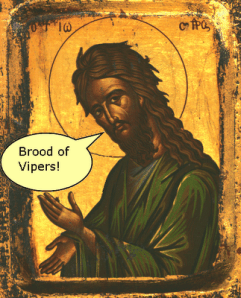
Two of my favorite “churchy” holidays fall in the same week of the church year. They are Epiphany, when the wise men finally make it to the Holy Family, and Baptism of the Lord Sunday, when Jesus is baptized by John in the Jordan River. They take place about 30 years apart in Jesus’ life, but a few days apart in the church calendar. Time is like that sometimes.
Both of these celebrations of the church are worth noting and remembering.
Epiphany means “to reveal”.
In the context of the magi, those foreign astronomers who followed the star to Jesus, it is the revealing of the Messiah to people outside the family, so to speak. The magi are the first non-jewish people to get their own revelation about Jesus.
In the context of Jesus’ baptism, the epiphany is God’s own voice speaking from the heavens.
But first we have John the Baptist, who as a child in his mother’s womb, leapt when pregnant Mary visited. He’s been waiting 30 years for the epiphany of the Messiah.
He calls ALL to repentance, and speaks of the winnowing fork and separating the wheat from the chaff.
John’s message reveals an uncomfortable and inconvenient Good News to a brood of vipers such as us.
REPENT.
TURN BACK TOWARD GOD.
This Good News may not feel like Good News to the people hearing it.
Don’t think that the fact you were born into the right family, or the right congregation is going to matter.
John, by calling them a brood of vipers, as opposed to a passel of vipers, or a crowd, or a bunch, or a gaggle, is claiming that they are the children, the offspring, of these vipers. They come from a family of vipers. And surely the snakes from whom they are descended didn’t lead them to repentance. John has not much nice to say about the religious leaders of his community.
So John asks them—who warned you to flee from the wrath to come? Who, he wants to know, called them to this repentance.
I imagine the crowd on the riverbanks started to reconsider following this guy. “Umm…you did, John. You’re the one who called us here. Remember? Voice crying out in the wilderness and all that?”
But what were they expecting when they came to the riverbanks? One event that would magically change their lives so that nothing bad would ever happen to them? An easy, “presto!” moment of salvation that doesn’t require any change in your life?
John’s preaching calls them to something much deeper. Sure, he can baptize large crowds, but if they are just going to go home and live as if everything is the same, except now they have magic salvation power, then it is just a waste of everyone’s time.
To the crowd’s credit, they seem to get it. This epiphany works. If John preached that message to us, here in this sanctuary, would we accept it the way the crowd by the riverbank seemed to?
At the end of this long lecture about vipers, axes leaning against trees, and everlasting fire, instead of fleeing back to the comfort of their homes, they ask him “what, then, should we do?”
His answers are pretty specific. If you have 2 coats, you should share with someone who doesn’t have one. If you have plenty of food, you should share with those who are hungry. He might speak metaphorically with the axe lying at the root of the tree, but here the directions are clear and to the point.
His answers are specific to different people as well. If you are a tax collector, those people who make their living by collecting money from their own people to give to the occupying Roman leaders, you are told to only collect what has been assigned—no skimming off the top at the expense of your people.
If you are a soldier, you should be a soldier with integrity.
Interestingly, his instructions are fairly modest. He doesn’t tell the crowds they can’t have nice things. He just says they have to share what they have. He doesn’t tell the tax collectors to stop being agents of the Romans. He doesn’t tell the soldiers to become pacifists.
Following God’s call, for John, means to be who you are, with integrity. Not everyone needs to quit their jobs and become Pharisees, preachers, or prophets.
Just be who you are. With integrity.
So, heeding John’s call to repentance means that your life should be “of a piece”. In other words, you shouldn’t come to church on Sunday to be a Christian, and then rob, cheat, or steal during the rest of the week.
I was writing this sermon as the election was certified this past week. I remember what happened 4 years ago, when people now being called ‘patriots’ stormed the Capitol and attempted to stop the certification of the election, while also seeking to murder Vice President Pence.
It is easy to critique the people involved with that attempted insurrection as we hear John the Baptist calling people to live with integrity. And it is worth keeping a clear memory of what happened, and not let lies become truths.
But what is more difficult is charting our own course to live with integrity. It can be easy for me to focus on those people egregiously living without integrity and then I forget to focus on my own behavior.
When it comes down to it, the only person I can change is myself. Alas. Am I repenting and returning to God in the best way I can? Are you repenting and returning to God in the best way you can? John doesn’t call us to point out who needs repentance more than we do. He calls us to our own repentance.
John wanted those who were coming to be baptized to understand the life altering implications of their actions. Living as people of repentance means we share what we have, look out for others, live with integrity, and by so doing, prepare a way in the wilderness, making a straight highway for our God.
The question of what then should we do leads to a big epiphany, because it calls for change.
And it opens you up for trouble too.
Inserted rather clunkily into this text is an accounting of John being arrested by Herod. The way Luke puts it in the story, you wonder who baptizes Jesus if John’s already been arrested and sent to prison. All four gospels tell of Jesus baptism, and I have great confidence it was, indeed John who baptized him.
In order for John’s life to be “of a piece”, however, he had to say inconvenient things to dangerous people. Herod had many evil behaviors with which John disagreed, and when Herod married his brother’s wife, (and according to another gospel), said he would have dated his own daughter if she weren’t his daughter, John publicly spoke against the immorality.
One gets the sense that had Herod come with the crowds to be baptized, after John had given career advice to the tax collectors and soldiers, had Herod asked, “what then should I do?”, John might have said, “and if you’re Tetrarch, then rule the people with fairness and justice and stop asking your daughter to dance for you. That’s disgusting.”
Speaking truth to power will get John killed. The Good News of the Gospel is not uniformly received as being good news. If you’re unwilling to be changed by it, it is threatening news.
In Luke’s gospel, Jesus’ baptism is stuck at the end of this story about John, and John’s arrest. Yet Jesus’ baptism is connected to everyone else’s baptisms too. In Luke’s telling of the story, you wonder if Jesus was with the crowd at the beginning and if he, too, asked “what then, shall we do?” as they did.
This is another one of those moments in scripture where we realize our faith is personal, but it is not private. Jesus doesn’t get his own, private baptism that is unrelated to his community. He’s baptized as the crowd is baptized.
His baptism takes a turn that perhaps didn’t happen when you or I were baptized. The heavens are opened. In Greek, they are “torn apart”, as if ripped and therefore not fully able to be closed again.
And if the tearing apart of the boundary between heaven and earth wasn’t exciting enough, the Holy Spirit descends like a dove, or a dive bombing pigeon. And a voice from heaven:
“You are my Son, the Beloved. With you, I am well pleased”.
Again, it’s a personal voice, but it isn’t a private one, whispered in only Jesus’ ear. It is not a note that God passed to the back of the class, only for Jesus to read. It’s a public epiphany.
There’s still a lot about Jesus that will be a mystery to people, his close friends and family included. People will still be asking lots of questions and misunderstanding Jesus’ motives and strategy.
But in Jesus’ baptism, God’s love and God’s pleasure are clear. In us, God’s love and pleasure are clear. God’s voice fell on ALL who were baptized.
It’s perhaps easier for us to believe God would find Jesus beloved and find pleasure in Jesus. Because Jesus walks on water, heals people, and all that.
The first part of this passage, when Luke has John call everyone baby vipers and warn them about the wrath to come—that’s the obvious news to us. We know we’re disasters most days. We get that we need to do better, even if we’re still asking questions about how to do that.
The epiphany of Jesus’ baptism, is that we, too, are God’s beloved children. We are as God made us—imperfect, flawed, joyful, clever, stubborn, generous, kind, and selfish. With us, God is well pleased.
There’s a circular nature to this story. We work on repentance and getting things right so that we’ll be in the right place when God’s voice rips the heavens apart and announces the good news. AND because we’ve heard God’s voice declaring us beloved, we ask what we should then do, and go about the work of repentance.
It’s not cause and effect. We don’t do good work so God will love us. We do good work because we are God’s beloved children and God is primarily about love, with a side dish of being well pleased.
Imagine the world we could create if we started living as if we were God’s beloved children in whom God is well pleased. Imagine a world where we started treating God’s other beloved children as if they, too, were God’s beloved children, in whom God is also well pleased. Imagine what can yet be revealed to a world in desperate need of God’s love.
So, Calvary, what then should we do?
We already have some answers to that. We walk with refugees as they navigate new life in a different country. We feed people. We support mission partners. We advocate for policy that respects the dignity of all of our neighbors. We gather in community to worship and grow together in faith.
So, Calvary, what then should we do? It’s a real question that I hope we’ll answer together. How do we respond to the grace of the God who loves and calls us, both as individuals and as a congregation?
Let us live into our identity as God’s beloved children.

 Glass Overflowing