A sermon preached at Calvary Presbyterian Church in San Francisco, CA
November 3, 2024
Introduction to Worship:
How is it with your soul? As you may have heard, there’s an election this week. No big deal, right?
I have a low pitched hum in my head that pops up when I’m stressed, as if my anxiety has to be voiced every minute of the day, even if I’m the only one who can hear it.
We’ll have the chapel open on election day, if you would like to come in for a time of quiet prayer and reflection, or for a sound bath in the morning with Alison, or music with John and Michael in the afternoon.
It is good that we can gather together this beautiful morning, hopefully with an extra hour of sleep. I hope you’re tending to your soul, in prayer and meditation, in time with friends, by dancing or whatever it is that feeds your soul.
Adam Lindsay Gordon, in his poem, “Ye Wearie Wayfarer”, says:
Life is mostly froth and bubble,
Two things stand like stone,
Kindness in another’s trouble,
Courage in your own.
In a world where we cannot control everything we’d like to control, we can tend to that. Kindness in another’s trouble and courage in our own.
As we enter worship this morning, let us begin with this prayer from Kate Bowler:
Dear God,
Bless me with radical love, inventor of love. And may that love overflow onto, into, and through me. Flood me with Your kindness, generosity, and compassion, so that I may be Your hands and feet in the world.
Help me to remember that love isn’t always in grand gestures and extravagant gifts, but in the small, faithful acts. Help me to remember it is in the showing up, in the work behind the scenes, in doing that which won’t get us recognition. The one who is the first in and the last out. The generosity of time, resources, spirit. The one who leaves flowers in her wake. This is the long faithfulness that can change the world.
God, bless me in this Little Way, to be able to do small things with great love. One small action at a time, until it’s a bridge – with a span that reaches from my little life to Yours with each act of love. And when I screw up or forget or grow weary, bless me with the courage to begin again. Loving and loving again. Being changed by Your love and transforming the world one little act of love at a time. May it be so.
A Prayer for the Courage to Love Small from Kate Bowler’s “Good Enough”
Scripture:
1 Kings 17:1-24
Sermon:
Today, the Narrative Lectionary drops us in the story of Elijah. Elijah is a pivotal figure in the history of Israel and is in the minds of many of our New Testament authors. It is to Elijah that John the Baptist and Jesus are often connected, so knowing the story of Elijah will help you understand how 1st Century Jews understood the person of Jesus of Nazareth. Additionally, the story of Elijah is just great storytelling.
As Elijah’s story begins, Ahab is king of Israel. The united kingdom that David’s son Solomon had inherited has divided into the Northern Kingdom of Israel and the Southern Kingdom of Judah.

And Ahab, in the Northern Kingdom, is more evil than any king before him, which is saying something because many of the kings before him were about as evil as you could imagine. In addition to being a bad and evil king, Ahab also married Jezebel, who was Phoenician, from the city of Sidon, and had the misfortune of being named Jezebel by her parents. And while the biblical writers want the Hebrew people to be faithful to their gods, when Jezebel remains faithful to her gods, they call her a Jezebel.
The biblical writers seem to want to blame all of Ahab’s problems on Jezebel, but let’s remember what power women did not have in those days, or today, for that matter. There’s a ‘christian’ pastor this week who said that a husband should get two votes and his wife none because if the wife voted against the husband, that would be like committing adultery. There are still men today calling women Jezebel.
Remember that before we judge Jezebel too much for the sins of her husband. I digress.
Jezebel and Ahab for the Kings chronicler, are the poster children of evil, idol worshipping, unfaithful, bad, bad leaders. And Jezebel gives a face to the Biblical campaign against intermarriage. “See—we told you what would happen when you married foreign women!” Never mind that David, Solomon, and almost every other patriarch in scripture had foreign wives.
And so Elijah appears on the scene to tell Ahab, “as the Lord, the God of Israel lives, there shall be neither dew nor rain these years, except by my word”. The punishment for Ahab’s evil is a drought.
And while the drought may come because of the Word of God, note that sustenance in the midst of drought come from God as well. God instructs Elijah to a wadi, or a riverbed or canyon, where there is water. And the ravens feed him in the morning and the evening.
Before we move on to the rest of this story, remember that the life of faith is not a promise that you won’t go through a drought. The life of faith says that when you are in a proverbial drought, God will provide. It may just be water in a nearly dry riverbed and food provided by birds, but God does not leave us alone. More than that, God brings us together, across our divisions.
Eventually even the riverbed runs dry and the Word of the Lord sends Elijah to someone for help. He goes to Zarephath, a Phoenician town near Sidon, which today would be in Lebanon, a country being bombed into drought by Israel at the moment.
The Word of the Lord sends Elijah to one of these foreign women the rest of the Bible keeps warning us about. And a widow, at that. Women left their own families when they were married and became a part of their husband’s family. But her husband is dead. And a woman without a man to look out for her is vulnerable in that culture.
Our widow, as Elijah is walking up her sidewalk, is preparing to make her own last supper. She’s out of food and resources. Her cupboards are literally, and not figuratively, bare. She and her son are about to die from lack of food.
And Elijah rings the doorbell, and asks her to bring him some water and some bread.
I’m not sure how I would feel if I were about to die and some other God’s prophet came and asked for my last little bit of food. I suspect my answer would not have been nearly as nice as hers.
Elijah gives her an answer that we normally hear from angels when they encounter humans—“Do not be afraid.” What follows the Word of the Lord’s instructions to share her food is a blessing.
Do not be afraid. You may think you are about to die, but you’re not.
Do not be afraid. You may not think you have enough to share, but you do.
Do not be afraid. God doesn’t ask you to give your last food unless God is about to do something big.
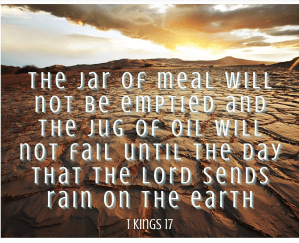
Elijah goes on to tell the woman that her jar of meal will not run empty and her jug of oil will not fail. Until the rains fall again, she will have enough to eat.
As I mentioned earlier, I’m a big fan of Elijah. But this widow from Zarephath might be my new hero. Perhaps her husband’s family would have taken care of her in normal times, but they are in a drought, the worst economic situation since the Great Depression. She’s on her own. Food stamps have been cut off and Ahab and Jezebel care more about tax cuts for billionaires than they do funding social safety net programs.
And she’s not even an Israelite. Did you notice what she said to Elijah? “As the Lord, YOUR God, lives, I have nothing baked…” This isn’t even her God she’s helping out.
And then, in a great act of faith, she takes the last of her meal, scraping out the bottom of the jar with her spatula to get every last bit, and she takes the last of her oil, shaking the jug upside down over the pot until all of the oil has drip, drip dripped its way out of the jug, and she puts it in the oven. She didn’t have enough to sustain herself and her son, yet she trusts the word of Elijah’s God and offers that small loaf to sustain her, her son, and Elijah.
She does not say, as soon as God fills up my pantry, I’d be happy to make you some bread.
She does not say, I’d love to help you, but times are tight. Surely you understand why I can’t increase my pledge this year.
She does not say, I’d love to help you, but I don’t know you and I’m not sure what you did to end up hungry but it is probably your own fault. Pull yourself up by your own bootstraps, buddy.
She doesn’t ask Elijah to explain how he got himself in this situation. He’s hungry. She feeds him. Possibly at risk to herself and her child. She doesn’t wait for proof from God either. She hears the Word of someone else’s God and she responds in faith.
At the very least, this text ought to remind us to be in conversation and relationship with people who worship God differently than we do. We have to remember to trust that the word of the Lord may come to us from people who are different than us.
As you may have seen on the news, we have an election this week.
And many of us are afraid and anxious, both about the outcome of the election and the potential aftermath from the results.
The Word of the Lord comes to us and says,
Do not be afraid. You may think you are out of resources, but you’re not.
Do not be afraid. You may not think you have enough to share and that you need to be afraid of your neighbors, but you have enough and there is no need to fear each other. You need each other.
Do not be afraid. God doesn’t abandon us, even when we’re in a drought or an existential crossroad in our political realm.
Do not be afraid. God calls us to participate in caring for people and will provide for us in that work.
Our task is similar to what the widow of Zarephath experienced. We listen for the Word of God to come to us, even if we’re in the midst of a drought. Then we trust the Word of God and go out on faith to do something to care for others, even while the world seems to be about to catch fire.
We work toward God’s mission in the world, we contribute and trust that God will make it work, like the widow’s jar of flour and bottle of oil.
Our stewardship campaign doesn’t start until next month, but this is a stewardship text.
We have to bake our loaves even before God has filled the jars with meal and the jugs with oil.
By committing to pledge to Calvary, each year you are like the widow from Zaraphath, answering God’s call to be a witness of faith in this community.
If every person at Calvary pledged what they could pledge, do you know what we could do in this community? Our jars of flour and oil would never run out.
As we read the text, we realize that the feeding isn’t the real miracle. At least it isn’t the only one. What the work of nourishment does is set in place the chance for new life.
The widow’s son falls ill and dies. Elijah cries out to God, seeking a miracle. And the Lord listens to Elijah and life returns to the widow’s son.
All of our work in stewardship, planning, and administering the work of the church is not just so we can say we have planned, budgeted and worked. It is so we can be a place of miracles. Who knows what God may do yet in this place!
When the widow invited Elijah into her home, her son wasn’t ill. She didn’t let him in so he could heal her son. This miracle was something she couldn’t even imagine she would need. Her faithfulness put in place the conditions that preserved life—for her, for her son, for Elijah.
This week, thinking about the widow, I’ve been thinking about the people in need of miracles, in need of the abundance of ‘enough’, in our community.
I mentioned this text brings stewardship to mind for me. But at its root, it’s about hospitality, an unreasonable hospitality.
She invites a hungry stranger into her home and offers to feed him, even though the cupboard is bare. It is extreme hospitality to do that. It is unreasonable to do that. We understand why she might have, reasonably, said no.
I want to be a hospitable person. I do. I want to welcome strangers and be generous with my resources. And, some days I’m tired and I don’t want to answer the door.
My mother in law is a very generous woman. And she is a fierce supporter of the mission co-workers in our denomination. And so whenever they are home in the US, she invites them to come stay with her and hosts them in her home. And she’ll often call me and say “I’m hosting a mission co-worker and they are looking for other hosts. Can you host them as they travel and share what they are doing?”
And I usually want to say “no” or “maybe, if the trip aligns with when my housekeeper will recently have been there because I’m too tired to clean the house right now”. But I try to always say “yes”. And I have never once regretted my yes. Because of my mother in law, I have had the privilege of hosting some amazing people in our home.
And each time I do it, I remember that nobody cares if my house is perfectly tidy because that’s not what we’re about and why do I let that get in the way of welcoming people in? What if the widow of Zarephath hadn’t let Elijah in because her cleaning lady wasn’t coming until next week?
When I have provided hospitality, I have always been the beneficiary. Hospitality feels good when you are the giver of it.
Victor and Lou have talked about this. They welcomed a refugee into their family, and gave Peter a home when he had to leave his country for his own safety. But when Victor and Lou talk about it, they don’t mention losing their guest room. They don’t talk about being inconvenienced. They mention how much richer their lives are because Peter is in it.
God wants us to be unreasonable in our hospitality. God wants us to care for our neighbors, even if they are foreign prophets who worship a different god. God wants us to share what we have so that everyone can be fed. How is God calling you to be unreasonably hospitable to someone this week?
The story tells us that God brought the drought on the whole land—innocent and guilty alike—because of the evil of the king.
I don’t believe God really functions like that—to punish everyone because the king is bad. It’s how the writers of the Kings chronicles saw it. And they were writing a chronicle of the kings of Israel and Judah, so it makes sense that they are focused on the behavior of people like Ahab, less concerned with the lives of people like you and I. We can understand that when the chronicler experienced drought, or political instability brought about by weak men who stoke fear, they saw God’s action when things went wrong.
But the God who created us in love doesn’t punish us in fury. And no political party controls the weather. Sometimes drought happens. Sometimes hurricanes, fires, tornadoes, floods happen.
The God who created us in love is the God who sends Elijah to the widow of Zarephath. God is ever and always working, even in the midst of global weather phenomena, to bring us together across the lines that divide us, for each other’s health, flourishing, and welfare.
It’s been a month since Hurricane Helene destroyed western North Carolina and other parts of the Southeast. I have a lot of friends there. And while they are exhausted and sad and shattered, they also have told stories of strangers knocking on their doors asking how they can help, offering to chainsaw downed trees, or use their trucks to haul off debris.
You could look at the stories of the hurricanes and say God is punishing a bad king. Or you can look deeper in the stories and see where God is bringing people together to care for each other.
Droughts happen. Fire, hurricane, and flood happen. Sometimes the king on the throne is like Ahab. Where is the word of the Lord in the midst of all the instability of the world? I would argue the word of the Lord speaks whenever we are unreasonable in our hospitality toward people who are different than we are, whenever we see the stranger as someone who matters to us.
In the midst of all of those things, God is working to bring us together. Are we paying attention?
Let’s imagine that God is showing up on our doorstep, asking for us to trust that our resources will be an abundance of enough. Enough for us. Enough to help others. Enough to nurture miracles. Let us listen for the word of the Lord in the midst of our lives, so we may respond in faith. And may we be on the lookout for miracles that will result. Amen.
Affirmation of Faith
Our affirmation of faith today comes from the Theological Declaration of Barmen. In May of 1934, 139 delegates representing 18 Lutheran, Reformed, and United churches from throughout Germany met to reiterate their common faith in the gospel of Jesus Christ. In so doing, they were contesting the imposition of Adolf Hitler’s National Socialist agenda on the churches in Germany. To oppose the Nazis in 1934 was considered by many to be, at the least, unpatriotic, and at worst, an act of treason.
Once Hitler’s grip on power was assured, the Nazis began intervening coercively in church affairs. They required proof of Aryan birth to be a member of a church, for example. Many church leaders who spoke against the Nazis intervention in the church were put in concentration camps for their stance.
The Barmen declaration claims that Jesus, alone, is the Lord of the church. That scripture, alone, is what bears testimony to who Jesus is. And that faith, alone, is God’s gift that helps one live a life of gospel obedience.
Let us rise in body or spirit and say a portion of what we believe:
Jesus Christ, as he is attested for us in Holy Scripture, is the one Word of God which we have to hear and which we have to trust and obey in life and in death.
We reject the false doctrine, as though the church could and would have to acknowledge as a source of its proclamation, apart from and besides this one Word of God, still other events and powers, figures and truths, as God’s revelation.
We reject the false doctrine, as though there were areas of our life in which we would not belong to Jesus Christ, but to other lords—areas in which we would not need justification and sanctification through him.
We reject the false doctrine, as though the church were permitted to abandon the form of its message and order to its own pleasure or to changes in prevailing ideological and political convictions.

 Glass Overflowing
HOLY WOW!!
LikeLiked by 2 people
I would second that. This is an excellent sermon for a time such as this.
LikeLiked by 1 person
Thank you!
LikeLike