A Christmas Eve sermon at Calvary Presbyterian Church in San Francisco, CA
December 24, 2025
Luke 2:1-20
Isaiah 9:2-7
Introduction to Worship and Opening Sentences
Good evening and welcome to worship here at Calvary Presbyterian. I am Marci Glass, pastor and head of staff, joined with my colleagues to welcome you here this night. And all of who you are is welcome in this space.
Whatever your ethnicity, nationality, immigration status, sexual orientation, gender identity, or expression, age, marital status, physical or mental ability, socio-economic status, belief, or doubt, there is room for you here. We believe God has brought us all into community, with all of our particularities. We’re all better off because you’re here with us.
Hear these opening sentences from Isaiah chapter 9:2-7
The people who walked in darkness have seen a great light; those who lived in a land of deep darkness-on them light has shined. You have multiplied the nation; you have increased its joy; they rejoice before you as with joy at the harvest, as people exult when dividing plunder.
For the yoke of their burden and the bar across their shoulders, the rod of their oppressor, you have broken as on the day of Midian. For all the boots of the tramping warriors and all the garments rolled in blood shall be burned as fuel for the fire.
For a child has been born for us, a son given to us; authority rests upon his shoulders, and he is named Wonderful Counselor, Mighty God, Everlasting Father, Prince of Peace. Great will be his authority, and there shall be endless peace for the throne of David and his kingdom. He will establish and uphold it with justice and with righteousness from this time onward and forevermore. The zeal of the LORD of hosts will do this.
One of my favorite images to use in worship is light. You may have heard me say “The light shines in the darkness, and the darkness has not overcome it,” quoting the opening verses of John’s gospel. We’ll hear it later in the service when we light our candles.
Darkness is most often a bad scriptural image. Later in John’s gospel, and frequently, he contrasts light and dark. You are either children of the light or children of the dark for John.
As we think about darkness and light this night, I invite us to remember the ways those words and images have also been used to harm. When scripture mentions dark and light, it is not referring to skin color. In our culture, it often is coded in our racist past. We should be cautious when we notice how our culture puts the good guy on a white horse and calls the bad guy the black sheep.
The light God shines into the world illumines the good and the bad in equal measure, so it is worth acknowledging our tendency to focus the light only on the places that reflect us in the most flattering way. God’s light shines on human goodness. God’s light also shines on those things we’d prefer to keep hidden and redacted. We are confident that here, in this place, we can bring all of who we are to worship and know that we are loved. God loves us as we are. God also loves us as we can yet be, and so we do not need to fear God’s light shining on all of who we are.
May we reflect the light of God’s goodness for ourselves and for our community. Let us worship in joy this night.
Sermon:
I read a passage from the Prophet Isaiah as worship began. The people who walked in darkness have seen a great light.
What comes to mind for you when you think of biblical prophets? I think of grouchy men standing on the street corners yelling at people—often thorns in the side of political and religious leaders. Isaiah was different. He was an inside the palace kind of prophet, a good Presbyterian, in the middle of the 8th century BCE, speaking to his own people about where God was in the midst of their lives. And they were facing some tough situations and needed comfort. It’s not a surprise we might prefer the words of Isaiah to the words of Amos, or John the Baptist calling us to repent because we’re a brood of vipers. Most days, I want Isaiah’s “Comfort, comfort my people” more than I want Amos to remind me that I’ve sold the poor for a pair of sandals.
We hear “for unto us a child is born” from today’s reading and we think of Jesus, or maybe we hear Handel’s Messiah.
And it is fine for us as followers of Jesus to hear Isaiah’s prophecy this way. Isaiah didn’t know about Jesus when he wrote this. He did not know Jesus would be born 700 years or so later. Isaiah might even be surprised, if flattered, to find we’re talking about him in San Francisco in 2025.
It’s interesting the way we interact with Biblical texts, isn’t it? Isaiah wrote 2700 years ago, and yet I still find his words resonate with my life. His words also blur the line between past and future. He writes:
For a child has been born for us, a son given to us.
Whether the “son” Isaiah references was one of the contemporary Kings of Israel or Judah—Hezekiah, or maybe Josiah—or whether it is Jesus, as we understand it, the fact remains that Isaiah speaks of it in the past tense. The Hebrew language doesn’t have tenses quite the same way English does, but it he does not say “a son will show up 700 years in the future.”
The son has been given already.
There is also a future directed sense of some of the passage. “He will establish and uphold (the kingdom) with justice and righteousness from this time on, forevermore.”
Time in this passage moves in weird ways. And it’s got me thinking about the way we interact with time. We experience time in a linear way—past, present, future. I’m not suggesting we can somehow overturn that, but I do think we interact with the past and the future in ways we might not usually be aware.
As some of you know, I’ve met my birth family over the past decade. On my birthday in 2017, I ended up on the phone with my birth mother. She did not call to share birthday greetings. I called her because a cousin let me know my birth mother was in the hospital. It was a perfectly nice conversation, and I am forever grateful I was able to talk with her.
I got off the phone and felt weird. It was the first time in 49 years that my birth mother and I had ever spoken on my birthday. I’m not telling you this because I wish things had been different. I’m well celebrated by my family and friends on my birthday. I remain abundantly thankful to have been adopted.
What the conversation triggered for me, though, is a realization about why my birthday had been a conflicted day for me. I would often feel depressed on my birthday, which never made conscious sense to me. Why would one be depressed on the day everyone celebrates you? Talking to my birth mother on my birthday made me realize why. My birthday is an anniversary of trauma, a day when mother and child were separated from each other without ever seeing each other or saying a word to the other.
On that birthday, even though we didn’t talk about my birthday, and honestly, I’m not sure she even knew it was my birthday, but we spoke to each other. I heard her voice. And that short conversation started to heal my past. The infant me finally got something she needed—her birth mother’s voice on my birthday.
Sorry to get all weird and time travely on you here, but when else have you seen something in the present start to heal a wound of the past?
Maybe it is a serious thing like reconnecting with a family member. Maybe it is a less consequential healing. I am a rabid superfan of the Golden State Valkyries, our new WNBA team. I’ve always enjoyed watching basketball games (just don’t make me play. I can’t dribble a ball to save my life) but I was a little surprised how emotional it was for me to see women athletes succeeding on such a big stage, every single game sold out, enthusiastic crowds bringing energy I’d not seen before at Chase Center.
Women have been playing basketball as long as basketball has been a sport, but we were confined to playing on only half a court for a long time because of our ‘delicate constitutions’. Basketball was actually the first team sport women played, starting in 1892 at Smith College, with modified rules to protect Victorian understandings of the refinement and gentility of women.
Women had previously been able to play tennis, wearing corsets and long skirts, but that attire proved unwieldy on a basketball court, so the first trousers for women were worn. Initially loose and covered by a knee-length skirt, these early pants were replaced soon after by loose bloomers over stockings. Men were forbidden from watching these collegiate games, with the women in such scandalous attire. 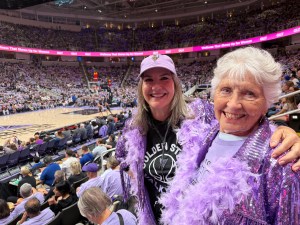
I took my aunt Jane to our Valkyries playoff game in San Jose. (Here’s a news clip of us from that visit) She’d played half court basketball in high school. Said she never could have imagined professional women’s basketball like this when she was growing up.
So when I think about the Valkyries, and all the young boys and girls I saw wearing jerseys of their favorite WNBA players, when I think of Aunt Jane and all the other women who fought against societal norms, it heals the little girl I was because I have hope for the girls of today that I needed for myself.
Healing in the present can help heal the past.
Isaiah reminds us that God’s light transcends even our understanding of time.
The people who walked in darkness
have seen a great light;
those who lived in a land of deep darkness—
on them light has shined.
And I want to see the light. I’m tired of walking in darkness. And at this particular time of the year—maybe it’s because the days are shorter, perhaps it stressful expectations of what the perfect holidays should be, and anxiety about how we won’t measure up, maybe it’s the constant barrage of cruelty on the news—the darkness seems oppressive.
Because of our dependence on seeing time flow from past to present to future, we get perhaps more depressed because we don’t seem to be improving. We’ve bought into the story that the future is supposed to be better than the past, that we’re supposed to learn from our mistakes. We look around and we don’t see much of that lately. From Isaiah we hear:
His authority shall grow continually,
and there shall be endless peace
for the throne of David and his kingdom.
He will establish and uphold it
with justice and with righteousness
from this time onwards and for evermore.
The zeal of the Lord of hosts will do this.
And we look around and we don’t see endless peace. We don’t see justice and righteousness from this time onwards and for evermore. Honestly, we see a lot of people on the national stage who have not healed their past trauma and are inflicting it on us right now. That is no excuse for fascism and cruelty, but when I can remember there are people whose wounds must be so deep and terrifying that they try to fill the void by demonizing others, acquiring unchecked wealth and power, putting their name on buildings and battleships, then I can have compassion for their woundedness and begin to pray for their healing.
Because our healing is all connected.
Isaiah says:
The people who walked in darkness have seen a great light.
He doesn’t say people were walking in darkness and one person saw a light, but kept it for himself.
Our salvation is personal, but it is never private. We are a people. God wants healing for the whole world. God’s light shines for all, not just for a few.
I want to see the light, feel it shining down on us. I’m tired of walking in darkness.
When the light is hard to find, or to cleanse my eyeballs and my soul after reading the news, I watch clips from Steve Hartman’s On the Road, a recurring segment on CBS News (and the one nice thing I can say about CBS this week). He travels the country and visits with people who have done interesting things. Some are whimsical, like an 11 year old girl who fell in love with the voice of Michael McDonald, lead singer of the Doobie Brothers and the joy on her face when she got to meet him over zoom.
One clip had a little girl who would go with her mother to the nursing home where the mother was a nurse, and the girl would go room to room and visit with people. And would ask each person “if you could have any three things, what would you want?” She kept a list.
The people didn’t want Maseratis, money, and dinner with George Clooney. They wanted things like new shoes, electric razors, Vienna sausages, avocados, and cheese.
So she started a non-profit to be able to fill some of those wishes. And I dare you not to cry if you watch that video where the residents give her hugs and are so joyful to be seen, and to receive Vienna sausages, of all things.
I want more of that light in the world, please.
What I notice in all those stories that give me hope is that they are never private, isolated stories. Hartman never says, “Jimmy was depressed and in need of help. So Jimmy helped only himself and is now happy all by himself.”
The stories are always about connection with other people, often unlikely people. One story was 3 young men who saw an old woman eating dinner by herself in a restaurant and asked if they could eat with her. They had such a good conversation that they started meeting at the restaurant each week. The light shines and radiates out through our connections with each other.
The Christmas story is about connection in a disconnected world.
Joseph and Mary have to travel to Bethlehem because they are living under Roman occupation and need to go be registered for the census. They get there and everyone’s guest room is full. There are no rooms at the Holiday Inn. But someone makes space for them, so they can welcome their child to the world. Shepherds come to welcome the baby. Later, wisemen will bring gifts and warn the family to flee an angry insecure king. Joann will preach that story on Sunday.
God became one of us, a helpless infant, subject to the violence in the world. God became one of us, a helpless infant, subject to the hospitality and kindness of the world. God became one of us and grew up in community. Jesus was never a solo act. He gathered disciples. He declared everyone was family. He turned over tables when his community was being harmed.
If God chose to shine light by being born into a vulnerable community in the midst of political unrest, maybe we need to reconsider our call. How are we reflecting God’s light into a world in the midst of unrest?
The author Toni Morrison said, “If you are free, you need to free somebody else. If you have some power, then your job is to empower somebody else”.
Perhaps it is when we are in the midst of darkness that we appreciate our call to reflect God’s light the most.
For Isaiah, God has shined a light on us so that we can, in turn, bear that holy light into the world.
Remember the simple power of shining and reflecting light for people who walk in darkness.
In a few minutes, the sanctuary will darken, and we will light the Christ candle, one small light in the darkness. But then from that light, we will each light our candles as we sing Silent Night. I pray this year we will all carry the image of the light we will shine in this service, that we may remember the difference we can make when we shine together.
The people who walked in darkness
have seen a great light;
those who lived in a land of deep darkness—
on them light has shined.
Go, bear the light into the darkness. Amen.
Candle Lighting
Carrying a candle
from one little place of shelter
to another
is an act of love.
To move through the huge
and hungry darkness, step by step,
against the invisible wind
that blows for ever around the world,
carrying a candle,
is an act of foolhardy hope.
Surely it will be blown out:
the wind is contemptuous,
the darkness cannot comprehend it.
How much light can this tiny flame shed
on all the great issues of the day?
It is as helpless as a newborn child.
Look how the human hand,
that cradles it, has become translucent:
fragile and beautiful; foolish and loving.
Step by step.
The wind is stronger than this hand,
and the darkness infinite
around this tiny here-and-now flame
that wavers, but keeps burning:
carried with such care
through an uncaring world
from one little place of shelter to another.
An act of love.
The light shines in the darkness
and the darkness can never put it out.
Jan Sutch Pickard,
Candles and Conifers
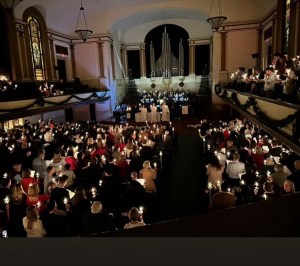
Thank you, Bethany Burrill, for the photo

 Glass Overflowing
Thanks for prompting me to struggle some this morning. I’m wondering to what extent salvation is corporate.
LikeLike
It makes me think of Paul talking about the cosmic nature of what Jesus did. And I think the cost to society of us making salvation so personal and private is that it means we no longer feel a need to worry about how our neighbors are doing. If we’ve ‘punched our ticket’ to heaven, why would we care if the people down the street have enough food or are attacked by ICE? (That’s a little too simplistic, but I think there’s something there)
LikeLike
In the darkness that surrounds us, it is incredibly uplifting and reassuring to find Hope – for indeed a child was born, IS born unto us that is Light, and whose Light is eternal and miraculous. We need His light every nano second of our lives – and when we have it in our hearts, we must try to go forth to share it with those whose darkness is still intact. This sermon is one of the most powerful and poignant I’ve ever come across. It is also timely, a life-saving balsam in a period of chaos. Thank you.
Shirley Meyer-Solorzano
Shirley.marin@gmail.com
LikeLike