A sermon preached at Calvary Presbyterian Church in San Francisco, CA
July 13, 2025
Scripture:
Rev 2:1-7, 3:1-22
Introduction to Worship:
Good morning and welcome to worship at Calvary Presbyterian Church. I am Marci Glass, Pastor and head of staff. Whether you’re here for the first time or whether you are here every week, I deeply believe that it is God who has invited you here today, and it is my privilege to welcome you as a guest in this place. In the music, in the liturgy, in the prayers, in the silence, I pray you will find what your soul needs this morning.
What was the last letter you wrote? Not an email or a birthday card. But an actual letter on paper? I try to write letters every so often, partly to keep the postal service in business, but mainly because I think it is such a gift to get a handwritten note.
Today in worship, we’ll be hearing God dictate some letters to the angels of the churches. And, so as we enter worship, I invite you to consider writing a letter to someone. Who will you write it to?
I even have put out postcards on tables in the narthex and in coffee hour so if you are thinking, “Marci, I couldn’t send a card because I don’t have any stationery”—I fixed it for you!
Often I think we don’t write letters now because we think that by the time it reaches someone, the news will be old. We’ll have texted or emailed the recipient many times before the letter will be delivered. Or maybe we worry that we won’t say it ‘right’, whatever it is we think we need to write.
I encourage you to let those worries go and write a letter to someone this week. As we continue in worship, we’ll hear these letters to the different churches and so I also invite you to think about what God would say in a letter to you.
Let us pray, which is, of course, our own kind of letter to God.
Opening Prayer
You speak continually, Lord God,
calling us to your way,
reminding us of Love,
encouraging our wavering will.
When your word is a challenge to us,
give us open hearts to receive it and to turn back to you.
When your word is a balm for our struggles,
give us open hearts then too,
that we may trust your grace is as much for us as for others.
Make us ready to hear you today,
and to respond.
Amen.
Sermon:
My husband and I are getting ready to sell our Boise home later this year, so we’ve been going through closets and getting rid of things. But one thing I cannot get rid of are my letters. I have collections of the letters my friends sent to me in college, or that my husband sent me when we were dating long distance before we were married. I have a few letters from my parents, that they sent me at camp or in college, and even a few from my grandmother, who died in 1981.
They reflect one side of a conversation, because in most cases I don’t have the letters I sent, only the letters I received.
But I can’t quite quit those old letters. I appreciate the glimpse they give me into my past, reminding me of the things that seemed important enough to me at the time to write in a letter.
I mourn the loss of letter writing.
For me to write a letter today, I would feel a need to say something important. And I promise you that from reading the old letters, we didn’t care about saying something important at all. It was the way we stayed in touch with people we loved when long distance calls were too expensive.
Would God write letters to the angels of the churches today? Or send an email?
Don’t get me wrong. I appreciate email. It is nice to be able to reach out to someone quickly, to get information to people easily. Email is fine, once you delete all the spam.
I got a lovely email this past week, from one of you, thanking me for something. And you know what I did? I printed it out to put in my file of other emails I want to keep like I keep my old letters.
I’ve also gotten letters and emails of complaint, with critiques of sermons or church governance. And those are important too. Because it matters that we can say difficult things to each other.
As Victor was reading the scripture passage this morning, what did you notice in these letters? I know it seemed like a long reading, but it was only the letters to four of the seven churches. Smyrna, Pergamum and Thyratira also got letters if you want to check out the rest of chapter 2.
One thing I noticed as I read them this week is that it was easier to read them as a critique of other people. I had a moment of “I’d really like to read this letter to the churches that are celebrating how we’re putting people in cages in the swamp. I want that ‘synagogue of satan’ to hear that God is going to come like a thief in the night.”
And I realized it is probably not helpful for me to read the good parts as if that is what applies to me and the bad parts as if that is what applies to the people I disagree with. So let’s resist, as much as we are able, reading these letters to our enemies. Let’s see what God is saying to us, and let God deal with what God is saying to others.
Another thing I noticed is that these letters come from a place of love. God cares for and loves God’s church. And in the spaces where the churches get it right, God sees it. God sees their faithfulness and their endurance in suffering. God sends word of encouragement, to hang on through their trials.
I want God to see our faithfulness. There is such a deep hope for me in the idea of God seeing and knowing our heart. I want to be deeply known as we are deeply loved.
And
These letters also terrify me. They made me miss the dragon and the beasts and weird things we’ve heard the past few weeks from Revelation. Give me something less clear, something that I can pretend to not know how to interpret.
Because how close do we really want God to look at our lives? God tells these churches. I see you. I know your works.
Some of the things he writes to these churches are a gut punch. To the church in Laodicea, God says:
‘I know your works; you are neither cold nor hot. I wish that you were either cold or hot. So, because you are lukewarm, and neither cold nor hot, I am about to spit you out of my mouth.”
The phrase in Greek for “I am about to spit you out of my mouth” is better translated as “you make me want to vomit”.
You know what I never want God to say to me in a letter? That. I do not want to make God so nauseated that they want to vomit when they think about me.
But I think there are places where we are lukewarm. The church in the US has been lukewarm in recent years. And I understand why we have been so lukewarm. Membership in mainline churches has declined in my lifetime. We were 63% of the population in 1970, and that declined to 54% by 2000, and 40% in 2024. It makes sense that, as we have been worried about losing more members, it becomes harder to be faithful. If you are desperate to hold on to what you have, you don’t want to say anything that might anger someone and make them leave. I get it. And I have friends serving in other churches who worry they would lose their jobs if they angered the wrong congregants, causing them to leave the church.
Nobody wants to be responsible for someone leaving the church. But I think our very fear of losing people in the past 50 years has been the reason they’ve left. If your message is lukewarm, why would people sign up for that?
We haven’t wanted to offend people. So we haven’t said anything of importance or of challenge. And we’ve pretended we’re doing it because we don’t want to mix politics and religion. But all of our lives are political. Funding for schools, building roads and maintaining bridges, caring for our neighbors, regulating the internet, collecting taxes, and delivering the mail. It’s all political. Who are we to think there is faith that is not connected to the way we live out our lives?
Which is not to say that I think church should be partisan. While you can probably guess who I voted for, I have never endorsed a candidate from the pulpit and I never will because I do not think that is a faithful use of the pulpit. The good news of Jesus Christ is bigger than any political party and should never be reduced to a human agenda.
You may have heard in the news this week that the government has now decided that faith communities are free to endorse candidates from the pulpit. That will weaken the church even further, and I do have some ‘synagogue of satan’ comments in my mind for some people about this ruling.
But I digress.
The American mainline church has been lukewarm. People haven’t found a connection between their faith and their lives and have wandered off to brunch instead of coming to church.
Let anyone who has an ear listen to what the Spirit is saying to the churches.
God ends the letter to Laodicea with “I reprove and discipline those whom I love. Be earnest, therefore, and repent.”
God writes to the church, because God cares about the church and God loves the church.
Maybe it wasn’t the lukewarm part that caught your attention in these letters. Did a passage stick with you as you heard it read?
I also noticed that the churches that thought they were rich and had things figured out, God saw as poor and in need of repentance. In these letters, the things that human communities value don’t appear to be what God values.
The church in Philadelphia seems to get the best of the letters, but they would probably not be a church today we would lift up as “successful”. They do not have power, and they are not rich, they are under persecution. But they are faithful and have kept God’s word. And God says they will make the church in Philadelphia a pillar in God’s temple. The church in Sardis looks successful and alive, but God says they are dead.
The things humans value—power, wealth, and success—are not measured by God in the same way. And as the pastor of a relatively powerful, wealthy, and successful congregation, that gives me more than a little pause.
The church in Ephesus gets a pretty good letter. God sees their patient endurance and faithfulness. God’s complaint is that they have abandoned the love they had at first. That feels like a critique you can address and correct. You started in love. Life happened and you abandoned that love. Get back to love.
Maybe that’s a challenge we can take on. Are we loving and caring for each other? How can we deepen our connections and relationships to better support our loving each other?
Are we loving and caring for people outside these walls, using the resources God has blessed us with to love those in need of help?
Are we preaching love and calling for love to be an ethic in a world of cruelty and hate?
Are we loving people we find challenging to love, praying for people we’d rather scream at, and setting aside our desire to be right so we can answer God’s call to love?
Let anyone who has an ear listen to what the Spirit is saying to the churches.
These letters end with “Listen! I am standing at the door, knocking; if you hear my voice and open the door, I will come in to you and eat with you, and you with me.”
There’s some other door imagery in these letters. The church in Philadelphia is told God is setting an open door before them that nobody can close, and their letter opens with
These are the words of the holy one, the true one,
who has the key of David,
who opens and no one will shut,
who shuts and no one opens:
As a kid, we had a picture hanging at our lake cabin, actually it was in my bedroom at the cabin, of white Jesus standing at a door, gently knocking on it. You may have had it in your home too. I think it was by artist Walter Sallmon.
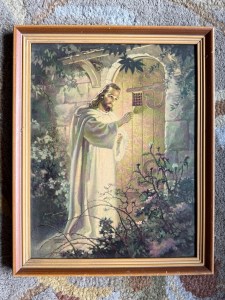
Jesus is not pounding down the door. There isn’t even a visible door knob, where he could open it even if he wanted to. He’s gently knocking.
I think many of us were raised with this image, even if you didn’t have it hanging in your bedroom the way I did, and it has always been interpreted as a personal thing. Are you, as an individual, going to welcome Jesus into your heart?
And I think that is a part of it. Our faith is personal. It matters what we do as individuals.
But these letters were written to churches, not to individuals. It would be a truer image if what I’d had hanging in my bedroom was Jesus standing outside of First Presbyterian Church in Spokane, knocking on the door to be let in to his own church.
That’s a very different image, isn’t it. Jesus standing outside of his own church, hoping someone will hear his voice and let him in. To his own church.
Are we going to open the door?
God wants to be invited into our lives and into our churches, not to punish us, we’re told. The text says he wants to come in and eat with us. Do we hear him knocking? Is there room for Jesus at our tables?
Friends, God is writing us a letter in love. God is calling us back to love. So let our lives be a love letter back to God. Amen.


 Glass Overflowing