A sermon preached at Calvary Presbyterian Church on Easter. April 20, 2025
Introduction to Worship:
Good morning and welcome to worship at Calvary this lovely Easter morning. I am Marci Glass, pastor and head of staff here.
Whether you’re here for the first time or whether you are here every week, I deeply believe that it is God who has invited you here today, and it is my privilege to welcome you as a guest in this place. In the music, in the liturgy, in the prayers, in the silence, I pray you will find what your soul needs this morning.
There is a tradition in some churches of burying the alleluia during Lent. Lent is the season of preparation for Easter that we have just been through. And as Lent began, we took an alleluia, buried it, and set it aside for today. The children will unbury it this morning in Sunday Studio. While it was buried, we didn’t sing any hymns or speak any liturgy that included an alleluia.
Alleluia means ‘God be praised’, and we still did praise God, even if we didn’t use the word during Lent.
But today we unbury our alleluias because God has conquered death and alleluia is the first response to that news.
Alleluia!
The world, such as it is these days, may make you think maybe we should keep our alleluias buried a little longer. There is difficulty, and despair, and cruelty on display.
But that is the best reason I can think of to unbury our alleluias today.
The world needs to know that death does not win.
The world needs to know that hope is alive.
Your voice may be small, or it may be loud, but I invite you to unbury your alleluia now. God’s love cannot be contained. Love is on the loose.
Alleluia!
Alleluia!
Alleluia!
Scripture:
Luke 24:1-12
Sermon:
Last week, I was invited to the Calvary Nursery School to talk with the children about Easter. Getting to visit the nursery school is one of my favorite gigs, but how do you explain resurrection to 3 year olds?
Also, I recognize not all of the kids at the nursery school are Christian, and I want to be respectful of other faith traditions in the telling of our story. And, I really, really did not want to freak the kids out with some zombie Jesus image of a dead man leaving his grave.
Let’s face it, if you don’t already know the story, it’s not an easy story to tell.
There was a cartoon in the New Yorker this week that showed Jesus and the disciples at the Last Supper. And Jesus, pointing to the things on the table says, “So the bread is my body, the wine is my blood, and the chocolate bunny is a fun springtime treat”.
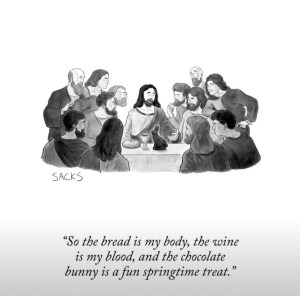 And that might be a fair assessment of my time with the nursery school kids. Far more conversation about the Easter bunny than resurrected Jesus.
But in truth, I think resurrection is as complicated for us to understand as it is for 3 year olds.
Death we understand. We don’t like it, in most situations, but we understand it. We see it around us.
Life after death? That’s trickier. Give me the easter bunny, please.
We can sympathize with the women who went to the tomb that morning with supplies to anoint a dead body. If they’d understood resurrection, they would have taken Jesus a change of clothes and a sandwich.
But they get to the tomb to do the faithful work of caring for the body of their loved one, their rabbi, their friend. And the tomb is open and the body is gone.
I stopped watching horror movies many years ago, once I realized I was a grown up and I didn’t need to subject myself to that fear anymore, but I remember watching those movies and always yelling at the screen, “don’t go into the cemetery alone in the dark!”
It’s what we want to say to the women. Of course they are terrified at the sight of an empty tomb. Of course they are worried about grave robbers.
It is then that the angels pop up next to the empty tomb in their dazzling outfits, terrifying the women in the early morning light. And then had the nerve to say to the women, “Why do you look for the living among the dead?” They don’t even say what every other angel says in scripture after they terrify humans, “do not be afraid”.
Why do you look for the living among the dead?
What do the angels even mean when they ask that? Luke records:
Why do you look for the living among the dead? He is not here, but has risen. 6Remember how he told you, while he was still in Galilee, 7that the Son of Man must be handed over to sinners, and be crucified, and on the third day rise again.
The angels remind the women that Jesus had been trying to help give them a framework to understand resurrection while he was still alive. Jesus had told them he was going to be handed over to Rome. Jesus had told them he was going to be crucified and rise again on the third day.
As we talked about last week on Palm Sunday, the people wanted Jesus to overthrow Rome and come in military power. Jesus wanted the people to understand the ways of peace. The angel reminds the women that they are still looking for Jesus in all the wrong places.
Jesus wasn’t found cozying up to Caesar. He wasn’t found amassing arms for a military take over. He also wasn’t found in his tomb.
Why do you look for the living among the dead?
Because we still believe in death. We still experience it. We still see people trafficking in it and threatening us with it. It’s hard enough to believe that Jesus didn’t want power or wealth or military victory—because that’s what we want, oftentimes. But for Jesus to defeat even death?
Why do you look for the living among the dead?
The angels aren’t gaslighting the women. They aren’t pretending Jesus didn’t just die a horrible, state sanctioned, unjust death on a cross. Jesus died. The angels aren’t claiming Jesus didn’t die.
Resurrection isn’t pretending that death isn’t real, that it doesn’t hurt us deep in our souls. Being Christian, being resurrection people, is not making a claim that if you follow Jesus, everything in your life will work out perfectly and you’ll have prosperity and nothing but blue skies.
By asking the question, the angels are letting the women know death isn’t the ending they thought it was.
But life after death isn’t a return to exactly what was before. Jesus doesn’t move back into his apartment and get back to his routine with the disciples. There will be accounts of people encountering Jesus after the resurrection, but it sometimes takes a minute for them to recognize him. Even Jesus is changed by death.
Easter takes place in springtime, which used to mean more to me when I lived in places that weren’t perpetually spring like. After a long winter in snowy, cold, dark places, you welcome the signs of new life and spring differently than I do living here.
But it is not a coincidence that our sanctuary is filled with beautiful flowers today. They are a sign of life. They are a reminder that when the earth feels barren and empty, there are seeds or bulbs that are yet being born.

But the new life of resurrection isn’t a return of what we’ve known before. If you planted a tulip bulb and what grew out of the soil was a sequoia instead, that might be a better image for Easter.
Life after death is different.
Maybe you have an experience of it in your own life.
When you were at an ending.
When you could not return to where you had been before.
My experience with life after death is the reason I’m a pastor.
It doesn’t feel as dramatic as death to me now, 35 years later, but at the time it was an ending. And there was grief and anxiety and loss.
I was in college. And I was a good student, and even got up on Sunday mornings to go to worship. And I got pregnant at 19. That wasn’t supposed to happen to girls who got up to go to church in college.
It is almost hard for me to remember now how it felt as a death. But at the time, it felt like my life was over. I was worried my family might disown me. I was afraid I was not going to finish college, or have a career. Dreams died in those days for the future I thought I was supposed to have.
I had an image of myself that died then too. I had an image of myself as a ‘good person’ who ‘did the right things’, so I didn’t really need God and I didn’t really need help from other people. The image of me that died in those days was the lone ranger, pulling myself up by my own bootstraps, an island to myself.
Day by day, through that time, people helped me turn away from the brick wall of ending that seemed to be in front of me and they guided me to different paths. Day by day, God put glimmers of new life in front of me, helping me slowly see possibility where I first only saw grief. Day by day, my church cared for me, teaching me the valuable lesson of community and the gift of accepting help.
I placed my son for adoption. And in a miracle for which I cannot say alleluia enough, I’ve been in his life the whole way through. I’ve seen him graduate from high school and college. Was at his wedding. I get to see him as a father to my granddaughter, and this fall, I happened to be in Dallas, where he lives, for a church meeting, when his wife went into labor. I got to meet my grandson in the hospital the morning after he was born.
I promise you that in 1989, as I gave my son to another family, I had no framework to even dream any of the goodness that has happened. It never occurred to me I might someday have a relationship with him, let alone my grandchildren. It seemed as far fetched as new life after an empty tomb.
Why do we look for the living among the dead?
Maybe it is because we lack imagination for goodness.
Or maybe we worry we are unworthy of the goodness of God.
I certainly did not feel deserving of God’s grace and love in that moment when I thought I had destroyed everything.
But that’s the thing about the grace of God. We do not earn it. We cannot control it. We can only receive it. And it searches us out, in moments of joy and contentment, in moments of grief and loss.
There is no place the love of God will not go to find us, even to the tombs of our lives. So why do we stay by the tombs, looking for the living among the dead?
After the angel speaks with the women, we’re told: Then they remembered Jesus’ words, and returning from the tomb, they told all this to the eleven and to all the rest.
Like the women at the tomb, who went back to tell their friends, we’re called to tell people about Jesus, about this love that is stronger than death. Like the women at the tomb, we want people to know that what is an ending for us does not mean God is finished helping us tell our story.
As we live into this Easter season, I invite you to notice when the death and pain of the world make you forget to leave the tomb, when your imagination forgets to believe impossible things, when your heart protects itself from the possibility of life after it has known death.
In these days, especially in these days, the world needs to know the depth, and height, and breadth of God’s love. So leave the tombs to share the remarkable news that nothing can separate us from the love of God. Not even death.
Christ is risen.
Alleluia. Amen

 Glass Overflowing
Happy Easter! Gosh, I miss your sermons
LikeLiked by 1 person
Thank you,Terri! Grateful our paths crossed for a season and for the ways we can stay connected now.
LikeLike
Me too! You are such a blessing
LikeLiked by 1 person
so happy to learn of your grandchildren. I had not seen that bit of information before. God is Good. Alleluia!
LikeLiked by 1 person