An Epiphany sermon preached at Calvary Presbyterian Church in San Francisco, CA
Jan 5, 2024
Isaiah 60:1-3, 19-22
Luke 2:41-52
Introduction to Worship
Today we are celebrating Epiphany. This is an ancient Christian celebration, dating at least as far back as the 300’s. Epiphany is one of my favorite days in the year of church life. And it is the day we celebrate the arrival of the magi, or the wise men who came to visit Jesus, Mary, and Joseph. January 6 is the actual feast day of Epiphany, which is also, if you count it up, the 12th Day of Christmas.
This word comes to us almost directly from the Greek.
“Epi”, meaning ‘on’ or ‘upon’,
and “phaneros”, which means ‘visible’, or ‘seen’.
Epiphany means to “show up, show on, show out”.
So, an epiphany is more than just a “lightbulb” moment, or an “aha!” moment. An epiphany is something that is revealed to you. Something where light shines and makes something clear and manifest.
We don’t know much about the magi. The Greek text just calls them “magi”, which referred to a caste of astrologers in Zoroastrianism, a religion in Persia. The word “magi” is where we get the word “magic”. The biblical text doesn’t give us their names and we don’t know how many of them there were.
The magi received the epiphany for all of us. They saw God made flesh and saw salvation for all people.
On this day, as we celebrate epiphany, we give thanks for people who were willing to go to great lengths to follow a star in search of God.
I’m a fan of the poems of WH Auden and in his poem For the Time Being: A Christmas Oratorio, the characters of the magi speak about their journey.
“At least we know for certain that we are three old sinners,
That this journey is much too long, that we want our dinners,
And miss our wives, our books, our dogs,
But have only the vaguest idea why we are what we are.
To discover how to be human now
Is the reason we follow this star.”
To discover how to be human now. Doesn’t that seem like a good reason to worship God together this day, at the start of a new year?
Sermon:
This is one of the few stories of young Jesus that make it into the gospel accounts. And it is every parent’s nightmare. Losing your child. I can well imagine Mary’s panic when she realized that Jesus wasn’t with their other family and friends, elsewhere in the caravan.
Jerusalem for the Festival of Passover was a busy place. People from all corners of the world, coming ‘home’ to the holy city to celebrate holy days, even if it wasn’t their home, even if they didn’t know the streets and neighborhoods as well as they did of their own hometowns. It would be easy to be lost and hard to be found.
Passover is the holiday that marks the deliverance of God’s people out of the hand of Pharaoh. And I bet she appreciated the need for deliverance even more once her son went missing.
And I don’t know what you would think your life would be like as the mother of God, but I suspect you wouldn’t expect to have a child who would wander off like that. Is it too much to ask young God to be well behaved?
Yes, in fact, that is too much to ask. No matter God’s age, God doesn’t behave. God does what God will, and not what we will. The God who created the universe and then chose a small, scrappy people in a forgotten corner of the world to be the people of God—that’s a God who doesn’t follow our script.
The God who continues to work through deeply ordinary people, the God who sends the angels to shepherds instead of kings when announcing the birth of God, the God who asks an unmarried teenager to bear the divine life, the God who chose to be born to a family who would be refugees at the whim of tyrants—that’s a God who doesn’t follow our script.
Even the story of the Passover is not one we could have written on our own. God heard the cries of God’s people and delivered them out of slavery in Egypt by parting the waters of the Reed Sea, causing the waters to crash back down where waters belong, when the Egyptian chariots and horses and soldiers were giving chase.
At every turn in scripture, God will do what God will do, and not what we would do.
And when we’re shocked that 12 year old Jesus wanders off and leaves the family caravan, we’re reminded that we keep forgetting that God’s ways are not our ways.
I can only imagine how Mary felt when they finally found him, in the temple, sitting with the teachers and asking good questions. The relief that he was safe, and the pride that everyone was impressed with his smarts, quickly gave way to “child, how could you do this to us? You really had us worried when you disappeared”.
And then Jesus says the wrong thing to his mother who loves him and just wants him to be safe. “Why were you searching for me? Shouldn’t you have known I would be here in my Father’s house?”
Jesus, no.
Because Luke wants us to think highly of Mary, he doesn’t record what she said in response to that answer from Jesus. Luke tells us they didn’t understand. And that Mary treasured all these things in her heart. Similar to Christmas Eve, when she ponders these things in her heart, this young God gives Mary a lot to think about, but the place to hold those thoughts is in her heart, not just in her brain.
God’s actions need our heart, soul, and mind to make any sense of. They need some pondering and some treasuring.
As I mentioned at the start of worship, today is Epiphany, the day the church marks the arrival of the magi who followed the star to Jesus. We heard part of that story from Matthew’s gospel last week.
I was in Hawaii this past week, and we spent a lot of time looking at the night sky. You could see the milky way, and so many constellations were easy to discern. Saturn, Venus, and Neptune were also visible in the night sky, and I know that because I downloaded an app that pointed it all out.

The reason the stars and planets and galaxies were easy to see in Hawaii is because we were ‘people who walked in darkness’ as Isaiah wrote. The night sky is dark in the middle of the Pacific Ocean. You can navigate the seas by following those stars. Well, I couldn’t, but someone could. People do.
Isaiah also goes on to say that the people who walked in darkness have seen a great light. On them light has shined.
Which means they could no longer navigate by the stars they were used to seeing. When you’re a people who walk in darkness, you figure out how to get around in the dark. But when the light shines on you, it changes what you can see.
When we were standing on the beach, looking up at the night sky, if big flood lights had turned on, the stars would have turned off for us.
As I was thinking of this story from Luke’s gospel, I was struck by how disorienting it is for us when God’s light shines.
The sun shall no longer be
your light by day,
nor for brightness shall the moon
give light to you by night;
but the Lord will be your everlasting light,
and your God will be your glory.
Your sun shall no more go down,
or your moon withdraw itself;
for the Lord will be your everlasting light,
Are we willing to let God be our everlasting light, to give up the ways we’ve learned to stumble around in the dark, to give up the constellations we’ve used to chart a course so we can instead follow God’s everlasting light?
The answer seems like it should be easy.
Yes, of course, I want to follow God’s everlasting light. I’m tired of the darkness I see in the world around me, and the celebration of greed and cruelty. I’m tired of the darkness of violence, and the glorification of power.
Of course I want to follow God’s everlasting light.
But I’m so used to stumbling around in the dark.
In CS Lewis’ final book in the Narnia series, The Last Battle, one scene that always stays with me is the dwarves. They’d fought against Aslan, the good lion, because they had followed so many false Aslans that they were done trying to follow. And at the end, they were in paradise, where war had ended and light was shining, but they refused to see it. They kept insisting they were imprisoned in a stable, dark and smelling of manure.
Even Aslan himself tried to convince the dwarves that they were free, but to no avail.
“Starting a new lie! Trying to make us believe we’re none of us shut up, and it ain’t dark, and heaven knows what,” the dwarfs said.
They later insisted Aslan wasn’t really there: “Don’t take any notice! They won’t take us in again.”
“They will not let us help them,” Aslan explained. “They have chosen cunning instead of belief. Their prison is only in their own mind, yet they are in that prison, and so afraid of being taken in that they cannot be taken out.”
I want to be able to see God’s light when it shines. I don’t want to continue to think the darkness is the place to stumble around. I don’t want to choose my own cunning instead of belief.
This is another one of those moments that call for our heart and soul as well as our mind, as when Mary treasured those things in her heart. To follow God’s everlasting light requires us to let go and to trust. To let go of our need to chart our course by our own stars and to trust that God’s star will get us where we truly want to go.
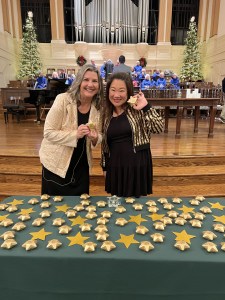
Joann and I with our Epiphany sparkles on
We’ll receive our Star words in a few minutes, when we come forward for communion. If you’re following online, make a comment, and we’ll draw a star for you after worship. My word this past year was “surrender”, which felt a little cruel for someone who has control issues. But it continues to teach me.
I can choose my own cunning instead of belief, like the dwarves, or I can let go of my own script and see where God might take me.
May I have the courage to surrender, and to let God’s light be what guides my work, trusting that there is more available to us than the darkness of the world.
President Jimmy Carter died this past week, at the age of 100. And no matter what you thought of his presidency, it is hard to fault the way he lived his life. He and his wife built close to 4,400 houses for Habitat for Humanity. He taught a bible study each week at his church in Plains, Georgia. He volunteered around the globe for fair elections, for health programs. He brokered peace deals.
He once said, “I have one life and one chance to make it count for something. I’m free to choose that something. That something—the something that I’ve chosen—is my faith. My faith demands that I do whatever I can, wherever I can, whenever I can, for as long as I can with whatever I have, to try to make a difference.”
May he rest in peace, surrounded by the light perpetual that he kept following.
God provides the light. We don’t have to manufacture it ourselves. We get to reflect it to the world, and allow it to shine through us. Remember that when the darkness feels overwhelming and oppressive. God provides the light. We let it shine through us.
John Bunyan put it well in Pilgrim’s Progress:
“And I said to the man who stood at the gate of the year, “Give me a light that I may tread safely into the unknown.” He replied, “Go out into the darkness and put your hand into the hand of God. That shall be to you better than a light and safer than the known way.”
Amen

 Glass Overflowing
Thank you, Marci. I preached on the “naughty Jesus” text on 12/29. As an expression of gratitude for all you excellent contributions to my life over the years, I’d like to send you a manuscript of it. I’ll use your church email. Keep up the great work!
LikeLike
Can’t wait to read it! Thanks.
LikeLike
Please send me an email address to which I can send it.
LikeLike
marciglass@calpres.org
LikeLike
I shared these words with our pastor in an email this morning:
Is it too much to ask young God to be well behaved?
Yes, in fact, that is too much to ask. No matter God’s age, God doesn’t behave. God does what God will, and not what we will. The God who created the universe and then chose a small, scrappy people in a forgotten corner of the world to be the people of God—that’s a God who doesn’t follow our script.
Thank you for reminding us that we aren’t the boss of God.
LikeLiked by 1 person
It’s a reminder I need all the time.
LikeLike
Marci, surgery put me in brain fog land and I forgot to ask for a Star Word! May I have one please?!
thank you! Susan
LikeLike
hope you’re recovering well. Your word is “discovery”.
LikeLike
thank you! May your new year be filled with joyful abundance!
LikeLiked by 1 person
peace to you! May I ask for a star word for me and my brother?
LikeLike
Kendall, your word is “intimacy”. Your brother’s word is “trust”.
LikeLike