A sermon preached at Calvary Presbyterian Church in San Francisco, CA
November 17, 2024
Introduction to Worship
When people talk about exercising to strengthen their muscles, I think most of them think about lifting weights at the gym, or going for a run—doing that routine, habitual work that builds strength, endurance. If I decided today that I was going to run another half marathon, even though I haven’t run in probably 8 years, since before my knee deteriorated and I had to have it replaced in 2020, we all know that I couldn’t just run that half marathon tomorrow.
I would need to start by running for a few minutes, and then walking for many minutes, and then running a few more minutes. Day in. Day out. We understand that it takes time to prepare to run a marathon.
The one and only half marathon I did run was while I was in seminary. We were also parenting small children and I had Theology class, which, that was a lot. But I had a plan, and I stuck to it, and I trained for a half marathon in four months.
To be clear, I never need to do that again. By mile 10, I was bored out of my mind. But I am proud that I did it once. And I am aware that if I am motivated to do something, I can put in the effort to get it done.
I would like us to think about a lot of things in life as if they were strengthening our body or getting in cardio shape. There are other ‘muscles’ we need to build and develop, with regular, habitual work, that can’t be done in a gym.
Here are a few things, an incomplete list, that need routine practice to develop and get stronger.
Worship—we’ve all seen how difficult it was to get back to regular in person worship attendance after we became couch worship potatoes. But now, so many of you are here most weeks again, and have gotten back into this routine. It took time to build that habit back, didn’t it?
Generosity—it is possible to have spontaneous acts of generosity, but for me, becoming a generous person took some time and practice. Because if I’m generous when things are going well, I’m more likely to remain generous when things get tight, because I’ve lived through the blessings of it and now how things work out.
Hospitality—I preached about this a few weeks ago. This past week, I experienced a large group moment of generosity and hospitality—and it wasn’t at church. It was at the Chase Center for a Warriors game.
Klay Thompson, who played for us for 13 seasons, left this summer to play for the Dallas Mavericks. And Tuesday night was his first Warriors game wearing a different jersey. One could imagine that the return of someone like that could have been tense. But 400 employees of the Chase Center lined the tunnel where players arrive, to greet and welcome him back. It was a sell out crowd of 18,000 people, many of whom were wearing his old jersey, giving him a standing ovation to welcome him home, right before we then defeated his new team. Generosity and hospitality only go so far.
I was telling a friend what it felt like to be in the arena for that moment, and it was quite an experience. I was reminded that there was no risk or downside to the Warriors to be gracious in his return. And from what I know about the organization, this wasn’t a spontaneous act of hospitality, but something that has been practiced over time.
Worship, generosity, hospitality—that’s the start of my list of things that take habit and exercise.
I want to add a few more.
Hope—this week, Brene Brown wrote this about hope vs despair:
“The research shows that hope is a powerful antidote to despair. What’s interesting, however, is that hope is not an emotion (C. R. Snyder). Hope is a cognitive-behavioral process. It’s about having a goal, a pathway to achieve that goal, and a sense of agency or “I can do this.””
“Right now”, she says, “the thing that is helping most is micro-dosing hope. I have no access to big hope right now, however, I am asking myself how I can support the people around me…how can… I stay committed to courage, kindness, and caring for others, regardless of the choices made by others?”
She doesn’t use my language of exercising the muscle of hope, but that’s what she’s talking about. Now is not the time to decide we’re in shape to deadlift 300 pounds of hope. Now is the time to pick up the 5 pound dumbbell of hope and start getting our hope in better shape.
And finally, Imagination—today we are going to be talking about imagination, and hearing a story from the book of Isaiah where the prophet called his people to exercise their imagination again after it had gotten out of shape in exile.
As we enter worship, let us also remember that rest is a part of getting stronger. We gather together here to be restored so we can put in the work we need to do to develop our generosity, our hospitality, our hope, and our imagination. Welcome. We’re glad you’re here.
Isaiah 43:14-21
Sermon:
We’ll be hearing from the prophet Isaiah through Christmas, and our stewardship passage for the year kicks us off. Isaiah was likely written by more than one author, over a period of years. It is from Isaiah that we get a lot of our Advent and Christmas imagery. Jesus and John the Baptist use Isaiah’s language. Much of the text of Handel’s Messiah comes from the Book of Isaiah.
The book speaks to the people of Jerusalem, first as a warning, and later as a comfort. First, he warns them that if they abandon their God to gain political power, things won’t go well for them.
And then, after they had been sent to exile in Babylon, he preaches to them of comfort, reminding them that while they have not been faithful to God, God remains faithful to them.
Today’s passage is from the comfort section of the book. And Isaiah’s words are relevant to us, even those of us who already know lives of comfort and privilege. We also can see around us the failure of human political systems, where people vote by a slim but winning majority, for a candidate who has promised to hurt people, has promised to harm immigrants, has promised to harm trans kids and the queer community, has promised to make billionaires more billionaire-y.
Isaiah is writing to people like us. People who thought we were in control and could handle things just fine. I don’t know how you’re feeling as the cabinet announcements are being made but everything is not being handled just fine. I feel like all I can do right now is to not normalize this behavior. Congress might agree to these appointments, but it doesn’t make it okay to fill the government with patently unqualified and unserious candidates. Isaiah is writing to remind people who have forgotten that control is an illusion, writing to remind them that trust in God is the one thing we can do when things seem unmanageable.
We are not in literal exile as Israel was in Isaiah’s day. So I don’t want to overstate our connection. But I do hope we will remember that there is resonance in the stories of scripture, even if the contexts of our lives are not exactly the same.
The prophet Isaiah tells us not to remember the former things, or to consider the things of old. But before we look at the new things, we should notice that Isaiah doesn’t completely follow his own advice. Because the first part of our text involves a lot of remembering and considering. “Thus says the Lord who makes a way in the sea, a path in the mighty waters, who brings out chariot and horse, army and warrior….”
This is the same God, he reminds them, who ushered the people of Israel through the parted waters of the Red Sea, delivering them from Egypt, saving them from slavery. Don’t forget it.
So, before we NOT remember or consider the things of old, let’s make sure we have done just that. Because it is the past instances of deliverance that will call us to believe and trust and remember that it will happen again.
The God who stopped Pharaoh, the God who freed a people from slavery and delivered them to the Promised Land is still speaking to God’s people today.
And God still has plans to deliver and redeem God’s people.
But do not remember the former things, or consider the things of old. Because deliverance will not be the same. Don’t go stand at the side of the Red Sea, waiting for the waters to part. Because they won’t.
Any further deliverance is going to be a very different kind of exodus.
In other words, “while I am the God who saved you back then, that is no longer going to be the story you tell people. When you talk about your God, you will tell a new story.”
Here at Calvary, it is important that we remember the stories of how God has cared for us in the past, how Calvary has weathered storms and how God has provided for us in the past in ways that we still benefit from today.
So we consider the old things because as they remind you to have hope for, and an imagination for, the new things that God is doing.
Do you not perceive it?
This is a NEW THING.
God tells us, “I am the one who can put water in the desert. I am the one who will make the path for you. A path where no path has been before. Even the ostriches and jackals will honor the Lord.”
Whatever this New Thing will be, you can’t even conceive of it on your own. And you don’t get to determine how the story will play out.
Some of us hear this announcement of a new thing and say, ‘great! where do I sign up?’ For some of us, the past is something we would gladly leave behind for a new opportunity.
But some of us are looking for more details. “okay, God. before I sign up for this journey, I need you to be specific. The jackals and ostriches are an intriguing detail, but I don’t quite know how that applies to me and I need some more information. I’ve got some control issues.”
We are people who want to see the future before we get there. And if the past has been good to us, if we are perfectly comfortable in the present, why would we want to leave it behind for something unknown and new? God’s message of a new thing is not always a welcome message to comfortable people.
The people hearing Isaiah’s words aren’t sitting in comfort though. They are in the midst of the consequences of some of their bad political and religious choices. Destruction. Exile. Loss. Devastation.
Earlier in the book of Isaiah, the prophet had tried to steer the people away from making those bad choices by warning them of the wasteland they would create. In chapter 34, he writes of what shall happen to Israel:
Thorns shall grow over its strongholds,
nettles and thistles in its fortresses.
It shall be the haunt of jackals,
an abode for ostriches.
The Jackals and Ostriches that appear in today’s text in chapter 43 are not entirely new. But they are being re-assigned their role in the story.
As one of the commentators says about this text:
“The prophet projected a vivid image of chaos: jackals and ostriches prowling amidst the ruins of a world collapsed under the weight of the iniquity of its inhabitants. To portray the radical nature of the new thing that God purposes, … Isaiah reintroduces the jackals and ostriches, this time themselves restored to beauty and wholeness and giving honor to their Creator! Even they have taken their place in a world abiding in shalom, a world in which God tenderly cares for the people whom God has chosen, a world – and now we come to the culminating act that gathers all creation up into one common purpose – in which Israel by its very existence bears witness to the one reason that gives eternal value to life: so that they might declare my praise.” (Hanson, Paul. Isaiah 40-66 in Interpretation. (JKP: Louisville, 1995) p75)
Whatever plans we make, in other words, are of a different scale to what plans God is making. We are invited to join in the work God is doing. We are invited to be witnesses of what God is imagining and doing, where the jackals and ostriches that prowl the ruins can become, in the faithfulness of God, the markers of a new creation. We are invited to trust that whatever new thing God is preparing and dreaming for us, no matter how unfathomable, is better than trusting only our own gumption and resolve.
Isaiah uses his prophetic imagination to call Israel to remember their own imagination. When you’ve lost your country, and been taken into exile in a foreign land as your political structures have collapsed, imagination is dangerous. In the midst of your trauma and anxiety, what your mind can imagine is terrible. “We’ll never get back to Jerusalem, will we? We’ll never have elections again now that Babylon has taken over and claims to have a mandate.”
You can see how imagination is dangerous when combined with anxiety. And I’m not saying Israel was wrong for shutting down their imaginations. The situation on the ground for them was bad.
But when your imagination shuts down, despair can creep in because you haven’t just stopped imagining the bad possibilities, you stop imagining any good ones too. And when you have no hope or dream for what a future could be like, Babylon has won.
So Isaiah is calling them back to the work of imagining a future they do want to live in.
Do not remember the former things,
or consider the things of old.
I am about to do a new thing;
now it springs forth, do you not perceive it?
From the midst of exile and anxiety, God calls the people to be on the lookout for deliverance, for mercy, for goodness.
The Stewardship committee picked this passage for our annual giving campaign this year because we are perceiving that God is doing new things here at Calvary and it is an exciting moment for us as a congregation.
Calvary can look back at previous moments of God’s deliverance with gratitude, but whatever the future holds for us, God’s deliverance will look different in 2024 than it did in 1854 when the church was founded in a brand new town on the edge of the country.
And I confess that I would like to be able to really clearly see this new thing God is doing, rather than just sort of perceive it. But if total control is not the spiritual gift God has given me, alas, I will take the glimmers of this new thing. I can feel it jump starting my imagination for what might be. And you can feel it too, right?
In a world where people are isolated and turning away from each other, you gather here each week, building community across your differences. This matters. Your presence as community is a reminder to the world that we don’t have to be isolated and alone. God is doing a new thing, do you not perceive it?
I feel glimmers of God’s new thing in the work of some of our committees, and I apologize for just uttering the most presbyterian kind of comment imaginable—to say that God is at work in committees—but it is true. I am excited about the people who have said yes to the church wide nominating committee when they have been asked to serve as elders, deacons, and Foundation trustees. There are churches having to beg people to serve, but we have people enthusiastic to say yes. God is doing a new thing, do you not perceive it?
I feel glimmers of God’s new thing in the work of the Faith In Action Team and the Living Sanctuary team, where they are faithfully engaged and responding to what we can do as a church to keep people safe, sheltered, and cared for. This past week, Tosca and Zanne cooked 100 meals for the women at SafeHouse. Yesterday we had eighty some people in the building for an event hosted by the Racial Equity Initiative at Calvary, where we learned some of the challenges faced by people who re-enter society after they have paid their debt to society in prison. It was an eye opening experience to see how many challenges they face, and a reminder that we have work to do. God is doing a new thing, do we not perceive it?
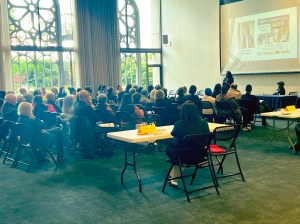
Pure1 led a re-entry simulation at Calvary on Nov 16, 2024.
For years, Calvary has been talking about hiring another youth director and it took some time, but I am convinced that we were waiting for Jeff Smith to be available to be hired and we just didn’t know it at the time. He’s been a great addition to the staff and is a glimmer for me of this new thing God is doing. If your kids haven’t met him yet, I hope they will soon. God is doing a new thing, do we not perceive it?
I feel glimmers of God’s new thing during the week, when this building is buzzing. In addition to the church groups that meet during the week, we host yoga classes, a muslim prayer group, community meeting space, weekly rehearsal space for multiple choirs and orchestras, author events with Book Passage, and so many more moments. God is doing a new thing, do we not perceive it?
And as we’ve put the budget together for next year, there is a similar excitement. We realize that to do what God is calling us to do requires resources. But rather than producing anxiety, as I know talk of money can do, it is producing anticipation and hope. We believe God is at work in this place and we are hopeful that if everyone participates at whatever level they can, we’ll be able to imagine what God is dreaming for us.
When the despair and worries of the world threaten to take away your hope, I invite you to remember to imagine. It doesn’t erase the work we have to do, or the real problems we face, but deeply believe it helps us connect to what God is already at work at in the world.
We begin with imagination. And then we get to work, welcoming the outcast, caring for each other, seeking justice in society, loving our neighbors as ourselves. And we trust that in that work, God is doing a new thing.
We get to be a part of it. Let’s get those imaginations going. We’ve got dreams to bring to life.

 Glass Overflowing