Introduction to Worship
As you may have already read in the bulletin, today is Reformation Sunday. Our prayer of confession, and other pieces in the service today date from the early years of the Reformation—back in the mid 16th century. Some of our music today was written by early Reformers as well.
On this last Sunday in October each year, we take a look back at our roots as Presbyterians and as Christians of the Reformed tradition. While the Presbyterian Church grew from the Reformation in Scotland, we also trace our history back to the reformers in Europe—Martin Luther, John Calvin, and many others. You can see some stern looking murals of 4 reformers in the chapel.
On Oct 31, 1517, Martin Luther had some ideas to reform his beloved church. So he nailed them to the door of the cathedral in Wittenberg. 95 ideas in a long list. And while there were people talking about reform before Luther, it is to that moment in history that we put a start date on the Reformation.
Among those ideas that changed the world and influenced our worship today was the understanding of the Priesthood of all believers—which means that we don’t believe that people like me, who are ordained to the priesthood or ministry, are holier than you are.
Each of us is capable and encouraged in community to seek an experience of the Divine directly. Rather than mediating your faith through the priest (think of going to confession, the selling of indulgences, etc), the reformers believed that we could pray our confessions directly to God. I know many of you are not fans of the prayer of confession which we say each week, but try to see it as an act of liberation. Rather than have to come and speak your confessions to me, you are free to approach God yourself. This belief also led to the idea that the Bible should be read by the people in their own languages, and not just by the clergy in Latin.
One of the reasons that Presbyterians are known for starting schools all over the world is because you have to know how to read in order to read the Bible. The very act of reading the Bible is a claim we make that God can and does speak to each of us.
Today is also the day we welcome the families of the Calvary Nursery School in worship. While the school is an independent organization now, it was founded by the church 70 years ago, in 1954, because education is a core value of the Presbyterian Church. We are grateful to have our Calvary Nursery School people with us today, and are glad to be connected to the best nursery school in town.
A lot of pain, and even death, came about because of the Reformation. When researching my birth family, I discovered one of my ancestors was murdered in Dresden for being a secret Calvinist in Lutheran Germany! We see that pain play out today when people focus more on what divides us than on what we hold in common.
Luther ended up being forced out of the church he wanted to reform, but even so, the medieval church did reform. We celebrate our particular Presbyterian ‘flavor’ of the faith, while we also recognize other strands of Christianity, and other faith traditions altogether, also carry forth a love of God. We trust that the sovereign God, who created the universe and set the planets spinning in their orbits, is big enough to be reflected by more than just what we can see or understand.
A little differently than the reformers, we believe God called us to be who we are, and brought us together to be the church. And we trust God called others to worship in different ways.
Scripture:
1 Kings 5:1-5; 8:27-30, 41-43
Sermon:
When I moved to San Francisco, I worried I might possibly miss winter. Turns out. Nope. Not even a little. I quickly saw the benefits of perpetual spring. But last week, I traveled to Minneapolis for a conference and stayed with my best friend from college in her beautiful home overlooking Lake Minnetonka. And the trees were in glorious color, in their participation in the sacrament of letting go, as they get ready for winter.
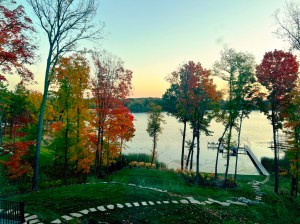
So I don’t miss winter. But I do, a little, miss autumn. And was thankful for a chance to enjoy the fall leaves last week.
Autumn leaves have me thinking about permanence. And the lengths to which humans will go to pretend we can keep things from changing. No matter how beautiful leaves are when they turn crimson and orange, there is nothing we can do to keep them in that state. We cannot staple leaves to the branches to keep them from falling. And if we did, somehow, manage to keep them on their branches, it would kill the tree to not live through its cycle of bud, leaf growth, leaf death, and hibernation.
The poet Mary Oliver, in her poem, In Blackwater Woods, says this about what autumn leaves teach us:
To live in this world you must be able to do three things:
to love what is mortal;
to hold it against your bones knowing your own life depends on it;
and, when the time comes to let it go, to let it go.
Our lives, our civilization, our everything, is like that too. The permanent part of life is change. What do we need to let go?
Should we work to make that change beneficial for the world? Absolutely.
Should we have good hope that God is seeking beauty in our world and in our lives? Absolutely.
Should we pretend we can avoid change? Absolutely not.
Solomon inherited the throne from his father King David, God’s golden boy, the favorite one. David—the guy who had Uriah the Hittite killed so he could marry his wife, Bathsheba—the woman who would become Solomon’s mom.
David may have had all of the steadfast love of the Lord, but it didn’t mean his life was simple or that he made good decisions.
I think about the stories from David’s palace and wonder what it was like to be Solomon, David’s youngest son, his surviving son. Succession had nothing on this family. What must it have been like for Solomon to survive a childhood as the son of the “other woman”, with an erratic father–—one minute on top of the world and the next minute disaster?
In this passage, it’s reported that David didn’t build the temple because he was too busy fighting wars and didn’t have time to meet with the architects.
David offers a different reason in 1 Chronicles 22, which reports:
“David said to Solomon, ‘My son, I had planned to build a house to the name of the Lord my God. But the word of the Lord came to me, saying, “You have shed much blood and have waged great wars; you shall not build a house to my name, because you have shed so much blood in my sight on the earth. See, a son shall be born to you; he shall be a man of peace. I will give him peace from all his enemies on every side; for his name shall be Solomon, and I will give peace and quiet to Israel in his days. He shall build a house for my name. He shall be a son to me, and I will be a father to him, and I will establish his royal throne in Israel for ever.”
Usually the truth is somewhere in the middle of both accounts, and whatever the motivations, Solomon embarked on this huge public works project, taxing the people huge sums to have money to build the temple.
It took 7 years to build. He had to conscript labor in order to build it—this story is the only other place in Hebrew scripture where the same word they used in the Exodus story for slavery in Egypt is used again.
Pharaoh used slave labor to build pyramids to his own glory.
Solomon used it to build a temple to the glory of God.
I don’t know how that makes you feel, but the darker side to the biblical stories complicate things for me. It reminds me of the time I learned that slave labor was used to build the White House.
Is it still a beautiful building that is part of our history? Yes.
Does it sadden me to see the way slavery is built into the buildings that shape us and our national identity, reminding me that anti-racism is systemic work? Yes.
For all the ways we want the Biblical story, and even the stories of our own lives to be well behaved and well mannered ones, the truth is that they are often neither.
We wish we didn’t know stories about people who seek impossible goals, trying to please their parents, as Solomon did building the temple. We wish we didn’t hear stories of our heroes being flawed and participating in systems of oppression.
Wishing doesn’t make it so.
We know we are flawed people, even as we try to act as if we’ve got it all figured out . We even know, at least in our hearts we know, that most of the moments of grace, transformation, and connection that we have in our lives arise out of the messed up places. And yet we want to freeze our story in the few “perfect” moments, like autumn leaves on trees.
Solomon built the temple to stand forever.
Spoiler alert—it won’t stand forever. It was already ruins by the time Jesus wandered through Jerusalem. It was likely already destroyed by the time 1 Kings was being compiled.
We know that human building projects will not last forever, no matter how much we wish they could.
When I traveled on my sabbatical in 2017, I toured a lot of ruins. I visited a graveyard in New Jersey where some of my colonial era ancestors are buried. All those names, so carefully etched in stone, have faded away, already lost to time, just a few hundred years on.

photo by author, gravestones in Elizabeth, NJ
The church next to the graveyard, which one of my ancestors helped build in the 1600s closed it’s doors because the neighborhood changed around it and the church never responded to the people who moved into the neighborhood. I don’t know what the future looks like for that church building, but I’m confident there will be life in that place, even if it’s not the “forever” my ancestors imagined when they built the first building in the late 1600s..
In the UK, I visited Lindisfarne, an early monastic community off the coast of Northumbria in England. It hasn’t been an active site of worship since Henry VIII dissolved the monasteries in the mid 16th century, and many of the walls are tumbled down, yet there was beauty in the ruins. It felt sacred, even if the walls built to hold God are no longer standing. God is still there.
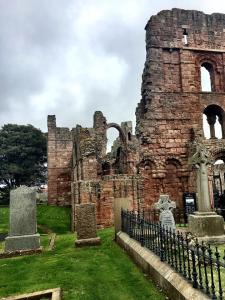
photo by author, Lindisfarne
We hear stories of churches closing, or things ending, and we feel sadness, we see the destruction in the ruins.
Do we also see the beauty in the ruins?
Do we see the way God is not confined to our human building projects with the same emotions and expectations we are?
Solomon built the temple as a place for God to dwell forever. In the same sentence, he acknowledges God has stated a divine intention to dwell in “thick darkness”, presumably not requiring 4 walls and a gold roof.
Solomon builds the temple anyway and puts on an extravagant celebration—the biggest temple dedication ever—with an elaborate choreography of processions, priests, and pomp. And God interrupts the plan. Before the section we heard read today, we’re told:
“And when the priests came out of the holy place, a cloud filled the house of the Lord, so that the priests could not stand to minister because of the cloud; for the glory of the Lord filled the house of the Lord.”
I love this image of God being poorly behaved and refusing to enter the drama on cue. I’m also terrified of this reminder that God is operating with a different script than the one I’m so carefully trying to write and control.
As I mentioned at the start of worship, October 31, 1517 is when Martin Luther nailed his 95 complaints on the door of the Wittenberg Cathedral, and so today is when we mark Reformation Day. There were many other things happening at about the same time leading to change in the church, such as the invention of the printing press, and the introduction of coffee to Europe, but it is Luther’s action from which we mark the beginning of the Reformation.
The medieval Roman church thought its foundation was solid. Luther, Zwingli, Calvin, Knox, and others surveyed the walls and said, “we need to fix some of this”.
At first, for Luther, it wasn’t about starting a new denomination. It was about course correcting the church he loved before it sailed off a cliff.
Luther and the other reformers’ stories and lives are as complicated as David or Solomon’s. And it is hard to “celebrate” any schism of the church, even as I recognize I can be your pastor because women’s ordination is a byproduct of the Reformation.
While not all change is good, some of it I’m really grateful for. And some of it is well beyond our imagination. It would likely be quite shocking for many of the 16th century reformers to realize their work had led to women’s ordination, or the inclusion of people who are gay, lesbian, or trans in the leadership of the church.
God’s presence will not be confined to our buildings or stick to our script.
“ecclesia reformata semper reformanda secundum verbum dei” is the fancy Latin way to sum up what we, as Presbyterian flavored protestants believe. We are “a church reformed, ever being reformed, following the Word of God”.
What should be clear to us 500 years after the Reformation began, and a few thousand years after Solomon built a temple to last forever, is that while God does work through the organizational structures and the buildings we build, God is not contained or limited by them. The Spirit of God moves in and through our attempts at permanence and disrupts us, calling us to be ever reforming, ever following the Word of God.
We can’t keep change from coming, whether it’s the leaves abandoning their posts on the tree branches, or mighty temples of stone, turning to dust in the sand. My prayer is that when the glory of the Lord shows up and messes up our plans, we will have hearts open to trust that God is calling us to something new, even if the architecture and structure will look different.
The Reformation is not just a history lesson. As inheritors of the teachings of Martin Luther, John Calvin, John Knox, and others—we are people who believe God is always re-forming us and reforming the church.
What are we building? How are we being re-formed? In all the changes we’re seeing in church and culture, what is being built right now is very much up for debate. I pray our actions, our witness, our compassion in the world will build temples to God’s love, mercy, and peace, and not to our own greatness.
We’re ten days out from the election. We’ll have the chapel open that day as a space for prayer and meditation, if you’d like to stop by between 8 am and 6 pm. I know many people are feeling anxious, both about the outcome and about potential aftermath. I understand the anxiety.
And maybe the story of temples in ruins that were built to stand forever don’t initially seem like a good story to give you this close to this particular election. But. Here’s what I know.
One of the permanent parts of life is change. And so our participation in that change is what we control. We can focus on our fears or we can work for our hopes. It is hard to do both. We don’t need to pretend there aren’t things we’re worried about. But we can choose how to respond. And if you need permission to turn off the news for a bit, you have permission to turn off the news and stop looking at the polls. Maybe use that non-news time for meditation, for service to others, for time spent with loved ones, for a pedicure. Whatever you need.
Another thing I know. God is at work, inside and outside our church structures, our governmental structures. God is neither contained nor limited by human agendas. So as we look at what we are building, we can look for where the divine is present and active and then work toward those things.
The comfort I take as I survey this strange moment of history we are living through, is that I get to serve here, with you. I find great comfort in this community, in the care you provide each other and the broader community, in your capacity to do hard work for good beliefs. What a gift it is to not feel alone and isolated in a time like this.
At the end of our reading today, Solomon said that the way foreigners are welcomed in the house of God is how God will decide whether or not to dwell I the house on earth that Solomon built. Listen to Solomon’s charge to his people, even as he voices it to God:
‘But will God indeed dwell on the earth? Even heaven and the highest heaven cannot contain you, much less this house that I have built! ‘Likewise when a foreigner, who is not of your people Israel, comes from a distant land because of your name —for they shall hear of your great name, your mighty hand, and your outstretched arm—when a foreigner comes and prays towards this house, then hear in heaven your dwelling-place, and do according to all that the foreigner calls to you, so that all the peoples of the earth may know your name and fear you, as do your people Israel, and so that they may know that your name has been invoked on this house that I have built.
What will people see when they look back 500 years from now, and survey the ruins of 21st century San Francisco, the way we’re looking back at the Reformation’s beginnings or at Solomon’s Temple? Will they see God’s work in how we welcomed foreigners, as Solomon said?
The work you do in this community to share kindness, mercy, hope, and inclusion—I trust and pray God will continue to build something out of that witness of love. It may or may not be a physical building. God may be constructing scaffolding in people’s hearts that keeps hearts open and expanding, ready to welcome more and more people into their circle of care. Just think about what that might build.
Put on your hard hats. We’ve got work to do.

 Glass Overflowing
This was an encouraging sermon. I wish I lived in San Francisco to physically worship with your community and be encouraged to inclusivity. Thank you.
LikeLiked by 1 person
Thank you! Calvary is a great congregation.
LikeLike