A sermon preached at Calvary Presbyterian Church in San Francisco, CA
September 8, 2024
Introduction to Worship
Good morning and welcome to worship at Calvary for our Homecoming Sunday, as we begin our program year today with a big lunch after worship. Hope you can stay for that.
Today also begins a new year in our Narrative Lectionary readings. Beginning with Genesis, we will read through the broad sweep of scripture between now and Memorial Day.
One of the reasons we read scripture every week, and encourage you to read it during the week, is that scripture is the story of our Christian faith, and culturally, we have lost the thread of the narrative.
When we don’t know our stories, we don’t know who we are.
We experience things in life and then assign meaning to those events by telling stories. The stories we hear and the stories we tell define and shape our world. And so, as we start through the readings for the Narrative Lectionary today, think about the biblical stories we’ve heard, and how we’ve internalized them—for good or for bad.
The story of the Garden is how our ancestors told the story of us, of how we came to be, of how we were created in love, of how we were created from and for each other for companionship, of how we find meaning in work and toil.
Sometimes that story has been told to punish women, to keep them from full participation in society. As you might guess, that’s not how I want us to hear this story.
As many of you know, I’m just back after a month preaching for a Church of Scotland congregation in London. And as you heard their pastor preach here, and they heard me preach there, I hope we got different perspectives on the story of our faith, and how we are connected to each other despite cultural differences.

Crown Court is a much smaller congregation than Calvary, and it has some different challenges and certainly a different context for ministry, but most of it felt so familiar. They, too, are trying to find their way as church in a world where religion’s meaning in our culture has changed. They, too, are seeking to be faithful to God’s call to welcome all of God’s children to church, just as God created them to be.
We serve the same God, we read the same scripture, even if it sounds better read with a Scottish accent. I am thankful for the chance to work in another context for a month. As I observed their challenges and struggles, I could do so with a little bit of distance—not my circus, not my monkeys, as they say.
But, more than anything, I missed my circus and I missed my monkeys, and so I’m glad to be back here with you, ready for a new program year. Let us worship in joy and hope.
Scripture: Genesis 2:4-25
Sermon:
Today we are beginning a new year of scripture readings from the Narrative Lectionary. The Narrative Lectionary is a four year cycle of readings that cover the broad sweep of the story of scripture. We begin in Genesis and go through the Old Testament through the autumn. After Christmas, we’ll be in one of the gospels through Lent and to Easter. And after Easter, we’ll read New Testament letters and writings, through Pentecost.
The Narrative Lectionary uses longer passages of Scripture than some may be used to hearing, but it allows us to emphasize the story of scripture, helping us connect our lives to the broad sweep of the biblical narrative.
Some of these stories may be new to you. Some will feel very familiar. I invite you to listen to each story as if you were hearing it for the first time. Don’t let what you thought you knew about it keep you from hearing what God may be saying to you today.
And so we start at the very beginning, a very good place to start, as Julie Andrews taught us.
Or almost the very beginning.
The creation story from Genesis which we heard is a continuation of the story begun in chapter 1.
In the first creation story, God speaks and the world comes into being. Here, in this story, God shows us the act of creation, shows us what creation means, and shows us why it matters.
The creation stories in Genesis were never intended to be a historical reporting of the first day of creation. The creation stories are about helping us understand our place in the world and our reason for being in the world. Walter Brueggemann, one of my professors says the creation stories are about human’s destiny as God’s creations, to live in God’s creation, with God’s other creatures, on God’s terms.
And the story of us begins in a garden. Humans, we’re told, are put in the garden to till it and keep it. Work is not punishment. Work is part of who we are.
And the work to which we are called is not unlike the work that God does. It isn’t exactly the same, but it is similar. In our very creation, God shows us how to work. In order to make the first human, God got down on their divine knees, knelt in the dirt, and formed human out of the dust. The word for human in this section is ‘Adam’, which means ‘out of the dust’.
Similarly, when woman was created, God put Adam into a deep sleep, opened him up, took his side, and then formed the woman into being too.
The work of creation is messy. God’s hands surely got messy in the dust and mud and open rib cages and blood and guts. In the creation of humanity, God was involved, not sitting at a remove. The work God showed us how to do is creative, and full of love and hope. It was tilling a garden in order to bring life.
Many of you work in gardens, which has health benefits. Truly. Getting your hands dirty, even being in nature, is good for your health. And gardening is messy work. It requires bending down into the garden bed to weed, pulling the bugs off leaves, and then scrubbing the dirt out from under your nails. The tilling and keeping of a garden is work, and God showed us how to work by making us.
Humans aren’t exactly the same as tomato plants, but light, a little water, and proximity to marigolds is good for us as it is for tomato plants.
I wonder if God knew what God was sowing when God was busy creating us out of the dirt
and mud
and ribs
and bailing wire
and duct tape.
Because humanity is not as predictable as the plants in our gardens. When I read the news, one minute, we are doing horrible things to each other—war, gun violence, callous disregard for the plights of our fellow humans—and the next minute, I read stories of such surprising compassion and love toward the stranger—so many contradictions we are.
We never know how another will respond. In the dust of war torn countries, places where we would expect nothing good to grow, compassion and love may be the dominant trait in people.
In clean neighborhoods, where dust is meticulously banished, and where every opportunity is provided, people may exhibit nothing but violence and depravity.
The growing of humans is clearly complicated work. And so the creation story in Genesis calls us to attend to that. It reminds us how important and how complicated it is to live together. God instructs the Human that he may freely eat of any tree in the garden. God is generous with permission. An entire garden for the human to enjoy and work and care for.
AND
There is a tree from which he could not eat.
The freedom we have in God’s creation is immense. But not complete.
The tree of the knowledge of good and evil often gets lots of attention in this story. And your guess is as good as mine as to what the tree was, or why God put it smack dab in the middle of the garden.
Perhaps we wouldn’t plant a tree right in the middle of our garden if we didn’t want people to mess with it—but that just serves to remind us that it isn’t our garden. It is God’s. And God’s ways are not our ways.
But to emphasize the forbidden-ness of that tree while ignoring the provision of the entire rest of the garden seems to be mis-characterizing the intention of God.
God gives humanity a lot of permission, a lot of freedom, in the garden. An entire garden, minus one tree, is ours to enjoy and from which to be fed. And yet it remains God’s garden and our relationship to God remains what it was at the beginning. We are the creatures in the garden made with love out of the dust.
Do we see God primarily as a God who prohibits?
Or as a God who gives permission?
This is a fundamental question.
If we see God setting humanity loose in a garden that, with some labor and care, will provide for them—then we have permission to see our lives in a way that allows for us to be creative in our own working and tilling of the garden. We can trust that God has provided and will continue to provide. We can set aside anxiety and fears of scarcity. There is enough for all.
If we see God setting humanity loose in a garden that is full of snares and traps and the punishment of work—then we worry about getting it right and pleasing a God who is trying to trick us into getting it wrong. We work only for ourselves. We separate ourselves from others and worry there won’t be enough because we don’t trust in God’s provision, only in God’s prohibition.
We hear stories on the news of people who I’m sure are well meaning and doing the best they can, just as you and I are. Yet they have been taught that God will be displeased with them if they get it wrong, or if they allow someone else to get it wrong.
The way we understand the garden story informs how we live our lives—and how we treat the rest of the people in the garden.
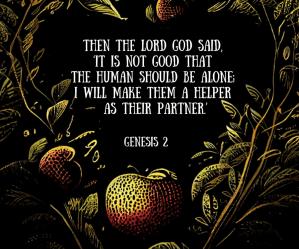
God says it is not good for the human to be alone. And that’s why we have dogs and cats, and the hedgehog, and the deer and the antelope. God puts all of these animals in the garden and the human names them. They are given as helpers and companions.
And they’re great. But they’re no woman, amIright? They weren’t enough. And so the woman is made from the man’s side and it is only once another human is there in the garden that the words man and woman exist. The translations in your bible don’t capture the moment it changes, but in the Hebrew, the words for man and woman only occur once the woman is created. Before that it is the word for human, out of the dust, Adam, that is written.
It is only once another person is in the garden that we hear the voice of the human speak. Language is a product of community. We need each other to speak, to communicate. The community we have with other humans is a gift of God from the very beginning.
The woman is created as a helper for the man. For too many years, that word has been reduced to a sense of helper as someone who picks up dry cleaning and washes the dishes, both of which are things I appreciate as help when they are offered.
The word is bigger than that. Ezer means a helper of strength. Moses names one of his sons “Eliezer”, which means God is my helper, and not because God folded Moses’ laundry, but because God saved his life. At its root, the word translated as ‘helper’ is ‘to rescue and save’ and ‘to be strong’. Wherever else the word is in scripture, God is the helper, God is the one to come alongside to save.
There’s a sentence at the end of this passage about a man leaving his mother and father and joining his woman. Which is odd at this point in the narrative because Adam and Eve didn’t have a mother and father. So while it is understandable we think of marriage when you read this passage, this passage is not about being single or married. The community we have with each other, with the other beautiful things God made out of the dust, does not require marriage. It is about being connected to each other, and helping each other through life.
We are already connected to each other because God made us from and for each other. From the very beginning, we are connected. And we are to be helpers—strong to save— for each other.
It is not good for the human to be alone is a reminder, as the poet said, that no one is an island, entire of itself. We are connected, one to the other, by the God who formed us out of the mud.
We have a tendency, though, to pretend the concerns and problems of other people are not our problems.
People who can’t afford food or housing in our city are our people, and their concerns are ours. We participate in a food bank and serve at shelters—hope you’ll sign up to help. We advocate for housing measures. Because we were created to be their helpers.
People legally seeking asylum at our border are our people, and their concerns are ours. Sign up to help the Sanctuary team if you want to participate in this ministry. Because we were created to be their helpers.
Students and teachers being shot in school in Georgia this past week—those are our people being killed at the altar of gun worship. We were created to be their helpers. We need to demand change from our congressional leaders.
If we pretend we aren’t connected, we are ignoring the story of the Garden. It is not good for the human to be alone.
The story of the Garden reminds us to care and to respond to the plight of people we don’t know. Not because we share their politics or their religion. But because God formed them from the dust of the earth and put them with us in the Garden too. Because we were created to be their helpers.
Who and how can you help this week?
Maybe you, like me, need the reverse of this question. Who can you allow to help you this week? Where in your life could you use a little help?
If we are created to be help to each other, it also means we acknowledge we sometimes need to be on the receiving end of the aid. As a child, my most used phrase, according to my parents, was “I can do it me own self”, and often uttered as I had both feet stuck into the same leg on my tights. And while I am still probably more independent than is useful, I know I need help. From my husband and kids, from my coach and my counselor, from my friends, from my colleagues. I’m a healthier person when I have support.
And it isn’t just that I need help, although I do. It is that other people are sometimes better suited to do something than I am. I was here last week to participate in the show tunes Sunday, but that is something Victor, Michael, John, and the choir planned with much greater skill and ability than I would have been able to plan or carry out. Being a helper and being helped is a way of acknowledging that everyone brings gifts to the table and if we don’t let each other use our particular gifts, we are missing out.
As you go through your week, I invite you to think about the ways we choose to be in community with others and the ways we pretend we are separate from others. I invite you to reconsider this particular biblical story and re-claim it from the sexist and patriarchal ways you may have heard it before because it is too important a story to keep telling badly. And dig out your bibles and follow along this year as we read through it. If you need a bible, let Joann or Victor or I know and we’ll get one for you.
Our story as people of faith begins in a Garden of abundance, where we were made out of the dust. It’s a great story. Glad to be a part of it with you, glad to have you as my helpers, in this corner of God’s Garden. Let’s go get our hands dirty, helping each other.

 Glass Overflowing