A sermon preached at Calvary Presbyterian Church in San Francisco, California
July 21, 2024
Introduction to Worship
When I was in 4th grade, our school got a new principal. The previous principal had been revered and loved, as far as I could see. The new guy—not so much. He showed up and started exerting his authority in solutions that seemed in search of a problem. He declared which side of the hallways people could walk down. He announced nobody could cut in line. You’d think he’d shown up to a lawless outpost of chaos. I was skeptical. He had authority but he didn’t seem to have the power to enforce it.
After these draconian laws were put in place, I noticed that he would come to the cafeteria and walk past all the students in the lunch line, going to the front of the line to get his lunch.
So one day I went up to him and told him where the back of the line was. He told me he didn’t have time to stand in line because he had meetings to go to. I told him I had to get to recess. We all had somewhere to go.
My teacher came over when she saw this confrontation taking place and he asked her if I was her student. “Yes, she is”.
“You should teach her to respect authority”.
“Yes, sir. But it is your rule she’s pointing out”.
He called my parents too. He told them they should teach me to respect authority. My parents loved to tell this story about me, once I was an adult. I didn’t get in trouble, exactly, when they got off the phone, but I don’t think they loved getting calls from the principal. “Maybe don’t pick fights with the principal?”
I learned at a young age that there can be a difference between authority and power. You can be elected, appointed, or ordained. You can seize authority through a coup or through violent means. But if the people you claim to lead don’t recognize power in your authority, it is pretty hollow.
One of the reasons misinformation is so dangerous and prevalent is that it keeps us from recognizing the authority of our systems and leaders.
Hannah Arendt, a 20th century German philosopher and historian said:
“This constant lying is not aimed at making the people believe a lie, but at ensuring that no one believes anything anymore.
A people that can no longer distinguish between truth and lies cannot distinguish between right and wrong. And such a people, deprived of the power to think and judge, is, without knowing and willing it, completely subjected to the rule of lies. With such a people, you can do whatever you want.”
Today in worship, we will talk about power, and authority, and influence. We will dedicate this window to the memory of Joe Beyer, a longtime member of Calvary who modeled for us the power and influence that comes through service, welcome, and kindness. And we are celebrating the 170th birthday of this congregation. Over those many years, we have seen highs and lows, success and failure, celebration and mourning. We’ve seen influence and power wax and wane. Through it all, however, we’ve seen the faithfulness of God. In our 170 years, the nation has elected 32 men as president, has fought a civil war, two world wars and many other global conflicts. San Francisco has grown from a 5 year old town of 50,000 people to a city of 850,000. There has been a lot of change in 170 years. Through it all, God’s faithfulness has not changed.
The story that our descendants in faith will tell of these days is yet to be written. May our faithfulness to the God who called us and who surrounds us help us live and write many more good chapters. O God, our help in ages past, our hope for years to come.
Let us worship in joy and gratitude.
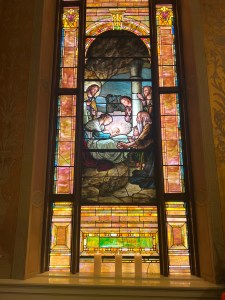
The Joe Beyer window
Daniel 6:6-27
SERMON
Last week, when Daniel’s friends were in the fiery furnace, there was a different king on the throne. In the lion’s den story, we move from king Nebuchadnezzar to Darius.
And as we’ve already talked about in this series, the Book of Daniel is an apocalyptic book, meaning it is telling a story to give commentary on current political situations, but setting it in the past. Neither Darius nor Daniel should be seen as historical figures, even if Babylon and Persia were real historical countries. By the time this book was being written down, it was a different political landscape for the Hebrew people. And so mentioning different kingdoms in this book is a way of pointing out that there is more than one country being critiqued in the story.
In the previous chapter, the previous king, a Babylonian named Belshazzar, had a dream. The interpretation of his dream was that he was terrible and that his kingdom would be divided between two other kingdoms, the Persians and the Medes. That very night, he’s killed and Darius becomes king of a somewhat divided rule, one where both Mede and Persian rules and agendas have to be met.
Darius’ court is a proverbial den of lions. Everyone looking out for their own interests, making sure they get what’s theirs, and seeking out ways to bring down their opponents. And even though Daniel has no political aspirations of his own, from what we can see about him in the story, the schemers in the lion’s den of Darius’ court clearly see him as a threat, much as the Babylonians had.
Daniel continues to worship his own God.
He doesn’t write an op-ed saying why nobody should bow down to Darius.
He doesn’t seem to invite people to join him in his prayers or lead any sort of anti-Darius movement.
He seems somewhat ambivalent about Darius. Daniel had seen kings come and kings go. Now there’s a new king, wanting the same thing the previous ones had wanted. Big whoop. These human kingdoms keep acting as if their power, authority, and control is so absolute, and yet they need to go after a person minding his own business, praying in the privacy of his own house.
It doesn’t feel like these kings and advisors are the ones with true power, does it? We see it a lot from politicians, even today. The ambivalence Daniel offers a despotic system is more than insecure and vain rulers can handle. These vain and scared rulers can do a lot of damage in their quest to look strong. Proverbial lions dens are bad enough. Actual ones are deadly.
And violent rhetoric fuels violent behavior. And no amount of violence and force and shows of might will make a person actually feel strong. You can pump your fist in the aftermath of an attack, and it looks like strength to some, but it doesn’t fill the void inside a person that leads them to crave the worship of other people.
When his advisors came to him with that irrevocable edict, I wish Darius had said, “I appreciate the gesture, boys. But we’re all good here. We’ve got a country to run. Let’s not worry about throwing people to the lions”.
But he doesn’t say that. He signs it. And his advisors use it to trap Daniel, as they had intended.
And this is where Darius drives me nuts. He throws up his hands and says “oh I wish there were something I could do! But I can’t! I’m only the king of a country where people worship me as a god but I’m helpless to fix this”.
There likely were political calculations for him. If he’s trying to keep an alliance between the Medes and the Persians solid, there are consequences to revoking the law. Perhaps it makes him look weak, or like a flip-flopper, which is the insult we give to politicians who change their mind when given more information.
But he’s the king! We see a similar king have a similar response in the story of the sham trial of Jesus, accused by the religious leaders of being the king of the Jews, when Pilate washes his hands and says there is nothing he can do to stop the injustice. Even though he’s Rome’s highest authority in that territory. “Oh, I wish there were something I could do! But I can’t! I’m only the commander of a large army of Roman soldiers, but I’m helpless to fix this!”.
I’ve been thinking about power and authority. How do we use whatever amount of those things we have to make the world better? How often do we use our lack of power and authority as an excuse from trying to make the world better?
It appears in the beginning of our story that Darius had authority, but the scheming court advisors seemed to have the power.
See the difference?
How many times have we seen leaders with authority say they’d love to do something, but their hands are tied? Gun control might be a good illustration. We’ve had a lot of thoughts and prayers over the years, but not much in the way of legislation. And by not much, I mean none. We may see people wearing assault rifle lapel pins, but they duck and cover just like the next person when bullets fly.
And I’m not saying that laws don’t matter. Societies survive because people agree to a shared set of rules and values. But sometimes those rules need to be changed.
When I was being ordained as a minister, the ordination vows were at odds for me. One of the vows asks, “Will you be governed by our church’s polity, and will you abide by its discipline?” Another one asks, “Will you in your own life seek to follow the Lord Jesus Christ, love your neighbors, and work for the reconciliation of the world?”
At the time I was being ordained, in 2008, our polity said people who were gay and lesbian could not be ordained as ministers. To be ordained was to submit to that, which I found to be at odds with that other vow to follow Jesus and love my neighbors while working for the reconciliation of the world.
It was a difficult decision. Ultimately, I decided that it would be easier to work for change from within the church than it would have been if I had left the church.
Wrapped up in that decision was also my privilege. I had classmates and friends who did not have the choice to be ordained when we were graduating. Because I had married a man, I had the privilege of being ordained. I love my husband, but he is not my best qualification for being a minister.
The church is now in a better place. But there needed to be a reclaiming of power in the church for ordination and marriage equality to happen. Presbyteries, our regional bodies, had to use their influence to educate people and to send good representatives to General Assembly, our national meeting where decisions are first made. The Assembly had to claim its power to vote for change. And then those changes had to be ratified across the church. Those changes happened because people realized they had power to speak out on the floor of presbytery meetings, to share their stories with other people to change hearts and minds, and to vote for ordination equality.
For too long in our denomination there were too many people like Darius, unwilling to claim power to change the law. Or else the unjust law didn’t affect them, so they didn’t feel any urgency to address it.
Systems of power will rarely give up power just because it is the right thing to do. Governments, denominations, corporations—whatever system it is—are arranged and designed to keep power.
Change most often happens when people join together to peacefully reclaim their power. Tyrants don’t walk away from power. Martin Luther King, Jr, John Lewis, and other leaders in the civil rights movement showed what Gandhi had shown in India—non-violent protest has the power to both change systems and hopefully, to redeem the people and the systems that need change.
Darius did manage to claim his power and change the unchangeable edict, but he didn’t get the non-violent memo. He threw the schemers, their wives and children too, into the lion’s den after Daniel survived the night.
Darius hasn’t stepped out of the domination game, even after seeing God’s power to keep Daniel safe. When politicians and kings claim power through violence, or when they encourage it from their supporters, the only system they will create will have violence at its core.
At the end of this story, Darius shows he had possessed the power to revoke his law all along. It just took a miracle for him to claim it.
Power and influence are more often seen on smaller scale than kings and tyrants.
Each of us has power, whether we claim it or not. We may not have authority to write laws, but we have the power to reach out to our elected leaders, to march peacefully in the streets if necessary.
We may not have authority, but we always have the power to be kind, to build a more welcoming world through our hospitality, our presence in the lives of people society tries to ignore, to support each other through difficult times.
Don’t underestimate your power.
What is a small thing you can do today, this week, this year to exercise your power in acts of love and mercy?
Today after cake and mimosas, we are going to pack lunches to take to shelters around the city. And then we are going to Open Cathedral to worship at 2 pm with our unhoused neighbors at UN Plaza. Never underestimate the power of your presence.
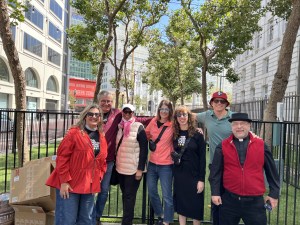
I tried to teach my kids to sit with the new kid in the lunchroom, or to invite someone sitting alone to join their group. Of course that involved my kids believing they had the social power to do that. And it involved them seeing it in action from the adults in their lives.
Today we have dedicated one of our beautiful windows to the memory of Joe Beyer. He died right when I moved here, so I never got to know him. But I think he’s a great example of how to use whatever power and influence you have to build a better world. So many people have told me stories about how Joe was the first person to welcome them to Calvary, of how their love of our history stems from the way he shared his love of our history. I’ve heard about his kindness, his gentleness, his humor, and his hospitality. There’s a legacy for you.
It is appropriate that his name is now literally on the walls of this church he loved so much, a visible part of our history.
King Darius is considerably less of a role model for us than Joe Beyer was, but even Darius made a statement that was true and powerful, when he said this about Daniel’s God. “For he is the living God, enduring forever. His kingdom shall never be destroyed, and his dominion has no end. He delivers and rescues, he works signs and wonders in heaven and on earth.”
The good news about the God we serve, which Daniel recognized all the way through his story, is that the signs and wonders of God are about life and justice, not about violence and domination.
We can choose how to wield our power. Do we want to destroy our enemies or build a better world? Do we want to dominate others or be kind to others, offering them a path to redemption? If we continue to look to God for guidance, we will see our power differently and will grant authority to people who will lead with kindness, justice, mercy, and love.
Thanks be to God for the servants and saints who have showed us the way of peace, welcome, and love.

 Glass Overflowing
Yep, a mugger has power to hit another in the head and take her property but does not have the authority to do that. Laws matter. But when it comes to a pastor-pleasing session, questioning decisions comes at a cost. Thank you for this series on Daniel. Once our assisted living group comprehends and celebrates Revelation we’re going to Daniel to which there are connections.
LikeLiked by 1 person
>> if the people you claim to lead don’t recognize power in your authority, it is pretty hollow. << Love this line.
LikeLiked by 1 person