A sermon preached at Calvary Presbyterian Church in San Francisco, CA
May 12, 2024
Introduction to Worship
Good morning. Thank you for joining us this morning for worship, both in person and online.
Today is Mother’s Day. And for everyone who celebrates today, we celebrate with you. And for everyone for whom this day is more complicated, less celebratory, and more painful, we are with you in those feelings too.
Because church ought to be the place where you can bring your celebration. Church also ought to be the place where you bring your grief, your sorrow, your anger, and your pain. It is through the wideness and the depth of God’s love that we have space to hold the contradictions of our lives. On this day, we honor the complicated, beautiful, painful, joyful, sometimes exhausting, and messy experience of mothering and being mothered. There is no perfect mothering experience in either our lives or in the story of scripture, only a myriad of real, lived experience.
Mother’s Day feels like a contradiction for me this year, immeasurably grateful for my relationship with my adult children, but also missing them because they live across the country.

o thankful for two different mothers—the woman who gave me life and for the woman who chose to adopt me and become my mom, and also sad because they both have died in the past few years.
Poet Rainier Maria Rilke said this:
“She who reconciles the ill-matched threads
Of her life, and weaves them gratefully
Into a single cloth –
It’s she who drives the loudmouths from the hall
And clears it for a different celebration. ”
This is the work of faith—to weave the entirety of our story into our faith story. To bring our celebrations and our sadness to each other for prayer and support.
So whatever it is that you’re holding on to today, it is welcome here. You are welcome here.
1 Corinthians 15:1-26, 51-57
Sermon:
We’ve been in the season of Easter now for the past six weeks. This past week, Christianity has marked ascension, which is the 40th day after Easter, when Christ ascended into heaven. And next week when we gather, it will be Pentecost, the birth of the church, when the Holy Spirit was given to the people.
We’ve been preaching about Resurrection this season, because while it seemed to happen just fine for Jesus, we seem to not know what to do with it.
Is resurrection only about when we die? Or is it another way of talking about going to heaven? Is it real?
I have no answers about what happens after we die. I have faith in resurrection, but I do not have answers. Even Paul said in the passage we just heard, “Listen, I will tell you a mystery!” He doesn’t say, “Listen! Here’s a bunch of facts!”.
Paul doesn’t have answers either, no matter how confidently he writes.
But the church in Corinth had the same questions we have. And so part of Paul’s letter to them is about this mystery of resurrection.
We read 1st Corinthians as scripture, and it is. But Paul wasn’t writing scripture. He wasn’t writing a book on doctrine. He wasn’t even writing a ‘how to’ manual. Paul was writing a letter to a community he loved and cared for. The theology in Paul’s letters is ultimately his form of pastoral care and concern.
Because he loves these people, he worries that they are not unified and so he reminds them they are the body of Christ. Because he loves these people, he sees their dissension and writes to remind them that without love, they are just making noise. Because he loves these people, when he sees them afraid of death, he writes to them about resurrection.
Our circumstances may seem very different from first century Corinthians, who were divided into factions, dealing with inequality, and living in an age of empire. But maybe they aren’t that different at all.
Many first century Jews believed in resurrection of the dead, when all who had died would be restored. They weren’t counting on Jesus, where only one person was resurrected and others stayed in their tombs. That’s the question Paul is addressing for the Corinthians. Our questions about resurrection may focus around different questions than the Corinthians were asking Paul, but even if we don’t worry about those particularities, let’s not throw out the meat of his argument.
Paul writes, “Now if Christ is proclaimed as raised from the dead, how can some of you say there is no resurrection of the dead? If there is no resurrection of the dead, then Christ has not been raised; and if Christ has not been raised, then our proclamation has been in vain and your faith has been in vain.”
Paul goes on from there. I confess as I read through this, part of me wants to take Paul gently by the shoulders and say “Paul, dear one. Calm down. It’s going to be okay”.
But here’s why it isn’t okay for Paul, to have them believing they are not resurrection people. Because if you don’t believe in life after death, then all you are left with is death.
And if death is all you believe in, then the proclamation of the gospel has been in vain, and your faith has been in vain, says Paul.
Death is big and large and in our faces, like a mountain. And when we proclaim death instead of resurrection, we walk up to that mountain, decide there is no way to get around it, and there is no further place to go.
A few illustrations.
I wrote this week in the e-blast about the terrible situation in Gaza right now, as Israel bombs Palestine into oblivion in response to the terror of Hamas last fall. The situation in the Holy Land has been complicated long before the hostages were taken in October, long before the settlements, long before the creation of the state of Israel after the horrors of the Holocaust. If you read scripture, you can see that the Holy Land has been holy to many different people and cultures from the beginning of time.
Now it is a mountain we cannot see a way around. We don’t want to be anti-Semitic because we remember the horrors of the holocaust and do not want to ever see that repeated. At the same time, we must speak out against the state of Israel’s bombing of innocent civilians.
To unravel the threads of right and wrong feels an impossible task and so we throw up our hands in despair and walk away. That’s what death has us do.
But we are resurrection people. Even in the face of seeming impossibility, we believe in God’s ability to bring new life. And so we continue to work for peace, and to advocate for justice, and we pray, participating in the grace that has saved us. Resurrection is ultimately God’s act, but we participate in it. We remind the world that while death is big, loud, and mouthy, it does not have the final answer.
Just because we cannot see a solution doesn’t mean God cannot see one. And so we continue in the work.
Wherever you feel despair, that is the work of death. When we think, ‘it doesn’t matter if I vote’, or when we turn away from the pain of the world, that is the work of death.
Being resurrection people sends us back into seemingly impossible places, asking what might God be dreaming for us here.
Another example. I was adopted as an infant. In 1968, adoptions were closed. I grew up knowing that I would never know who my birth mother was. When I was a young adult, I was able to write a letter to my mother, and the agency through which the adoption took place would contact her and see if she was willing to meet, or at least give me any relevant family medical history.
She wrote back, telling me she did not want to meet me and she hoped I had a good life.
At that point, it was confirmed for me that I would never know who I looked like, or whose personality traits or bad cholesterol I had inherited.
It was a big, ol’ mountain of impossibility that I saw no way around.
And then, about 10 years ago, the state of Washington passed a law that opened sealed birth records. Once the law was passed, birth parents had six months to fill out a health history form and then keep the records sealed if they wanted to.
My adopted mom told me about the law. I had given up on ever knowing more about my origin. I had given up on looking for my birth mother. My mom had not. I’m grateful my mom was a resurrection person.
I sent away for my birth certificate as soon as I could. And when it showed up in the mail, I truly did not know how to comprehend what I was holding. The whole story of what followed is more than we have time for today. I know y’all have brunch plans.
But where I only had seen death and ending, life was still possible. It wasn’t what I would have scripted. It wasn’t easy. But there was resurrection.
Being resurrection people means we believe God works in impossible situations.
70 years ago this week, Roger Bannister ran a mile under 4 minutes. Here’s what Bannister said about that race:
“Doctors and scientists said breaking the four-minute mile was impossible, that one would die in the attempt. Thus, when I got up from the track after collapsing at the finish line, I figured I was dead”.
That impossible obstacle, once passed by Bannister, was again passed only 6 weeks later by another runner.
When Paul talks about worry that his proclamation has been in vain, and that their faith has been in vain, he is reminding them not to let seemingly impossible situations be the location of their faith. Don’t believe in death, he tells them. Believe in God’s ability to bring life after death.
Do we want to be death people or resurrection people?
In Lewis Carroll’s book Through the Looking Glass, Alice is having a conversation with the Queen of Hearts.
“Alice laughed: “There’s no use trying,” she said; “one can’t believe impossible things.”
“I daresay you haven’t had much practice,” said the Queen. “When I was younger, I always did it for half an hour a day. Why, sometimes I’ve believed as many as six impossible things before breakfast.”
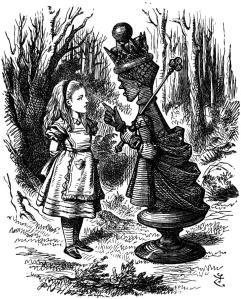
image by John Tenniel
I pray we will practice our belief in impossible things. The world needs to see resurrection.

 Glass Overflowing