A sermon preached at Calvary Presbyterian Church in San Francisco.
October 8, 2023
Introduction to Worship
Pulitzer Prize winner Gwendolyn Brooks, who wrote more than twenty books of poetry in her lifetime, was the first black woman appointed Poet Laureate of the United States.
Her poem, Paul Robeson, contains one of my favorite images.
We are each other’s harvest.
I knew Paul Robeson sang Ol’ Man River, but I’d forgotten other details of his life. He was born at the dawn of the 20th century and died in the 1970s. He was the only black student when he was at Rutgers, where he had an academic scholarship and played football.
He then got a degree from Columbia Law School while playing for a year in the NFL. He renounced his career in law because of the racism he faced and he started acting and singing. And it is his voice that we remember.
His voice was powerful and beautiful. And he sang the songs of slavery and oppression to remind people to work for justice, fully engaged in the civil rights movement. He was blacklisted by the McCarthy witch hunts. He kept singing and marching, recording 66 albums, with over 190 singles.
Listen to her poem about him.
That time
we all heard it,
cool and clear,
cutting across the hot grit of the day.
The major Voice.
The adult Voice
forgoing Rolling River,
forgoing tearful tale of bale and barge
and other symptoms of an old despond.
Warning, in music-words
devout and large,
that we are each other’s
harvest:
we are each other’s
business:
we are each other’s
magnitude and bond.
Friends, how are we using our voices? We are not all able to sing like Paul Robeson. But God has given you your own voice so that you can speak out on behalf of others in your own unique way. Our individual voices come together when we sing here to make music that none of us could make alone. Our voices reach out to each other in support, comfort and consolation. Our voices can cry out for justice, for ourselves and for others.
We are each other’s harvest. We are each other’s business.
Let us worship this day, raising our voices together as one gathering of God’s beloved community.
Scripture:
Mark 2:1-12
Sermon:
I sometimes (often) think my life is busy, but Jesus has been at work. In the previous chapter of Mark’s gospel, which happens to be only the first chapter, Jesus has already gathered his disciples, healed Peter’s mother, cast out demons, taught in the synagogue, healed leprosy, and healed crowds and crowds of people. He’s already had to go off on his own to the mountain to pray to get away from the crowds, which are following him from town to town because word is getting out and he can get no peace and quiet.
And then the poor, tired man goes home after a session meeting, to his own house. And he just wants to eat his take out, put on his sweatpants, and watch some Gilmore Girls, which he decided to binge during covid because he missed it the first time around.
And the crowds are there too. At his house. In his house.
And Jesus teaches them. It says he was “speaking the word to them”. Don’t you just wonder what word that was? Oh to be a fly on that wall.
It’s probably not the word I would have wanted to speak to them, which is why Jesus is the Messiah and I am not.
In any case, it is into this moment that a group of friends arrive, four of whom are carrying another friend on what I can only picture as a stretcher. They have a friend who needs healing. The doctors haven’t been able to help. The friend is paralyzed and cannot get himself to Jesus. He cannot do this himself. For him to be healed, it’s going to take a community.
The text does not tell us what the friend thinks of any of this. Presumably, he’d like to be healed. What is less clear to me is how he feels about his friends going to all this trouble for him. Maybe that’s just my issue, but I don’t think so. One thing I’ve observed in ministry is that people are far more comfortable with the idea of offering help to others than they are accepting it for themselves.
And even if I had agreed to let my friends help me get to Jesus, I’m quite certain I would not have pictured them hauling my stretcher up on the roof and digging a hole into the ceiling of Jesus’ house, then dropping me down in front of him. How’d that even work? Was he in a climbing harness? I just saw Pink in concert and thought of our friend on the mat being dropped into Jesus’ house as she went flying through the arena on wires.
As we ponder the friends, and the lengths they went to get their friend to Jesus, we are going to function with the premise that they had the friend’s permission and that they were exhibiting healthy and appropriate boundaries in their interactions with each other.
Their job is not to fix everything for their friend. Their work is to get him to Jesus, where the healing can happen.
And that is no small task.
Jesus, no matter what he thought about the crowds in his living room, or the hole in his ceiling,
—sees the man being lowered down before him,
—sees the work his friends have gone through to bring this man before Jesus,
—sees their hope for their friend’s healing, hope that is so strong they are willing to cause a scene,
—sees their faith, we’re told, and says to the man on the stretcher who has insulation and plaster in his hair, “son, your sins are forgiven”.
That isn’t the language I want Jesus to use, because I don’t equate illness with sin the way first century biblical authors did.
In truth, it isn’t even the language the religious leaders wanted Jesus to use, but for far different reasons. “Now some of the scribes were sitting there, questioning in their hearts, ‘Why does this fellow speak in this way? It is blasphemy! Who can forgive sins but God alone?’”
Bless their hearts.
They’ve just seen a man being dropped right in front of them. Maybe they don’t know him. Possibly they do. Capernaum wasn’t that big of a town. But they see what Jesus sees, right? They see friends who love this man so much they will do anything to put him before Jesus with a hope for healing. They see Jesus offer healing to the man on the stretcher.
And there they are, quibbling about policies and doctrine and rules, while this person who is right in front of them’s life is on the line.
Don’t get me wrong. I’m a big fan of policies and doctrine and rules. But if that’s all I see when an actual person is in front of me, in need of help, Lord forgive me.
Many years ago, right out of college, I was a Volunteer in Mission in Palmer and Wasilla, Alaska, where you cannot, in fact, see Russia from your house. I was there to do youth ministry. I suspect my only qualification for this posting was that I was myself a youth.
Anyways, I was hosting a dinner at the church for the few young adults at the church. I’d been there a few weeks at this point, I think. And some people walked into the church asking for food.
I turned them away.
We had plenty of food. I could have packed up a bag of food. I could have invited them in to eat with us. I didn’t.
I was scared. I didn’t know what the church’s policy was about helping people. Blah. Blah. Blah. I think even as I was sending them away, I knew I was doing the wrong thing, even if maybe it felt like the ‘safe’ thing to do.
I could have invited them in to join us. I sent them away.
I don’t have a life full of regret. But I will regret that the rest of my life.
When I think of the religious leaders quibbling over nothing with Jesus, I think of myself that day in Alaska. When people right in front of us need help that we can offer, we’ve got to stop hiding behind rules and tradition and fear.
Why do we put rules ahead of people? Why do we put our fear ahead of people? Why do we put scripture ahead of people? Jesus never told people to love their bible. He told them to love their neighbor, when they walk in to the church and ask for food.
That day in Alaska is not the only day I’ve gotten it wrong, of course. But it did change me. It started to orient me to welcome.
Because the truth is, I’ve been the guy on the stretcher, unable to get myself to Jesus. And I know what it’s like to have the scribes question whether or not I’m worthy of having my sin forgiven, whether or not healing should be within my reach.
In college, when I was facing an unplanned pregnancy, there were moments when I felt like the guy on the stretcher. If you’ve heard me preach before, you’ll know I placed my son for adoption and have known him all his life. 35 years later, it feels like a gift. But back then, it was impossibly hard. And there were a few people questioning in their hearts, and to my face, what a blasphemy it would be for me to show my face in church because of my sin. How dare I walk around campus with a smile on my face instead of a scarlet letter?
In truth, I felt that a bit in my own heart. It paralyzed me, metaphorically, at least. I felt I had let down my family, who had dreams for me to go to college and be the first generation to get a degree. I was raised to be the good church kid, the one who followed all the rules because God loved me. In those days, I couldn’t imagine I was deserving of Jesus, let alone deserving of asking friends for help trying to get closer to him.
Sometimes the barriers that keep us from healing are external. Systemic racism, patriarchy, and homophobia keep people from healing in real ways. And we’ve built those ceilings with reinforced concrete, stained glass, and steel beams. Policies and doctrines and rules need to be interrogated and structures need to be dismantled in our churches that keep people from getting closer to the healing of Jesus.
Sometimes the barriers are internal—shame and self-judgment we have taken on because religious voices have told us that they love the sinner but hate the sin. There were well meaning Christians who thought they were loving me when they tried to send me to a home, where I could be hidden away from view until after the baby was born.
I’m sure that was about their own fear, more than it was about me. I’m sure there was something about my situation that reminded them of their own mistakes, their own precarious virtue. Who knows. I’ve learned to have compassion for people who loudly criticize other people’s beliefs. They are usually hiding their own wounds. It isn’t an excuse for the way they hurt others though, even when we can find our compassion for them.
Luckily for me, I had a community that didn’t listen to the scribes questioning my value. They picked me up off the ground, took apart the ceiling, and brought me to Jesus.
My church family took me in and took care of me. Cutting more holes in the ceiling of my shame by feeding me. Welcoming me. Loaning me clothes. Visiting me in the hospital.
My university also dug holes in the roof of my shame.
I stood before my sorority and told them I was pregnant. I wanted them to be able to talk to me about it, rather than have to whisper behind my back.
Some of my sorority sisters told me a story recently that I hadn’t known. After I left that meeting so they could process the news, one of the sponsors stood up and spoke. Catherine Hawthorne was probably 80 years old at the time. Her husband had been a Vice President at Trinity and they were still living next to campus and very active in the community. She stood up and said, “well girls. You talk a lot about sisterhood. And one of your sisters needs you now. What are you going to do to help her?”
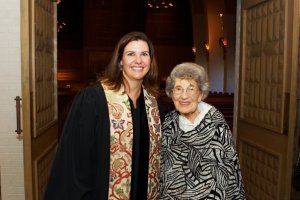
Mrs Hawthorne came to hear me preach in 2006 at Trinity, on her 98th birthday.
They waived my dues for the year. They gave me money to buy maternity clothes. They told me that I had to attend all rush events. They visited me in the hospital. One of them loaned me her car for the summer.

Before a rush event in college
If you think that acts of kindness, inclusion, hospitality, and welcome are small or inconsequential, they are not. My friends, university, and church were life saving for me.
The American story is that we are bootstrap pulling Lone Rangers who can solve all of our own problems. And it is the biggest lie ever told.
I could not have made it through that year without the help and care of others, often from near strangers who came up to me and offered to type my papers or buy me lunch.
If you think we can make it through this life without community, think again.
I do think we’re a bit out of practice being community after Covid. Maybe it started before Covid, actually. We’ve seemed to turn into mobs of individuals, but community—where we care for each other and slow down long enough to check in with each other—that can be harder to see sometimes. But God calls a people, not just a whole lot of solo actors.
Earlier I said I didn’t like Jesus using sin language when he healed the man. But maybe it is the perfect word to describe bringing someone back to community.
An article I read recently said this:
“Sin is, from the beginning, a work of division and separation, a turning of a people into scattered individuals, and God’s cure cannot take the form of the disease.”
Jesus’ healing brings us deeper into community, healing our sins. He asks the scribes,
‘Why do you raise such questions in your hearts? Which is easier, to say to the paralytic, “Your sins are forgiven”, or to say, “Stand up and take your mat and walk”? But so that you may know that the Son of Man has authority on earth to forgive sins’—he said to the paralytic— ‘I say to you, stand up, take your mat and go to your home.’
Jesus makes it clear that healing people and forgiving sin is all connected. If we want to be healed, it will take us deeper into community. If we’re concerned about sin being forgiven, we better build community so that can happen.
We are welcoming a great batch of new members today and next week in worship. And when they shared their faith statements with session, one thing that came up again and again and again was community.
To have people to go for support when life’s challenges arise. To join together to make a difference in our city. To be family together. To celebrate the joys of life. To be a part of something bigger than ourselves.
They all mentioned community.
But that doesn’t just magically happen by showing up on a Sunday morning. I mean, it’s a good start. But to become people who can carry each other to Jesus and can dig holes in his roof to help each other find healing—that takes some effort.

Our stewardship theme this year is Community Grows Here. As we’re putting together the budget for the coming year, we’re thinking about what is needed to build life giving community. Your pledges and gifts help support programming, and staffing, and opportunities to serve and give back. Victor preached last week about the seeds that we plant. Your financial support of Calvary plants seeds that help community grow.
Community Grows here. And on one level, that is descriptive of how we are already. We are a group of people that seek to support each other and be community. It is also, on another level, an aspirational theme for us.
Because post-covid, and in the current political climate, we are in a world where people have forgotten they belong to each other. We are more isolated than ever before. Church is not the only way to fix that, but it is one way. It is our way to heal the world, and to show the world that connection matters. And to model for others that life spent in community is complicated, but is also life giving and beautiful.
One thing we are starting today, and which I stole from the internet, is prayer squares. Hopefully you received a piece of paper with your bulletin when you entered. If not, I’ll pass more out later in the service. We invite you to write an anonymous prayer on it and then put it in the offering plate. After worship, we invite you to take somebody else’s prayer square and be in prayer for that request during the week. I pray it will be a visible reminder to each of us that we are each other’s harvest. We are each other’s business. We are each other’s support.
And so I hope you’ll remember the faith of the friends and think about what is required of us to dismantle the barriers that keep people from Jesus.
Are we building the kind of community that will notice when a person is lying there, unable to get themselves through the crowd to Jesus?
Are we creating spaces of connection and welcome and acceptance, where people are known and accepted as the beautifully flawed people they are?
Are we fostering Christian discipleship that allows someone to feel safe enough to ask for help when they are paralyzed and lying on a mat?
Think about the moments in your life when you were welcomed, accepted, and brought into community. Maybe they were big moments. I suspect most of them were small acts, in concert with other small acts—like people with spoons slowly digging into Jesus’ ceiling on your behalf.
Sometimes the work of community is messy work, and involves digging through some ceilings that are keeping people from getting closer to Jesus. We do it for each other but we also do it for the wider community. Much of our Faith in Action work and witness is designed to take apart those ceilings that are barriers to people’s flourishing and health.
And maybe the most impressive part of this bible story is that at no point does Jesus seem to care at all that his roof has been demolished. He doesn’t bring it up in this passage.
He never mentions it as he travels the countryside, preaching. “You have heard it said come to me all who are carrying heavy burdens….but I say to you, don’t come in through the ceiling, for Petes sake.”
He doesn’t mention it at the cross. “Father, forgive them, for they know not what they do. Except don’t forgive those guys who destroyed my house.”
We talk about our churches being God’s house. And maybe that’s our justification to not change, or to not do a doctrine remodeling project.
But if Jesus is okay with his house being destroyed so someone can find healing and welcome, we should be too. We have already started dismantling a lot of barriers in our work of LGBTQIA welcome, in our anti-racism work, in our support of each other. We’ve still got some roofs to dig through. Let’s get to it.

 Glass Overflowing
I would love for you to come to Fresno to preach this sermon! I’ve just been having a similar conversation/discussion/pondering with some of our church folk.
LikeLiked by 1 person