A sermon preached at Calvary Presbyterian Church in San Francisco, CA
September 10, 2023
Genesis 2:4b-7, 15-25; 3:1-8
Introduction to Worship:
Today begins the program year of the church, even though many of our programs have been going all through the summer. Our choir is back to rehearsing Thursday nights. Adult Education classes will resume after worship. We call it homecoming Sunday here, and it is good to have us back together after vacations and holiday weekends, to be gathered as a community of faith.
We will mostly be preaching this year from something called the Narrative Lectionary, which is a four year cycle of readings that gives you a pretty good overview of the sweep of the biblical story. We start today at the beginning, in Genesis. We’ll read through the Old Testament and prophets in the Fall and then after Christmas, we’ll read through a gospel through Easter. After Easter, we’ll hear from the letters of the New Testament.
It matters that Christians know the stories of our faith. It matters, because as Presbyterian flavored Christians, we believe God speaks to us through scripture, when it is read and when it is proclaimed. It’s why our ancestors in the reformation fought to be sure the Bible would be translated into the languages people actually spoke, rather than hearing the priest read it in Latin.
I think it also matters because a lot of people talk about the bible, and how important it is for our nation to be ‘bible based’, but then they behave in ways that suggest they haven’t read much of it. They take a story of love and redemption and turn it into a fear based story of exclusion.
And I think it matters we read it in community, because it’s a tricky book. The Bible is a library of stories, written by people from different cultures, languages, and worldviews, compiled over centuries, and translated from the Hebrew and the Greek into Latin, and then into English. If you’ve ever learned another language, you know that a lot of choices are involved in translation.
And so, as 21st century, American Presbyterian Christians, we have to wrassle a bit over what a nomadic person who lived 2500 years ago on the other side of the world meant when they wrote what they did in another language. We need each other. More specifically, we need the Holy Spirit moving between us to help us make sense of scripture.
When children are baptized, we give them a story bible for their parents to read to them. Even if you were able to attend worship each week, that’s only one hour of faith development a week. It’s worth paying attention to in the other 168 hours of your week too.
So we encourage you to read your Bible. If you don’t have one, let us know, and we can get you one. If your kids were baptized somewhere else and you don’t have a story bible for them, let us know that too. We can get you one. If you want to purchase a study bible, but are overwhelmed by what the different translations mean and have questions, let us know.
Next week, we’ll be starting a 9 am Bible Study on Sunday mornings, led by one of the pastors. You can drop in any week you can get here that early. We have a men’s bible study on Monday mornings on zoom and a few different women’s monthly bible study gatherings. You can join one of those groups, or if you want to start your own, we can help with that too.
Maybe you’re thinking you don’t need one more thing to do in your busy life. And I get that. I don’t mean to be adding stress to your life. But as a teacher and friend told me once, many years ago, “Marci, if you’re too busy for God, you’re too busy.”
I should cross stitch that and put it on a pillow where I see it all the time.
We’re glad you’re here today. That you’ve taken the time to gather together with other seekers, both in person and online. As we begin at the beginning, a very fine place to start, let us breathe in God’s love and mercy. Let us breathe out God’s love for a weary world. It is good we are here, together.
Sermon:
One of the reasons we read scripture every week in worship, and encourage you to read it during the week between Sundays, is that scripture is the story of our Christian faith, and culturally, we have lost the thread of the narrative.
When we don’t know our stories, we don’t know who we are.
Because we are story people.
We experience things in life and then assign meaning to those events by telling stories. The stories we hear and the stories we tell define and shape our world.
As illustration, here are some stories I was told as a child.
–The principal at my elementary school, Mr Claus, lost vision in one eye. We were told it was because he had run down the hall with a pencil in his hand.
–My shop teacher in junior high would hold up his hand and show us the missing digit of his hand as he told us to be careful using the lathe.
–My dad had false teeth since he was a teen, because he never brushed his teeth.
I think the early story of my life was that adults maimed themselves in order to serve as object lessons for me.
Don’t run with pencils. You’ll poke your eye out.
Pay attention by power tools. You’ll lose a finger.
Brush your teeth or you’ll lose your teeth.
(Fans of Arrested Development might recall J. Walter Weatherman. )
I was a careful child with well brushed teeth.
Twenty or more years ago, when we were taking my dad to have his dentures fixed, young Alden asked why his papa had fake teeth. I told him the story and my dad said, “I guess you can tell him that if you want”.
“What else would I tell him, dad?”
Turns out my dad lost his teeth in a fight at a drive in when his face met up with a tire iron.
Now, I see why he didn’t tell us that story when we were children. I trust though, you can also see why it was a little unsettling to hear the actual story after thinking I knew the ‘real’ story my whole life long. I’m also skeptical about what happened to my principal’s eye.
The stories we tell about our lives matter and they shape us. If we only tell what we think are the “good parts” of the story, where we are the heroes, and where we get it right the first time, our narrative is incomplete.
Similarly, if we only tell the stories of how we fail, how we do not belong, how we don’t matter, our narrative is also incomplete. We have to tell the whole story.
Telling the story of our life is also a communal act.
If we live by ourselves in a cave, there wouldn’t be anything exciting to tell about our story, for one thing. But without people to hear the story we have to tell, what is the story worth? To illustrate my point, in our story today, Adam doesn’t speak a single word until Eve exists and he has someone to talk to. Language requires community.
Also, stories are communal because they are mediated and negotiated between people. Last year when my family gathered in Spokane for my mom’s funeral, there was a fair amount of “remember that time when….”
Sometimes, we would all laugh and remember the story. Sometimes, though, I would have no idea at all of what they were talking about. Whatever the story was about was something that held more meaning for them than it did for me.
And sometimes, my reply was “that’s definitely not how it happened”.
We each have a particular story to tell and it matters that we give each other space to share stories and give each other time to listen to stories, even as we allow other people’s stories to be different than ours would be.
And I think it means sometimes we have to wrestle with the stories we think we know. Just because we’ve heard it told one way our whole lives doesn’t make it right. It just makes it true, or real, for us. We decide someone is the bad guy in the narrative because we’ve always been told they are the bad guy. But maybe it was more complicated than that? (Darth Vader)
And so, as we start through the readings for the Narrative Lectionary today, think about what it means to be people of the story. The story of the Garden of Eden, and of Adam and Eve’s decision to eat of the fruit of the tree of good and evil, has had implications in our lives for thousands of years because of the way the story has been told.
And so I’ve been wondering what the tree of the knowledge of good and evil has for me to learn this time. Because each time I read this passage, it means something different to me, so I’m grateful for biblical stories that are so multivalent.
The Genesis account is an historically loaded text. It has long been used to blame women for all sorts of things, even in the New Testament. The author of 1 Timothy writes in my absolute least favorite passage of scripture:
I permit no woman to teach or to have authority over a man; she is to keep silent.
For Adam was formed first, then Eve; and Adam was not deceived, but the woman was deceived and became a transgressor.
Yet she will be saved through childbearing, provided they continue in faith and love and holiness, with modesty.
Since you just heard the Genesis text read, I trust that you are wondering, “wait, Marci, wasn’t Adam a part of it? Didn’t he eat the fruit too?”
Why, yes. He did. Thank you for noticing. You are correct.
This text is used to keep women from full flourishing in the church. (Well, maybe not so much at this particular church. We’re doing pretty well here. But in other churches). This text is used to support the theological understandings of “The Fall”, where we left a garden of earthly delights for a life of labor in a hard world because of original sin.
But the word “Fall” does not occur in the text. Neither do the words “Original” or “Sin”. And, if you noticed, there was already labor in the garden. God put Adam and Eve in the garden to tend it, to protect it. They weren’t sitting on chaise lounges, drinking pina coladas all day. So the idea of work being a result of the Fall is not correct.
We’ve been telling this story poorly for a long time.
Do you have stories like that in your life too?
My story about my high school years was that I was awkward and large and marginally near the popular crowd. And I thought everyone else had it figured out while I was fumbling around and not doing well. And a few years ago at a high school reunion, I commented something to that effect when I was catching up with friends and they all looked at me like I was speaking in tongues. “What?”, I asked.
“That’s not what you were like in high school at all,” they told me. “You were the one who had it figured out. We all thought you were going to be the President of the whole country. Remember that? You were the one who had it together.”
It was an illuminating moment for me to consider that maybe I’d didn’t know myself quite as well as I’d thought. And that perhaps I’d been telling my story incompletely for a long time. Perhaps my experience of myself was different than other people’s experience of me.
We have to interrogate our stories. Always.
The story that I’ve gone to see again, and again, and again this summer is the Barbie movie. No joke. I’ve seen it in theaters 4 times and was unhappy it wasn’t available for me to watch on the plane the other day. I love this story.
The story in this movie also begins in an Eden.
I read an article by Daneen Akers, where she writes:
“Barbie begins in an Eden-like setting where every day is perfect. (Barbie says…)“[Today] is the best day ever. So was yesterday, and so is tomorrow, and every day from now until forever.” Of course, it’s a very pink and plastic kind of Eden with a lot of sparkly outfits and choreographed dance parties, but to the Barbies, this is perfection. Women run everything and the whole of Barbie Land works for the empowerment and fulfillment of the Barbies.
Ken, well—Ken is a helper, a secondary creation. He’s really an accessory to the main creation, and they all know it. Helen Mirren’s narrator even says, “Barbie has a great day every day, but Ken only has a great day if Barbie looks at him.”
By going to the absurd extremes, with actors who brilliantly pull it all off, co-writer and director Greta Gerwig scores hilariously resonant points about the harms and ills of gender inequality.”
But then Barbie begins to malfunction. She brings a dance party to a screeching halt, asking if anyone else has had thoughts of death. One morning, her Barbie high heel feet become very human looking flat feet. She wakes up with bad breath. Her toast burns and her milk goes bad.
To deal with her malfunctioning, she’s told she must leave Barbie Land and go to the Real World and fix the problem.

Barbie and Ken on their way to the Real World.
Barbie has a Tree of Knowledge of Good and Evil moment. Does Barbie choose to stay ignorant of complex emotions and the reality of death by staying in Barbie Land? Or does she choose to step into the real world, with all of its nuances, and pain, and beauty, and death?
Initially, she wants to return to the Eden of ignorance and bliss. But she has to go to Reality to solve the things that are going wrong. Because life is complicated. Full of pain and joy and success and heartbreak, and even death.
In the Barbie movie, Barbie gets to meet her creator. The woman who invented Barbie is played by Rhea Perlman, a comforting Jewish granny, with a heart full of pride and compassion at who Barbie is becoming.
As Akers writes: “She doesn’t control Barbie. She’s curious and even surprised to see the choices Barbie is making as she grows up and decides to become fully human, complex emotions and thoughts of death included.” She also warns Barbie of the consequences of the choice to become human: “Being a human can be uncomfortable. Humans only have one ending. Ideas live forever.”
In other words, she can stay in the garden of eden, perfect pink Barbie Land forever, or she can venture out into the world of humans, where people get sick and eventually die, where humans hurt each other, where wars rage and patriarchy rules.
Barbie weighs the consequences. She’s realized that she wants the complexities, and even the thoughts of death, that come with being fully alive. Because the real world is also where the magic happens. Where humans surprise us with kindness and beauty. Where we find community and love. And Barbie also wants creativity, which is a gift of the complexity of human existence. She wants to be “part of the people that make meaning, not the thing that is made.”
If Adam and Eve had stayed in the Garden, and not left it for the ‘real world’, the Bible would have been a much shorter book. And each and every day would have been the perfect day, just like yesterday, and just like tomorrow.
Maybe that has an appeal for us, on some level. Maybe, like Barbie first did, we think we want to stay in Eden and avoid the troubles of life. That maybe we can avoid pain and work. We think “dang it Eve, why’d you have to ruin things for us like that?”
But the ‘real world’ is also where the magic happens, and maybe Eve figured that out in her own way too.
The consequence of eating the fruit was that death became part of human experience.
It is past time for us to stop blaming Eve for humanity leaving the Garden. Leaving the Garden is what really makes us human.
Try as I might, though, I just can’t write a positive story for the serpent. We all know too many serpents in the world, who tell us things that are mostly, or partly, true, but interpreted in such a way that you have to wonder about their agenda.
But then it occurred to me that God put the snake in the garden in the first place. Even in the paradise God creates for us, we get smooth talking hucksters.
Maybe the snake was just playing their part in helping Adam and Eve figure out that to be fully human, we must leave the Garden. Maybe we’ve been misunderstanding the snake all this time.
I’m grateful for the world we live in outside of the Garden, for all its challenges, pain, strife, and snakes. Eve didn’t ruin anything for us. She showed us that life is worth the consequences of living.
It’s okay if you completely disagree with me about this. I recognize that early church leaders like Augustine would be rolling in their grave about what I’ve said. But they also wouldn’t have called me as your pastor in the first place, and they might also be scandalized by other modern inventions we have here, like live-streaming and the pipe organ.
The people who wrote Genesis were trying to make sense of the world they lived in. Why was life hard? Why did childbirth have to hurt so dang much? Why are there snakes and why are we so afraid of them?
The story of the Garden is a story of humans seeking to make meaning of their experience of life. And God enters into our exploration.
Barbie said she wanted to be part of the people who make meaning, and not the thing that is made. Maybe it isn’t either/or. We are part of creation. God made us. God made this world in which we live. AND God gave us brains so we can make meaning of our experience.
Jess has made us some swag for today. On the tables outside the sanctuary, and in Calvin Hall for the homecoming lunch today, you can pick up a “Make Meaning” sticker.
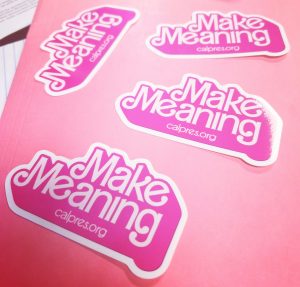
Place it where you’ll pass by it during your day, and when you see it, I invite you to remember that you get to be the person who writes your story, who makes meaning out of your experiences. We believe that we know ourselves best in community. So be sure to surround yourselves with people who will help you reflect and interpret the things that happen to you.
The poet Mary Oliver said,
Instructions for living a life.
Pay attention.
Be astonished.
Tell about it.
And don’t be afraid to leave the garden. It’s a beautiful world out there. Go make meaning, and share it with others.

 Glass Overflowing
Pingback: Laughing at God | Glass Overflowing
Such thoughtful, Spirit filled reflections. Thank you!!
LikeLike
Thank you!
LikeLike