A sermon preached at Calvary Presbyterian Church on March 22, 2026
John 19:1-16a
Introduction to Worship
Good morning and welcome to worship at Calvary.
I am Marci Glass, Pastor and head of staff. Whether you’re here for the first time or whether you are here every week, I deeply believe that it is God who has invited you here today, and it is my privilege to welcome you as a guest in this place. In the music, in the liturgy, in the prayers, in the silence, I pray you will find what your soul needs this morning.
A few weeks ago, one of the new members shared a quote in their faith statement when they joined the church. It is one I hadn’t thought of in a long while, and I was grateful to be reminded of it. Here’s the quote:
Be joyful, though you have considered all the facts.
It is by Wendell Berry in his poem Manifesto: The Mad Farmer Liberation Front
In it he also writes:
So, friends, every day do something
that won’t compute. Love the Lord.
Love the world. Work for nothing.
Take all that you have and be poor.
Love someone who does not deserve it.
And the poem ends with “practice resurrection”.
We’re going to hear a story today from John’s gospel as we continue the story of Jesus’ journey to the cross. We aren’t at the resurrection part of the story today. That will come on Easter morning.
But practicing resurrection is something we can do, even in the midst of our Lenten journey.
We can’t raise dead bodies from their tombs. Some resurrection is only in God’s purview.
But we can be on the lookout for new life in the midst of the death we see around us. In times of destruction, whenever we make art, celebrate beauty, cultivate new life and growth, we practice resurrection. When we help a stranger, we practice resurrection. When we refuse to believe that systems of oppression should prevail, we practice resurrection.
When we can find joy, though we have considered all the facts, we practice resurrection.
Practicing resurrection acknowledges we aren’t perfect at it—it is a growing edge for us—and we have some work to do to develop our resurrection muscles. And I’ve found joy is a good companion to my imperfections.
DON’T HESITATE by Mary Oliver
If you suddenly and unexpectedly feel joy, don’t hesitate.
Give in to it.
There are plenty of lives and whole towns destroyed or about to be. We are not wise, and not very often kind.
And much can never be redeemed.
Still, life has some possibility left.
Perhaps this is its way of fighting back,
that sometimes something happens better than all the riches or power in the world.
It could be anything,
but very likely you notice it in the instant when love begins.
Anyway, that’s often the case.
Anyway, whatever it is, don’t be afraid of its plenty.
Joy is not made to be a crumb.
Sermon
In last week’s episode, Jesus’ trial with Pontius Pilate begins. The religious leaders are looking for someone to do the dirty work of killing Jesus for them. Pilate is more concerned with keeping the peace during the religious holiday of Passover, than he is interested in the minutiae of Jewish law. He wonders what Jesus did to annoy his own people. He wonders why the Jewish people would want to kill their own king. He wonders how he can get out of this and not have a riot break out. At the end of last week’s passage, Pilate asks Jesus “what is truth?”. In this passage today, we will get an answer, so to speak.
In addition to asking about Truth, Pilate wanted to know about kingship. He asked if Jesus was the “king of the Jews” Jesus responded with “my kingdom is not from this world…”. Jesus’ words don’t deny he’s a king, and they don’t settle the matter in a clear way.
In today’s story, we don’t hear much about Jesus’ kingdom, but Jesus is presented as the King, even if a king to be mocked. Soldiers flog Jesus and hit him in the face as they have him wear a “kingly” crown of thorns and purple robe. Pilate offers the Jews their king, trying to be done with the whole matter. The religious leaders will deny Jesus’ authority and kingship.
In Matthew’s gospel, Jesus often talks in parables that begin with “The kingdom of heaven is like…..”
treasure hidden in a field
a mustard seed
leaven
Jesus doesn’t tell those stories in John’s gospel. His words, his stories, don’t describe the kingdom of heaven. His entire life is the story to show us what the king of heaven looks like.
Earlier in John’s gospel, Phillip says to Jesus, “Lord, show us the Father, and we will be satisfied.” Jesus replied to Phillip, “Have I been with you all this time, Philip, and you still do not know me? Whoever has seen me has seen the Father.” (14:8-9)
We are to look at Jesus to see who God is, to see what kind of King God is, to get a glimpse of God’s kingdom.
Which then leads Pilate to ask his next question of Jesus. Where are you from?
The story reports Pilate is “more afraid than ever” as he asks that question. He still doesn’t seem to know what is going on, but perhaps it is starting to dawn on him that there will be no simple solution to this problem.
Jesus doesn’t answer Pilate. Perhaps because Jesus is the answer.
Ironically, Pilate had just paraded Jesus in crown and robe, beaten and bruised, in front of the crowds and declared, “behold the man!” The art on the cover of your bulletin is titled that in Latin. Behold, the man. Later, he says, “behold your king!” Pilate unwittingly becomes an instrument to offer Jesus as king, displayed to the world.
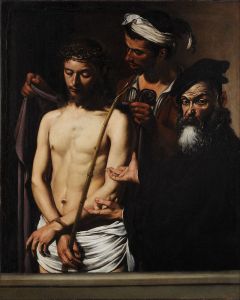
Even as Pilate thinks he is mocking Jesus as a weak king without subjects or authority, what he really does is reveal the hollowness of his own power, the lack of authority he truly possesses in the situation, and the utter difference between kingship as contrived by humanity and as embodied by God.
Pilate’s human authority beats an unarmed man to appease a crowd. God’s authority absorbs the violence but will not return violence to the world that God loves.
Pilate’s human authority requires threatening questions, posturing about his power, and diminishing his conversation partners through mockery.
God’s authority doesn’t demean others, it doesn’t beg for validation, it leaves room for others to claim dignity and humanity.
Behold your king!
Where are you from?, Pilate asks.
The answer has already been given. At the beginning of the gospel.
“In the beginning was the Word, and the Word was with God, and the Word was God. He was in the beginning with God. All things came into being through him, and without him not one thing came into being.”
Jesus is from the beginning.
Jesus is also “the way, the truth, and the life”, and truth is an important theme in this gospel. In all of Jesus’ interactions in this story, he reveals what is true about himself. More than that, he causes the truth to be revealed about everyone else too, no matter what they might say. We see the truth of who Pilate is. And the truth of who the religious leaders are. People also unwittingly and unwillingly show us the truth, when the soldiers proclaim, “here is your king”, and when Jesus’ own people say “we have no king but the emperor”. Truth is all over this story, whether people want to see it or not.
It’s supposed to be the trial of Jesus, but at the end, it’s the religious leaders who stand condemned. As the chief priests at the end of this story tell Pilate “we have no king but the emperor”, they deny a fundamental tenet of their faith, and mock their own Passover liturgy.
Remember, this trial is taking place as Passover preparations are underway, a day where they proudly profess “we have no king but YHWH”. To say they have no king but the emperor is an egregious claim, and it further mocks their attempts to remain ritually clean for the passover.
One of my favorite Oscar Wilde quotes is, “The truth is rarely pure, and never simple.” There are things we would say are true, but sometimes it’s not something that connects to our lives in a real way. The truth of it doesn’t have legs.
I say I’m opposed to human caused climate change, for example. At the same time, I drive a gas powered car and fly on a lot of planes. What is really true for me? The truth is, I like to be comfortable more than I want to be inconvenienced with reducing human caused effects on the climate.
Or, someone might believe in small government, until there’s a natural disaster and they need governmental assistance, which reveals the real truth, which is maybe, that we want government to take care of us, but not everyone else.
Or, we say we believe in First Amendment rights to free speech and protests. Until the people who are peacefully protesting hold views that are different than ours. I confess I feel very differently about people with signs outside a Planned Parenthood clinic than I do about someone taking a knee during the national anthem.
We have a lot of unexamined “truths” in our lives.
This week, Delores Huerta shared a truth from her life that she had held on to for over 60 years about sexual violence at the hands of Cesar Chavez. More than 30 years after his death, new allegations of sexual abuse against labor leader Cesar Chavez are triggering fallout across California, including the cancellation of planned celebrations in his honor. Chavez, who co-founded the United Farm Workers and led national boycotts and labor campaigns, remains a central figure in Latino civil rights history. He was posthumously awarded the Presidential Medal of Freedom in 1994, and his birthday was declared a U.S. federal commemorative holiday in 2014.
It is not uncommon for people to not come forward with truth about abuse, or to come forward decades later, because, quite frankly, we don’t tend to believe the people who do speak their truth. Even when we have emails from the bad guys, joking about the abuse, we still seem to ignore the cries of the victims.
And while these stories will never be confirmed because Chavez is not alive to defend himself in court, the truth is that humans are complicated.
He led an important labor movement, AND it appears that he was violent toward women. Sometimes our unexamined truths are about the complicated nature of humanity. I am thankful to Huerta for speaking her truth now. When other women came forward with stories of his abuse, she realized it had not happened to her alone, that there were other victims.
We all live with a fair amount of hypocrisy. There is a human tendency to reinforce our biases. And we live in a culture that encourages us to not examine our inconsistencies, and that rewards people who flaunt them and who help us pretend they don’t exist.
The power of this scene in John’s gospel is that Jesus reveals all those places where our unexamined truths don’t match what we really believe.
For Pilate, he says he has lots of power. The way Jesus engages him in conversation reveals Pilate’s insecurity and his desire for approval. For the religious leaders, they claim to serve God, but they reveal they have no king but Caesar.
Behold your king!
Behold yourself.
Jesus embodied truth deeply and thoroughly in his very life, standing as a mirror to reveal our inconsistencies back to us. Not to shame us, but to reveal the limitations of relying on human kingdoms and human kingship.
Jesus’ death on the cross will be the ultimate act of that revelation, showing us our violence cannot bring peace.
Mike McHargue is known as ‘science guy’, and also a Christian who has wrestled with faith, walked away from faith, and reconstructed his faith. He had a podcast I enjoy listening to called the Liturgists, and he wrote:
“The cross was not God’s invention—it was ours. In all our need for an eye for an eye, I have to wonder sometimes if God listened to us cry for blood and offered his own—if Jesus’ sacrifice on the cross was not to sate God’s wrath, but to show God’s response to ours.”
When we behold our king, as he’s on the way to the cross, we behold our own reliance on violence and we behold our need, our deep hunger, for another way.
There’s plenty of violence in our world today. I don’t have time to list it all. But as we think about our response to the violence of our government, the violence of nations against nations, the violence in our community, the violence in our own hearts, it is important that we don’t return violence with violence.
There is no path to peace through violence. But the path to peace may put you at risk, and in the path of the system that benefits from violence.
When we see people standing peacefully by their neighbors, asking ICE agents if they have a warrant, only to be attacked by the ICE agents, or arrested and detained themselves, it is a reminder that choosing peace and choosing justice is not a simple, or even safe choice.
How will we respond, as a country, as we see people standing in the face of violence, threats, and intimidation to reveal our violence back to us?
We pray every week to a God of peace as we live in a culture of violence.
As we move toward Holy Week, which begins next week with Palm Sunday, I invite us to live examined lives. I invite us to be aware of the times the media, or our nation’s leaders discourage us from that examination. As we watch Jesus journey to the cross, may it help us see Jesus more clearly, so we may know ourselves more deeply.
Our journey of Lent is intended to be a path of reflection and penitence and prayer. I am grateful to get to journey down this path with you.


 Glass Overflowing
Wonderful sermon for the times we are experiencing. Bold and needed.
LikeLiked by 1 person
Thank you!
LikeLiked by 1 person