Introduction to Worship:
Good morning and welcome to worship at Calvary.
I am Marci Glass, Pastor and head of staff. Whether you’re here for the first time or whether you are here every week, I deeply believe that it is God who has invited you here today, and it is my privilege to welcome you as a guest in this place. In the music, in the liturgy, in the prayers, in the silence, I pray you will find what your soul needs this morning.
Today is Transfiguration Sunday, when the church remembers the day when Jesus and a few of his followers went up the mountain to pray, and while there, Jesus was transfigured before them, all shiny and sparkly.
We won’t be hearing that story today though. In John’s gospel, which we are in the middle of right now, we don’t get the transfiguration story. I’m not entirely sure why John didn’t include it, but I suspect it is because Jesus is sort of transfigured all the way through John’s gospel. John begins with Jesus being present at the beginning of creation. Jesus talks to God throughout John’s story. He seems to sort of float a little above the concerns that weigh us The other gospels begin with the story of a human baby born in a manger and perhaps they need different glimpses of Jesus’ divinity than John does.
But our story does have transfiguration themes. When the passage is read, notice how people change (or don’t change) their understanding of who Jesus is, based on their experience. Sometimes Jesus is up on the mountain top, shiny and elevated, looking very much divine. Sometimes Jesus’s divinity shows up in the care he provides to a person who needs healing. May we see him and understand him more clearly, so we may be transformed.
Scripture:
John 9:
Sermon
I want to begin this morning with a disclaimer. The gospel of John often uses blindness as a metaphor for people who do not understand who Jesus is.It suggests that God would cause someone to be blind to reveal God’s glory. We do not believe that to be true. It is a dangerous message. My father was blind, and I am aware that using a condition that so profoundly affected his life as a metaphor for faithlessness is problematic. And yet the people with the worst vision in this story have perfectly functioning eyes. So I hope we’ll recognize the vision-related language in this story, and then do our best to notice, and be more attentive to, the language we use when we tell our stories.
I love this story. But you know how it is with stories you love? Every so often you read it again and it says something that you didn’t notice the last time, or the last 243 times, that you read it.
One thing I noticed this time around is at the beginning, when Jesus is asked the question,
“Rabbi, who sinned, this man or his parents, that he was born blind?”, it is the disciples who ask the question. Doesn’t it seem like the kind of question his detractors would ask to trap him?
But it was asked by his friends.
“Rabbi, who sinned, this man or his parents, that he was born blind?”
We assume that the disciples weren’t trying to trap him. Which means that they are trying to understand the world they encounter.
And Jesus leaves them in their dissonance. Jesus doesn’t clearly explain anything.
For him, everything in the world is a sign that points to him, helping us see and hear him more clearly. In John’s gospel, there aren’t miracles as we have in the other gospels. There are signs. And the signs aren’t big deals on their own. Jesus spat on the ground and made mud with the saliva and spread the mud on the man’s eyes? Not much of a miracle. Spit. Mud. No, this story isn’t about the sign. It is about how the sign points to Jesus. Signs are events and actions that make our vision clearer and make our hearing sharper.
Unless they don’t.
For some people in this story, the signs don’t improve their vision. This sign, of the man born blind having his sight restored, doesn’t in any way, fit with the world they know and can explain. And as such, even though they are asking questions, they seem to be standing there like this: with their hands over their ears and their eyes closed, singing “la la la la la. Not listening!”
So it makes me wonder if we should be careful of only asking questions that try to explain away they mysteries of faith and the mysteries of life. Some people are born blind. Some people are born with 20/20 vision. Jesus doesn’t explain it.
And the formerly blind man doesn’t either. He’s not interested in speculation. They ask him, and they ask him again, about how he was healed.
How did it happen?
Who did this?
What do you say about him?
For the formerly blind man, it is the act of testifying about his experience that brings him to sight. Yes, Jesus restored his vision, but lots of people have functioning eyes. It was his repeated testimony that seems to move him to seeing who Jesus truly is. “Lord I believe”, he says to Jesus at the end of the story.
So, even when we really have no answers to the questions, we’re supposed to say what we know, even when, especially when, it is different from what we thought we knew.
And we need to expect the interrogation.
One of the most popular insults on the internet to clips from my sermons is “women can’t be priests” or “God doesn’t want women to preach!”.
It isn’t something I can explain to them. For one, the internet is no place to have a real conversation. But even if they were right in front of me, I couldn’t convince them that our interpretation of scripture is correct and theirs is wrong. I could only tell them, “I don’t know the mind of God, but one thing I do know is this. I thought I was going to be a lawyer, or maybe a newspaper editor, and yet I kept getting doors closed for me to those careers and getting somehow shoved into doorways that led me to a church career.”
Or “I don’t know what God is thinking, but one thing I do know is preaching is the thing that makes me feel closest to God and makes me feel most alive.”
My arguments won’t change their arguments, but maybe my testimony might meet them in a different way?
Once you’ve encountered Jesus, your life is different. The crowd doesn’t even recognize the man when he first comes back with his sight. He has to keep telling them, “I am that guy”.
So then they ask him, ‘fine, if you’re the blind man, how can you see now?’
“The man called Jesus made mud, spread it on my eyes, and said to me, ‘Go to Siloam and wash.’ Then I went and washed and received my sight.”
He testifies to his experience. He doesn’t say that everyone needs to have the same experience he did. He doesn’t claim that his experience is more valid than someone else’s. He just says what he knows.
I wish the crowds had asked him, “What did the mud feel like when he put it on your face? What is it like to see? Is it what you thought it would be?”
Wouldn’t that be great, if instead of trying to make sense of everyone else’s experience, we could just enjoy it with them?
But instead they take him to the Pharisees, who sadly get blinded by the technicality of the sign. Jesus made mud on the Sabbath. The mud business doesn’t seem like a big deal to us, certainly not a hanging offense, but Pharaoh had the Israelites make mud into bricks, remember. Slavery in Egypt is not something they are going to forget, because it was horrible. So there is value in their long memory. But no matter how useful and beneficial those rules had been at the beginning, once the religious leaders have quantified their faith experience into only rules and restrictions, they missed the opportunity to see God.
Our traditions are great. But we shouldn’t let them close our eyes to the presence of God in our midst.
Through the interrogation with the Pharisees, the formerly blind man doesn’t get sidetracked. He keeps telling them what his experience was. And, when pressed, he makes a claim about Jesus. “He is a prophet.” His awareness of Jesus seems to be getting clearer for him as it remains muddied for the religious officials.
So then they bring in his parents. Not the parents finest hour. “Is this your son? You say he was blind? How can he now see?”
“Umm…well, yes. He’s our son. I’m pretty sure that’s my son. We have no idea what’s going on. Why are you putting us in this uncomfortable situation? We didn’t do anything. Just ask him!”
Gee, thanks mom and dad.
But sometimes our families are the last people who can understand our experience of Jesus. Because they have raised us in their traditions, and given us our rules. Why would our experience be different than theirs? But the man born blind doesn’t get derailed when his parents push him in front of the proverbial bus, handing him over to the authorities. He continues to speak of his experience and how the sign of Jesus’ healing helped him to see.
And he is quite impassioned in his own testimony. Clearly, he was paying attention in Sunday School.
Here is an astonishing thing! You do not know where he comes from, and yet he opened my eyes. We know that God does not listen to sinners, but he does listen to one who worships him and obeys his will. Never since the world began has it been heard that anyone opened the eyes of a person born blind. If this man were not from God, he could do nothing.
And then he’s driven out of his community. The neighbors, the religious authorities, and his own parents decide that they don’t want to trust the voice of the formerly blind man. They decide that their preconceptions about God are more important than the man’s experience of being healed by Jesus.
The story ends with some positive outcomes for the formerly blind man, more or less. He’s gained his sight. And Jesus comes and finds him and gives him the opportunity to make his confession of faith. “Do you believe in the son of man?”
“Lord, I believe”.
That’s all we can do. We can’t explain away the troubles of the world. We can’t explain away the mysteries of the faith. We can’t open other people’s eyes and turn their heads, saying “there he is. Jesus is right there. Look!”
All we can do, everything we should do, is testify to the light.
Now, I realize that in this story, testifying doesn’t seem like such a good deal. He loses many of his friends, church types, and family. He doesn’t appear to be “successful” at evangelizing because nobody “comes to Jesus”—whatever that means.
But here’s the good news. That’s not his job. Being successful at saving people isn’t what he is supposed to do. That’s what God does. He just testifies to what he’s seen. Presumably, Jesus didn’t heal the blind man because of his public speaking skills or his gifts for evangelism. Jesus healed him because he needed healing.
And so the man told his story.
“One thing I do know, that though I was blind, now I see.”
He had to change his mind about his own experience, just as his family and friends had to reckon with.
What is something you’ve changed your mind about, something that you were raised to know for sure was right or was wrong? Something that maybe even you were told God was very clear about?
I was raised in what I would describe as an average Republican-ish household. I don’t know this for sure, because my family never talked about politics. My parents would vote, but they never told me who they were voting for. I suspect they were Eisenhower kind of Republicans because the American dream worked pretty well for them. Neither of them went to college, but my dad was able to apprentice his way into being a respiratory therapist—the first one licensed West of the Mississippi. They were able to buy a house in the right neighborhood in town and raise their kids to be American dream people too.
I was raised with a contradictory set of messages. My grandmother hated Jimmy Carter, but when he came to town, she still got dressed up and went to see him to show respect to the office of president. I was taught to honor and respect people regardless of their skin color or where they were from, and my parents had a diverse group of friends. But I also grew up hearing racist and ethnic jokes and going to a restaurant called Sambo’s. I was told that I could be anything I wanted to be when I grew up, but I discovered along the way that there were jobs that were better suited for men than for women. And my dad taught me how to change the oil in my car, but really only seemed to want to spend time with my brother re-building his Camaro.
But things changed. My dad stopped telling racist and homophobic jokes. We couldn’t get him to stop telling Norwegian jokes, but since we were part Norwegian, that seemed like a win.
My mom called me when Washington State was voting on gay marriage, and said “I always was taught that homosexuality was wrong, but it seems to me that our society would be better off if gay couples could have the stability of marriage the way dad and I have had. Right? Doesn’t that make sense? And you think that’s okay with God?”
I will always treasure that conversation with my mother, assuring her that her argument made good sense to me and that it fit well with what she was taught about the sanctity and value of marriage too, even if she had to change her definitions a little.
We can see and understand things differently as our experience changes. Or we can choose to hold tightly to what we’re certain we know, even when it doesn’t match our experience.
And when I look around at the world, I can see a lot of people who are blinded by I don’t know what. Claiming to be worried about theoretical criminals on the street while also believing that people actually convicted of crimes belong in the White House.
What I can’t as easily discern is where my vision is cloudy, or where I’m refusing to see what is changing.
Listen to me now. Each and every one of us is wrong about something we’re certain we’re right about. We just don’t know what it is. Also, I don’t tell you that so that you can go tell everyone else what they are wrong about. Our work is to figure out our own error. What is the belief we’ve been stating as fact that we’ve gotten wrong?
In the public square, and too often in religion, our state of believing has ceased to be about common understanding and personal experience, and has become a discordant, clanging chorus where the loudest voices seem to win.
Our story of the man born blind suggests clear vision doesn’t come from allegiance to a belief system. It doesn’t come from being fixated on the HOW or WHY questions that try to quantify, explain away, or control the mystery of faith.
Clear vision arrives at the point where the man says “I do not know.”
What if we are called to gently guide people away from the walls of their own certainty and toward the horizons of God’s mystery? Horizons are not fixed points. They change as we move. They don’t pretend to be the final answer about anything. They are just the limit of what we can see right now, from where we stand. And the horizon looks different to those standing in a different space.
The Confession of 1967 begins with this line: “The church confesses its faith when it bears a present witness to God’s grace in Jesus Christ. In every age, the church has expressed its witness in words and deeds as the need of the time required.”
We speak an affirmation of faith in worship each week. The PCUSA’s Book of Confessions contains statements we have inherited from our ancestors in faith. From early creeds, to statements from the Protestant Reformation, to more contemporary statements—when we look at these statements over time, we see both the changes and the through line of our faith.
We don’t often use the Scots Confession in worship because today we would feel very uncomfortable about its language about women, the Catholic Church, and witchcraft, to name a few. But we keep it in our collection because it shows us who the church was in the 1500s and it shows us what they were facing and what they felt it was important to speak.
We have, lately been using the Theological Declaration of Barmen in worship with some regularity. It was written in Germany in the 1930s to make a claim about what it is to be a Christian when a political party is trying to co-opt the message of faith for political gain. We keep all these statements in our Book of Confessions to remind us of previous horizons so we can appreciate today’s horizons.
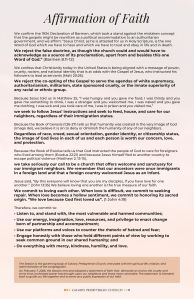
Today, members of the Session, our church’s governing board, will be leading us in an Affirmation of Faith they have written for us, claiming what they see on the horizon at this moment in time. Because it is an act of faith to make a claim based on what we know right now. It is also an act of faith to know God is still working and changing things we thought we knew.
When faith, when belief, has been life giving for me, it has been when people helped me understand faith as a mysterious horizon business.
It’s a community job. It’s work we each have to do, but we can’t do it alone. It’s why we are called here, to support each other, to speak of our experience so that others might possibly just recognize where God is working in their lives too. Because we’ve all had different instructions in our faith upbringing. Some of us have been pointed to horizons all along. Others of us have been told to entrench our positions and look no further.
Sarah Bessey is a Christian author. She had to leave her church to follow Jesus and has been working to re-construct her faith. When you see people doing that hard work, support them. It is, perhaps, easier just to walk away from faith entirely. She said that when she was in the beginning stages of her faith deconstruction, her father told her:
“I’m not afraid for you. If you’re honestly seeking God, I believe you will find what you’re looking for even if it looks different than what I have found.”
That’s faithful horizon work, friends.
So we pray that the signs of healing and grace that we see around us in our lives won’t leave us blinded by the Light. Instead, I pray that we’ll be able to see and then share that experience with the world, trusting that it will point the way to Jesus so that his Light may shine in all of the dark corners of our world. Amen.


 Glass Overflowing