Introduction to Worship:
Good morning and welcome to worship at Calvary Presbyterian Church.
I am Marci Glass, Pastor and head of staff. Whether you’re here for the first time or whether you are here every week, I deeply believe that it is God who has invited you here today, and it is my privilege to welcome you as a guest in this place. In the music, in the liturgy, in the prayers, in the silence, I pray you will find what your soul needs this morning.
How are you doing? How is it with your soul?
Mine has been a little weary, if I’m honest. Our country has had divides and divisions all the way through our history, but the particular divide in which we are standing feels bigger than most. I feel stretched thin, trying to straddle the distance between us. I’m unwilling to abandon God’s call for justice and mercy and love. I’m also trying hard to hang on to relationships with loved ones, but am baffled how they are celebrating politics of violence, division, and greed. They call me an ‘extremist’ and I don’t know what they think I’m being extreme for—love, the right of other people to live?
We seem to be living on two different planets and the common welfare seems to be lying shattered at the bottom of the chasm between us.
What are we to do?
Today in worship we are talking about dreams. And while we, as a nation, seem to be living for two very different dreams or visions, we as followers of Jesus are working for a particular dream. We embody the love and hope of God so that we do not become the violence and hate we stand against.
As fellow pastor Derek Penwell said this week, “Jesus called out predatory religion, disrupted economies of exploitation, named rulers’ threats without flinching, and still refused the sword. Loving our enemies never meant moral equivalence, but refusing to mirror their violence while committing to standing between them and the people they crush…we love enemies and bind wounds and pursue justice not because it works, but because that’s who we are. We do it because it’s the right thing to do. And whether or not it’s persuasive, we do it because Jesus did it first and told us to follow.”
We judge our dreams by the life of Jesus. Are our dreams at odds with what Jesus said and how he lived? Or do our dreams reflect God’s love and Jesus’ life?
And let us enter worship with this prayer, adapted from Cole Arthur Riley:
God of dreams,
We remain. Through trial, through labor, through the terrors and beauties of this world, we’re still here. Hearts drumming, lungs expanding. Help us remember that to simply go on is a triumph. As we recall our week, drive off the beast of anxiety that lurks in the corridors of our soul. Let us examine our days in truth, not as a ritual of self-hatred, but as a commitment to our inner life and how our selfhood has engaged the exterior world.
Remind us that what we give each day is enough, so we might move toward rest without apology or guilt. Each night, as our eyes drift closed, remind us of the mysterious regeneration of our bodies, that we might marvel at our own renewal in the sacred dark.
Make us dreamers each night, our imaginations liberated into a space without constraint. Let our rest be a portal to worlds known and unknown to us. And when we wake, we pray that the mystery of the night will have led us home to ourselves again. Amen.
Adapted from— Cole Arthur Riley in Black Liturgies
Scripture:
Genesis 27:1-4, 15-23; Genesis 28:10-17
Sermon:
Dreams are a weird business.
Cultures have been interpreting dreams from ancient days.
There are numerous dream accounts in scripture, other than this dream of Jacob’s.
There are dreams interpreted in the ancient story of Gilgamesh.
Sigmund Freud and Carl Jung made careers of dream analysis.
And you can enter your dreams into numerous websites today and have people (internet experts!) tell you what they mean.
We’re fascinated by dreams, I think, because they are so far outside of our conscious control. We can force our minds to memorize the multiplication tables, or use them to brainstorm ways to make the world better. During the day, we work to harness the power of our minds.
And then we go to bed at night, with a nice stone pillow beneath our heads, and we are no longer in control.
I can go to bed at night, hoping to dream about George Clooney and Colin Firth inviting me to join them on a yacht, hypothetically speaking, of course, but I end up dreaming about Sean Connery and I going to a Warriors game. (Don’t google that. I don’t want to know what it means).
There are mornings we wake up and wish we could return to the narrative of our dreams, even as the details fade away. No matter how hard we try, we just can’t return to that particular dream story. It would be easier to grab hold of a cloud or catch a shadow.
There are mornings we wake up and thank the good Lord it was just a dream. There are some scenarios we play out in our dreams that we couldn’t bear in real life.
And there are some dreams that are really really important.
I’ve only had a few of those dreams. But I’m thankful for them.
In college, during a difficult patch, I had a recurring dream that I was in a cult and needed to escape. At first I would wake up, still in the cult, often pounding against the walls. As time went on, the dream would start the same, but I’d end up running right through the glass wall and escaping. The last time I had the dream, I started in the cult, broke through the wall, ran down the street, and ended up flying.
Needless to say, in real life I wasn’t needing to get out of a cult. But I needed to know my own strength and ability to think for myself. I needed to act for myself. I needed to know I could make the choices I needed to make and survive.
Would I have gotten there without those dreams? Maybe.
All I know is I’m very thankful for those dreams, for dreaming me into myself.
Shortly after Justin and I were married, I was trying to figure out what to be when I grew up. I was actively praying for discernment. “God, give me a sign.”
I was considering law school. I was considering getting a teaching certificate. Either of them would have worked, but neither of them felt quite right. I had already turned down PhD History programs, because that path also didn’t feel right.
At the same time, the church we were attending was hiring a youth director. In the span of a few weeks, five different people asked me if I was applying for the job.
My response was instantly dismissive. “um, no. High school was horrible for me. Why would I want to put myself back into that hellscape?”
And then I had a dream.
I was in a college dorm room. And I heard a loud and resonant voice calling my name. “Marci! Marci!”
I was doing other things at the time, like reading want ads for jobs, and didn’t want to go see who was yelling at me in the hallway.
But the voice was insistent.
I opened the door and looked down the hallway and there was a giant stone head at the end of the hall. Like Easter Island meets Monty Python. And it was God. I knew it. And God said, “I’m trying to answer your question. Are you listening?”

And I woke up in a cold sweat and applied for the job the next day. And here I am. I will forever be thankful for that dream.
How do dreams speak to you?
Last week, Joann preached the story of Abraham’s near sacrifice of his son Isaac on the altar. The Bible doesn’t tell us, exactly, how Isaac felt as he and Abraham came home from their camping trip/near death experience.
It would not surprise us to learn that Isaac’s relationship with his father might have been affected, and not for the better. And that once Sara heard the story, about how her husband almost killed her one and only child, the one she’d prayed for, for decades—things might have been tense in Abraham’s marriage in the aftermath.
We aren’t told. But we can imagine.
Today’s story is the end of Isaac’s life, so a lot has happened since last week’s story. In the intervening chapters, Isaac has grown up, married Rebekah, and had two children, twins Esau and Jacob.
They aren’t exactly a picture perfect family. There is deceit and intrigue. Isaac and Rebekah divide the family by each favoring different sons. Jacob first will trick Esau out of his birthright and then steals his blessing in the story we just heard.
We hear this story and wonder what is the big deal with both the birthright and the blessing. Couldn’t Isaac have blessed them both equally? But in the days when this story was written, it was a cultural expectation that the eldest son inherited the blessing of the father.
Scripture, of course, is full of stories where God chooses to subvert this cultural practice. Isaac had already received Abraham’s blessing, in the place of his older brother Ishmael. Someday, Jacob’s blessing will fall to a younger son. Generations later, King David receives God’s blessing even though he has seven older brothers.
These stories are helpful reminders to us that God’s blessing is not the same as the world’s blessing. We can be rich, famous, powerful, and eldest born and that does not necessarily equal the blessing of God.
I read about the trickery, which defines Jacob’s story, and the trickery of his mother, and I don’t love it. Maybe it happens as it does because women and younger sons have to chart their own path in a culture that doesn’t value them. Maybe God’s blessing would have landed on Jacob anyway, without all the need for deception and subterfuge.
There is not a sense in the story that God was fooled by Jacob as Isaac was. God never says, “well, shucks. You got me! I wanted Esau to get his blessing, but what can I do?”
In fact, God had told Rebekah when the twins were born that the younger brother would supplant the older one. It feels like Rebekah and Isaac’s trickery started with God. And that just reminds me, one more time, that God’s ways are not our ways, and that we cannot predict where God’s grace or God’s blessing will choose to rest, no matter how often we want to confidently proclaim that someone is outside of God’s blessing and grace.
So guard your heart. When you hear politicians say with confidence that people don’t deserve to be here in this country, or don’t deserve to have civil rights or access to education or healthcare, or freedom of speech—or whatever the insanity is this week—guard your heart so you don’t grow to believe that there people we do not have to care for or care about. Even the politicians spewing the lies may not be beyond God’s grace or blessing.
Jacob flees his brother’s wrath and his father’s disappointment, and heads to his uncle’s place where his mom hopes he’ll find a wife.
And on the way, Jacob has a dream.
Imagine how important, at that particular moment of his life story, it was for Jacob to receive divine confirmation about his journey.
If I had stolen my brother’s blessing, and tricked him out of his birthright, I’d be wondering about the validity of my journey.
Can blessing really be so easily acquired?
Is a stolen blessing legitimate?
Is this all going to end when Esau catches up to him and kills him as he sleeps?
We don’t know why God chooses to work through trickery and deceit and people like Jacob.
But on some reflection, I guess I’m glad God does.
Because that means there is room for me, in my broken life, to be blessed by God also.
In the dream, God tells Jacob:
“Know that I am with you and will keep you wherever you go, and will bring you back to this land; for I will not leave you until I have done what I have promised you.”
Jacob doesn’t know it yet, but he’s headed to live with his uncle who will be his match in trickery. After this dream, he wakes up in the morning with what he needs to continue on the journey with confidence.
What are your dreams?
When and how has God spoken words you needed to hear to keep going on the journey?
Presbyterians aren’t really known for being dream people. We have “decently and in order” tattooed on our souls, which is how it should be.
Yet there are times when we need confirmation about the path we’re on that is different than the confirmation we get from maps, or GPS, or other external data.
We need divine dreams,
dreams that encourage,
dreams that equip us,
dreams that point us down the road.
If you’ve noticed, I never speak about God’s will. Or God’s plan.
I ask, instead, that we discern what God might be dreaming for us.
This is partly because I worry, theologically, about the message of God planning out every moment of our lives, leaving us as puppets on a stage, acting out some divine drama.
The idea of God’s will can leave us feeling we have no agency, that we are powerless victims to the story of our lives.
If, instead, I try to figure out where my life intersects with what God is dreaming for me, then I can try to live into the best journey God could imagine for me, which I guarantee is better than what I could dream up for myself. It doesn’t take away my ability to make mistakes. But it does still allow for God’s redemption of whatever situation in which I find myself. It is a little easier to ‘course correct’ if I feel like God is helping me find a way after I feel like I’ve hit a dead end.
It is harder for a church to dream, perhaps. How do we discern together what God is dreaming for us? How do we attend to the dreams of a congregation?
Your session, one of the elected offices of the congregation, has been seeking to do that. They meet each month to pray and seek discernment for the path of the church. One thing that has come up in our discussions is the need we have as a community to develop deeper connections and relationship than we can do while sitting in worship on a Sunday. The all church retreat over Memorial Day weekend fed our souls so well—they asked how can we keep that connection going. And so we’re trying a Monday night dinner and program.
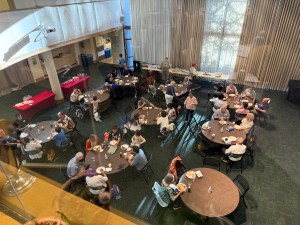
view from my window of people gathering for dinner
Last week was our first Church Night and 50 people came. It was such a gift to have time around the dinner table with people I don’t always get to visit with. And then the kids went off to children’s choir and youth programming. The adults met for a class. It isn’t too late to join. We’ll be back tomorrow night from 5:30 to 7:30 for a potluck dinner and classes.
You’ll also hear in a minute from one of the elders about how you can connect with our new ministry teams. It has been a while since we’ve looked at how our committees are structured, and we’re hoping this new configuration will set us up well to do what God is dreaming for us.
And I recognize it is the most Presbyterian of things to say that our committee structure is one of the ways we are trying to discern God’s dreams. But I am excited for this. We’re hoping this will give everyone a way to participate in the life and ministry of the congregation. Maybe you’re wanting to serve on a team. Maybe you’re wanting to help more with a project or an event, but not have regular meetings. We’ll have opportunities for all of that. Because your church needs you, and your particular gifts, so that we can live into what God is dreaming for us.
What do you think God might be dreaming for us here at Calvary, so we can better share with the world a dream of hope, possibility, and grace that transcends our divides and our challenges? It’s a real question and I hope you’ll consider it.
Jacob woke up from his dream and said, ‘How awesome is this place! This is none other than the house of God, and this is the gate of heaven.’
In the next verses we’re told “Jacob rose early in the morning, and he took the stone that he had put under his head and set it up for a pillar and poured oil on the top of it…Then Jacob made a vow, saying, ‘If God will be with me, and will keep me in this way that I go, and will give me bread to eat and clothing to wear, so that I come again to my father’s house in peace, then the Lord shall be my God, and this stone, which I have set up for a pillar, shall be God’s house; and of all that you give me I will surely give one-tenth to you.’
The response Jacob had to his dream was first a hope that the dream would come true—faith that God would be with him and that he could return to his family in peace. And then it was a response of gratitude, of giving back to God a portion of all God was giving him. May we have similar responses to our dreams—gratitude and generosity are a good way to live.
Jacob dreamt while using a stone for a pillow. I don’t have pillow sized stones for you today because they would be awkward to take home on Muni, but during the final hymn, I invite you to come forward and take a stone from the baskets, take your stone home with you, and put it somewhere where it will remind you to listen for God’s voice in your dreams, to remind you to listen for God’s dreams in your life, and to remind you of God’s promise to Jacob:
“Know that I am with you and will keep you wherever you go.”
God is with us, friends. May God keep us wherever we go. Amen.
May it be so. Amen
For the benediction, I shared this poem from David Whyte.
What to remember when waking
By David Whyte
In that first hardly noticed moment
in which you wake,
coming back to this life
from the other
more secret, moveable and
frighteningly honest world
where everything began,
there is a small opening
into the new day
which closes the moment
you begin your plans.
What you can plan
is too small
for you to live.
What you can live
wholeheartedly
will make plans
enough
for the vitality
hidden in your sleep.
To be human
is to become visible
while carrying
what is hidden
as a gift to others.
To remember
the other world
in this world
is to live in your
true inheritance.
(Excerpt from ‘What to Remember When Waking’
From RIVER FLOW: New and Selected Poems
Many Rivers Press. ©David Whyte)


 Glass Overflowing