A sermon preached at Calvary Presbyterian Church in San Francisco, CA
December 22, 2024
Isaiah 40:1-11
Introduction to Worship:
Good morning and welcome to worship here at Calvary. We’re glad you are here.
This past spring, my husband and I, along with my mother in law, and some other friends, visited Morocco. One of the highlights for me was the night we spent ‘glamping’ in the Sahara desert.

It was so quiet and still amid all the sand dunes, and yet the desert was so alive. And we got to ride camels!
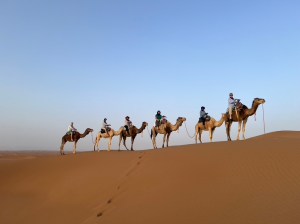
To get to the camp, we drove to the literal end of the road, and transferred our bags from the van to a few different off-road SUVs. And our new drivers led us across the dunes and rocks to the campsite.
There was no GPS guiding the way. There were no tracks to follow because the shifting sand has a way of erasing tire tracks. I kept wondering how the drivers knew where to go. I trust there were landmarks discernible to them that we not visible to us. The scrubby little trees or sand dunes all looked the same to me, but I’m sure if I did that drive every day, I would start to discern differences in them. Maybe?
I kept hearing Isaiah’s voice in my head as we bounced over the rocks and dunes:
‘In the wilderness prepare the way of the Lord,
make straight in the desert a highway for our God.’
There was nothing straight about the path we were on, and I think we were all a little sore by the time we got there, no matter how fun and exhilarating the ride had been, but the path did take us straight to the camp.

Tea in the Sahara
And I will likely always think of that bumpy ride in the desert when I think of what it takes to make straight in the desert a highway for our God. Because the path to comfort is not always comfortable.
It takes time. You have to make that drive multiple times a week, maybe each day, for a while, before the highway you need to travel is discernible.
It takes awareness. You have to pay attention to your surroundings, and notice where the sun, moon, or stars are in the sky.
It takes discomfort. Whether you’re in an off road Jeep, or on a camel, or on your own two feet—journeys on desert highways are not comfortable. Even if you fit your camel with the best shock absorber system money can buy, it’s a bumpy ride.
We are a few days to Christmas now, and you may have a to do list a mile long, or you may be carrying anxiety, grief, or worry. But we are here together this morning. So I invite you to be present in this time and space, so thet you may rest and find comfort in this hour. Because the God who provides comfort for God’s people is the God of love, and God’s care for humanity is rooted in the deep love of God.
Hear these words from the Prophet Isaiah:
Get you up to a high mountain, O Zion,
herald of good tidings;
lift up your voice with strength, O Jerusalem,
herald of good tidings,
lift it up, do not fear;
say to the cities of Judah,
‘Here is your God!’
See, the Lord God comes with might,
and God’s arm rules for them;
The Lord’s reward is with them,
and their recompense before him.
God will feed his flock like a shepherd;
She will gather the lambs in her arms,
and carry them in her bosom,
and gently lead the mother sheep.
Sermon:
This passage from the Book of Isaiah begins what is known as Isaiah’s Book of Consolation, also called Second Isaiah. The story told in the Book of Isaiah begins in 742 BCE, but by the time we get to chapter 40, scholars think we’re at least 100-150 years down the road.
At the end of chapter 39, we’re told “Days are coming when all that is in your house, and that which your ancestors have stored up until this day, shall be carried to Babylon; nothing shall be left, says the Lord.”
But as chapter 40 begins, that exile is ending, the penalty is paid, and people are to prepare to return home. It’s hard to say exactly how much time has passed, but more than one would expect between a chapter 39 and a chapter 40 in a book.
This is the chapter that is quoted when the gospel accounts introduce John the Baptist. We often hear of John the Baptist during Advent. This year, we’ll instead read about him in January, but here’s what Luke’s gospel, chapter 3, says to introduce John:
as it is written in the book of the words of the prophet Isaiah, “The voice of one crying out in the wilderness: ‘Prepare the way of the Lord, make his paths straight. 5Every valley shall be filled, and every mountain and hill shall be made low, and the crooked shall be made straight, and the rough ways made smooth; 6and all flesh shall see the salvation of God.’”
The gospel writers describe John as the embodiment of Isaiah’s prophecy, the messenger to prepare the way of Jesus.
But the author of Isaiah didn’t know about John the Baptizer or about Jesus. He was writing to people in his own time, people facing their own dislocation. People who had been carted off to Babylon, collateral damage of the policies of unfaithful and unjust kings. People who needed a literal highway to walk as they returned from exile.
For some of us, perhaps the anxiety in our world has kept us from identifying with the word “comfort” for a while now. Job stress, family instability, disease, pandemic disruptions, money worries, or other factors can make you forget what “comfort” is like.
For some of us though, the comfort of our lives can also get in the way of our ability to hear a dislocating and challenging message from God.
I theoretically want the valleys lifted up and the hills brought low, except for when I think about how much that might inconvenience me, because I’ve lived through road construction projects and I know what they entail. Do I really want the valleys lifted and the hills brought low when I can navigate the hills and valleys pretty easily most days? I have financial resources, a career I love, and more privilege than I can count because I’m white, heterosexual, and married to a doctor.
I mention this because it is worth remembering that we are all occupying different lived realities. We gather together each week as one community, and we are a community with different racial identities, citizenship status, gender identity, sexual orientation, political affiliation, income, housing, an employment status.
It is rare in a world being ever more divided and entrenched along fault lines of politics, culture, etc to gather together each week together. And while we hope the things that bring us together are stronger than the things that divide, I hope we also can be gentle with each other and with ourselves when we find ourselves in different parts of the biblical stories.
It’s worth considering who God is intending to offer comfort in this passage, and in our world. And are our building projects for the comfort of the already comfortable, or are we preparing the way so that all of God’s people will have an easier path to navigate the wilderness of the world?
Are we willing to be inconvenienced by construction projects if it will make the lives of our neighbors easier?
When Isaiah preaches God’s message of “comfort, comfort ye my people”, it is only comfort, it is only God’s liberation or salvation, if everyone is included in it. Are we able to include everyone in the things we do to bring comfort to God’s people? Comfort, comfort ye my people, is not intended to make kings on their thrones feel more comfortable than they already are. It is to remind kings on thrones that if they don’t offer comfort to their people, God will.
I was very uncomfortable watching people celebrate the murder of the insurance CEO a few weeks ago. God’s liberation is surely an intention that all people can have access to life saving healthcare. God’s liberation is also that they can safely enter a hotel in Manhattan, or go to school or anywhere else in public, without fear of gun violence. We cannot celebrate the death of one person. We cannot ignore the deaths of thousands.
Isaiah was speaking to a people in exile, offering comfort to a people who were facing real political troubles, reminding us that it is appropriate to see the political troubles of our world and respond to them with our faith.
That is one of the gifts of Scripture, to be able to reach across the years. A passage written by Isaiah as a response to a specific situation becomes the living word of God, hundreds of years later to 1st century Palestinians, and then again become the living word of God to us here in San Francisco in 2024, speaking specifically to our lives, our political realities, today.
We hear “speak tenderly to Jerusalem” and think of the Israeli and Palestinian people today—Jews, Muslims, and Christians— living in the midst of conflict, terror, and war. We continue to pray for an end to violence in Gaza and Lebanon, and a return of hostages, over a year after the conflict began.
Scripture is inherently political. We hope to keep it from being partisan. God’s word is bigger than any political party, or ideology, or national agenda. But the message of scripture isn’t received with equal comfort by all people.
Comfort ye. Comfort ye, my people,
One thing that gets obscured in this passage, perhaps because we equate it to John, singularly preparing a way, or we hear it sung as a solo in Handel’s Messiah, but “Comfort my people” in the Hebrew text is a plural imperative. “All y’all need to comfort my people”. It is not the work for one person. It is not an instruction to one person.
Scholars aren’t exactly sure why it is plural. One thought is that it is like other places in Scripture where the heavenly host is present. We see that in the book of Job, or in Psalms, or on Christmas Eve when the heavenly host scare the stuffing out of the shepherds on the hillside.
I think it is voiced in a plural imperative because it is a reminder that none of us are called do the work required by ourselves. Building the highway for God is not work that can be done alone in isolation from others.
I don’t know about you, but I do not think our society has been doing well with plural imperative living for a while, where people recognize the need to respond collectively for the good of others, to provide comfort. It got worse because of Covid, but our descent into isolating individualism began before 2020, and seems to be getting worse in the aftermath of the election in November.
It’s possible that those of us who gather for worship on a regular basis may be better equipped against the lure of lone ranger individualism than some.
We sing together and our individual voices become more than any one of them are on their own.
We volunteer and serve together and the help we give the community is magnified.
We give money together which allows our individual gifts to combine with those of other people to make more of an impact in the community than any of us can do alone.
We worship together, and as Isaiah says:
Then the glory of the LORD shall be revealed,
and all people shall see it together.
In this season of Advent, in this mad dash to Christmas, I suspect we both need comfort, and we need the discomfort that comes with preparing the way for God. We are the preparers of the way and also the people for whom the way is prepared.
What does Isaiah say we need to do to prepare the way for the coming of our Lord?
The text is clear. We are called to comfort. We are called to prepare the way. We are called to use our voices and cry out about where God is at work in the world.
Isaiah tells the people to get up to a high mountain and lift up their voices with strength to proclaim.
“HERE IS YOUR GOD!”
That is what we are to point out to people. We are to boldly and with confidence stand on the mountaintops and show people where we have seen God.
Where have you seen God? I invite you to be on the lookout for where God is at work in the world and in your life.
I’m thankful to hear that voice in Isaiah telling us to lift up our voices. And I’m thankful to have this community because your voices ‘cry out’ together for God better than any of our individual voices ever could, amplifying the message so people may know of a God who, as Isaiah says,
“will feed his flock like a shepherd;
he will gather the lambs in his arms,
and carry them in his bosom,
and gently lead the mother sheep.
And as we work together to prepare the way for God, I hope that we’ll be able to go about it with love and great joy. I hope, like Isaiah, we can say to the cities of Judah (and San Francisco)—“Here is your God!”.
Comfort, oh comfort, my people. Prepare the way!
Thanks be to God. Amen.

 Glass Overflowing