The Christ Hymn

September 29, 2008

A sermon preached at Southminster Presbyterian
September 28, 2008
by Marci Auld Glass

Exodus 17:1-7
Philippians 2:1-13

Since we’ve been moving through this Exodus text these past weeks, I’m sure it is no surprise to you that the Israelites are still where we left them, complaining to Moses and their God, still having trouble understanding deliverance, whether it takes place in a big, showy miracle like the parting of the Red Sea or whether it takes place quietly when water just starts flowing out of a rock.
But the Israelites ask a question that we are still asking today. “Is the Lord among us or not?”
I find some comfort that our question today was their question as well. Because one might think that the parting of the Red Sea and the Manna in the Wilderness would have been visible enough signs of God’s presence. One might think that people who had seen the Lord traveling in a pillar of cloud and fire wouldn’t have to ask the same questions we do today.
But they do.
Which means one of two things. One, either the presence of the Divine in our world is tricky enough to detect that miracles don’t play the role in that we might expect. Or, two, perhaps there are miracles all around us, like the water flowing out of the rock, and we are just as unable to see them as the Israelites were.
Maybe that is our question for the week. “Is the Lord among us or not?” But, I also invite you to notice that in this text, God doesn’t provide water for the
Israelites to show them that God is with them. God gives them water because they are thirsty.
Our motives in looking for miracles may be about figuring out if God is with us in this game called Life, but we need not to assume those are God’s motives too. The miracles in this world, whether we see them in unexplained healing, or in having just enough money to pay the bills, or in bigger or more showier manifestations, the miracles in this world might just be the way God notices that we are thirsty and then takes care of it. “Strike the rock”, God tells Moses, “and water will come out of it, so that the people may drink.”

I confess that I spent a fair amount of time this week wondering what was the connection between our lectionary passages from Exodus in the Old Testament and Paul’s New Testament letter to the church in Philippi. And I think it is the question posed in Exodus. “Is the Lord among us or not?” To get there, however, you might need to bear with me during a slight diversion. Because before we get to Philippians, we need to be clear about the way that Jesus changed the way we understand who God is.

After the Exodus, over the years, the Israelites continued to work on recognizing God’s provision in their lives. They grew into their role as God’s people, learning to pray this prayer:
Shema Yisrael Adonai Eloheinu Adonai Echad.

Shema— listen, or hear and “act on”
Yisrael — Israel, in the sense of the people or congregation of Israel
Adonai — often translated as “Lord”, it is used in place of the YHWH
Eloheinu — our God, the word “El” or “Eloheinu” signifying “our” God,
Echad — the Hebrew word for the absolute number 1

I bring up this prayer, found in Deut 6, because it is a part of all morning and evening Jewish prayer services. “Hear O Israel, The Lord is our God. The Lord is One”. This statement of belief, of belonging, of one-ness is fundamental to understanding what Judaism is and was.
This one-ness of God undergirds all Jewish thought and belief. We Presbyterian flavored Christians are also monotheists. We affirm this prayer as well as the Hebrew Scriptures, which are our Old, or First Testament.
But, when the followers of Jesus started making claims about Jesus being God, it didn’t go over well at the synagogues and temple. Because to claim Jesus as one with God is blasphemy.
And I wonder what that must have been like for those early Christians. How do you make your experience of Jesus fit in with thousands of years of prayers and teaching? Because there wasn’t the expectation among any one of the time that God would be born in human form. They were awaiting a Messiah, an anointed one, who was going to lead them to victory and salvation, but that Messiah wasn’t God and there wasn’t an expectation of God coming down to earth and becoming human.
And yet, that is what God did in the person of Jesus. And even for those who were hoping he was the Messiah, that didn’t turn out as they were hoping either. A humiliating death on a cross was hardly the way they were expecting their Messiah to defeat the Roman occupation.

Most scholars believe that in the text we read this morning from his letter to the Philippians, Paul is using a hymn from the early church. The text of 2:6-11 is poetic in the English, but even more so in the Greek. And before we look at how Paul is using the hymn, let’s think about what led those early Christian hymn writers to come up with these lyrics.

Remember the Israelites’ question? “Is the Lord among us or not?”
Somehow this bunch of monotheists who had experienced the Divine in the person of Jesus came up with this beautiful and poetic language to describe how the Divine became human and answered their question.
“Jesus, though he was in the form of God, did not regard equality with God as something to be exploited, but emptied himself, taking the form of a slave, being born in human likeness. And being found in human form, he humbled himself and became obedient to the point of death—even death on a cross.”

I know this language may sound familiar and comforting to us, but consider for a moment how odd the claim is. Jesus, who Paul is suggesting we emulate—remember–this Jesus emptied himself, taking the form of a slave and then he humbled himself.
In no culture was—or is—this the way to show leadership or authority. But we, my friends, are the followers of a God who emptied himself and lost everything according to the rules of the world.
And Paul is reminding the Philippians and reminding us that not only is this how God behaves, but this is how we are to behave. Because it is in this emptying of himself that Christ found true authority. Not as the world gives. But as God gives.
But, of course, this emptying of ourselves is, for me at least, tough to do. The Israelites didn’t do very well either, did they? God wanted them to let go and to learn to follow directions and trust that God would provide.
But it is hard to do. I believe they wanted to trust God, but when your next drink of water is on the line, when your survival in the wilderness seems to be up for grabs, you want to know long term plans. You want to see the solution.
Please know that when I preach about letting go of control, of emptying myself and sitting back and trusting that God is in charge, I’m really preaching to myself as much as anyone else. I am notorious for wanting to be in control, to know what the plan is. And my problem, or one of them at least, is that I can often make do on my own. I can go entire weeks without having to acknowledge that I am not in control.
Sometimes my control issues show up in subtle ways. Like when I apply the brakes on the passenger side of the car when my husband is driving the car. I do it all the time. Honestly, I married a saint—a saint who should apply his brakes a little sooner, but a saint nonetheless.
Or hiking down into the Grand Canyon, we walked past some mule teams making their way down the narrow Cliffside path. And as much as I would have appreciated a ride down the hill, I wouldn’t have done it because I wouldn’t have been in control. What if the mule freaked out and I plummeted into the canyon? The fact that I don’t think that had ever happened before wasn’t enough to convince me that mules on narrow trails are a good idea. Why would I trust some strange mule that I don’t even know?
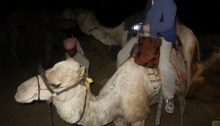
But when I went to the Middle East a few years ago, I had to let go of a whole lot of control. I had to trust that I was in God’s hands to even get on the plane to Damascus. And things were out of my control the whole time I was there. I didn’t know how to get were we were going each day—I had to trust the trip leaders to have it all coordinated. I had to trust the bus drivers on those horrifying roads. I had to trust the translators because I don’t speak Arabic. And when we got to Mt Sinai, I found out that the “optional” camel ride up to the top of the mountain (remember my opinions about beasts on hillsides) was not actually optional. We were all going to ride camels, in the pitch black, up to the top of Mt Sinai so we could watch the sun rise. I had not even ridden a horse, but I had to trust an animal I’d never seen before and rely on something other than my own two feet to get me to the sunrise. I had to empty out that last little illusion of control and climb on the camel.
And, you know what? It was one of the highlights of my life. Sitting there on the camel, in the middle of the night, with darkness all around and in the sky a blanket of stars like I’d never seen before. I knew we were on the side of a mountain, but I couldn’t tell if I was 10 feet or 10 inches away from the edge. I had to trust my camel and Samir, the kid who was guiding the camel to the top. And what I discovered, on that silent ride up the mountain, was that when I let go and emptied myself of my need for control, God came in to that empty space. On that dark and holy mountain, I had an answer to the question. God is among us.
But to know it, we have to look in unlikely places. In rocks that suddenly give us water. In a carpenter from Nazareth, crucified as a criminal by Rome.

The situation on Wall Street might be the perfect illustration of a situation where our illusion of control is being shattered. We still need to pay attention to our accounts, and communicate with our congressional leaders, but I suspect this situation is as outside of your control as it is of mine. I can’t write a check for $700 billion. I can’t keep banks afloat. I can’t predict the outcome of any of it. “So, okay, God,” we say when the stock markets are reeling and the economy seems to be on the brink of collapse, “are you among us or not?”
As we empty ourselves and ask that question this week, I invite us to look in the unlikely places for signs of Divine presence. And we can find comfort in Paul’s words. And I hope our leaders hear them as well.
If there is any encouragement in Christ,
Any consolation from love,
Any sharing in the Spirit
Any compassion and sympathy
Make my JOY complete—
Be of the same mind, having the same love, being in full accord and of one mind.
Do nothing from selfish ambition or conceit, but in humility regard others as better than yourselves. Let each of you look not to your own interests, but to the interests of others. Let the same mind be in you that was in Christ Jesus.

How does that saying go? We don’t know what the future holds, but we know who holds the future. AMEN.


Hopes and Dreams

September 17, 2008

A Discussion for the Southminster Community

I invite you to consider the following questions and to reply if you have some ideas. Please leave your name so that we know who we should thank for that great idea! If you are not a member of the Southminster community, you can still share your ideas, but please indicate your “observer” status in your reply.
Thanks. Here are the questions:

What are your hopes and dreams for the future of Southminster? In the next year? Five years? Ten years?

What are the needs in our community our church could try to help?

Do you invite people to join you and come visit our church? If so, why? If not, what would it take for you to do so?

Thanks for your thoughts.
Rev. Marci Auld Glass


Deliverance

September 15, 2008

A sermon preached at Southminster Presbyterian Church
September 14, 2008
Exodus 14:10-31

Our text this morning picks up in the midst of the Exodus narrative. God has sent Moses to deliver God’s people from slavery in Egypt. God has sent plagues on Egypt, including the death of all of Egypt’s first-born sons, to demonstrate God’s power to Pharaoh and his hardened heart. The institution of Passover, a holiday still celebrated to this day by Jews around the world, is described in chapter 12 and 13. I encourage you to look back through this narrative this week because Passover is THE remembrance of God’s deliverance and is so intertwined with Easter and Christian understanding of resurrection, that I’m not sure you can fully appreciate the communion image of Christ at a Passover meal of deliverance and remembrance if you haven’t read about Passover. So, I invite you to spend some time in this story this week.
In any case, our text this morning begins after the Passover, when the Israelites have left Egypt and are headed to the promised land, following God’s pillar of cloud by day and cloud of fire by night. Pharaoh, meantime, has had his heart hardened even further by God and decides to pursue his vanishing source of free labor.
Listen now for God’s Word to us this morning from Exodus 14:10-31…

Can you imagine hearing this story around the fire? After a day of wandering in the wilderness, heading toward the Promised Land, sitting around the fire after dinner, trying to keep warm in the cool desert night. Because this is the story the Israelites told. Again and again. Still today they tell it. And so do we. This is the story of deliverance.
And, yes, it has the elements of a great story. There’s the Bad Guy—Pharaoh who just can’t let the people go, who has continued in the 400 year tradition of exploitation and slavery, has changed his mind again—just when they thought they were out of there! There are the Suspense with the Unlikely Heroes—How are the unarmed, whining slaves with nothing but a stuttering leader and some unleavened bread going to outrun the Egyptian Army?
There is the car chase scene as the chariots chase after the Israelites—will they make it?!—running stop lights and plowing their chariots and horses through stop signs and ditches in an effort to catch up to the Israelites. There is the pillar of cloud and the pillar of fire, which I suspect were not things that the people saw every day. Physical and very visible signs of God’s direction for the people, giving Divine Assistance to the Underdog. And then, the best story element of them all, the miracle, the divine intervention.
It has been a while since I’ve seen Charlton Heston part the waters in the 10 Commandments, or even Jim Carrey parting his tomato soup in Bruce Almighty, but I noticed something in the text this week that I hadn’t before. Parting the waters took time. While the pillars of cloud and fire kept the two camps apart over night, Moses stretched out his hand and an east wind drove the waters back all night. This sense of the time it took for God to part the sea struck me in the text this time because I’d been thinking about the Israelites and had honestly been wondering why God was bothering to save them at all.
Because, let’s remember. God has already freed them from slavery with the signs of the plagues. God has directed them where to go and is leading their very path with the pillars of cloud and fire, and what do the Israelites say when they see Pharaoh approaching?
“Was it because there were no graves in Egypt that you have taken us away to die in the wilderness? It would have been better for us to serve the Egyptians than to die in the wilderness.”
These are the people God is saving! People who so quickly forget that they’ve already been delivered. People who forget at the first sign of trouble that God has already been actively working in their lives to save them.
But, when I started to think about the time that the parting of the waters took, I tried to put myself in their dusty sandals.
Imagine, your people have spent 400 years as slaves to this brutal regime of Egypt. It is all you remember. It is all anyone remembers. You escape slavery, only to turn around and see the entire Egyptian army pursuing you. You moan and whine a bit to God and to Moses about how slavery wasn’t really that bad and perhaps we should just go back quietly and forget this whole rescue business, hoping that Pharaoh will appreciate your acquiescence to his brutal force. But Moses comes to the locker room at half time with a great speech:
Do NOT be afraid! Stand firm and see the deliverance that the Lord will accomplish for YOU today. For the Egyptians whom you see today you shall never see again! The Lord will FIGHT for you and YOU have only to keep still!!”
So, despite the fact that they are up against a large body of water and have no boats, life preservers or inner tubes, the Israelites don’t turn themselves in to Pharaoh. They keep going, heading toward a big swim. And all night long, while on one side they hear the noise of the chariot wheels and the neighing of the horses, the sound of the Egyptians cooking their dinner and singing around the fire as they anticipate the rout and destruction of the foolish Israelites in the morning, on the other side they hear the wind. It is dark, so they can’t see what’s going on, but they can tell that something is happening on the Red Sea.
And then the morning arrives. Imagine that scene coming into view as the sun creeps over the horizon.
“What happened to the Sea?!”
“Is that a wall of water? How is it staying up there?”
And perhaps this is really the miracle of the story—these people whose faith was so shaky a few verses before—these same people walk into this alley of dry land, with walls of water on either side of them. And not just one of the people. But all of them. Helping mothers push their strollers. Carrying the toddlers. Assisting those on crutches and in wheelchairs. This is about the salvation of a community, not a bunch of individuals who happen to be walking in the same place.
And before the improbable wall of water remembered it was supposed to obey the laws of gravity, they all made it across safely to the other side. And while they stood there on the other side of the Sea, watching the destruction of the Egyptian army, I suspect their first thought was relief. A realization that Pharaoh would not be chasing them any more. They were free.
And moving from anxiety to trust and faith is a process, not usually something that happens in a moment. If it took God all night long to part the red sea, perhaps we should cut the Israelites some slack for taking some time to move into their freedom.
And, before you think that this is just an interesting campfire story, or even just history, consider this—Pharaoh and his system of fear based anxiety is alive and well in this world. Every time we become comfortable in our slavery, we are like the Israelites, crying out to Moses, “Let us alone! Let us serve the Egyptians.”
The Israelites had two paths to take in this story. One of them was a final return to slavery. The other was an impossible path to deliverance through a Sea Wall of water.
When have we done that? When have you disregarded all that the world would call “common sense” and turned your back on anxiety, slavery, your fear, and walked into the impossible deliverance God had prepared for you?
A friend of mine from seminary left her abusive husband after a number of years with him. Safety, even oppressive safety, had its attraction. There were concerns in leaving him—from where would the money come to provide for her children? What if she lost even partial custody in the divorce? Where were they going to live?
But now, a few years later, she is on the other side of the Sea and is looking forward with hope.
Another example of an impossible deliverance, and one that is still being played out today, is race relations in the United States. I suspect that few slaves in the 1850’s would have believed the idea that an African American would be a major party candidate for President. I’m not sure that many African Americans would have believed it 50 years ago. But some did.
Rosa Parks, by sitting down on a bus, became a part of an impossible deliverance. Believing that God’s message of deliverance was as true for her as it was for the Israelites, she rode that bus across a sea of intolerance, racism, and anxiety toward a promised land that we haven’t quite yet reached.
I’m sure that many of our lives have been impacted by addictions, either our own addictions or the addictions of people we love. Addiction is a Pharaoh that keeps people in slavery to drugs, alcohol and other things that take the place of our healthy relationships. And the impossible deliverance comes from, among other things, 12 steps. It isn’t immediate. It is a process, but by turning to God and trusting that God will get you through the moment, the hour, the day, a person who is addicted can put one foot in front of the other and head out of slavery and to the promised land.
And, perhaps our greatest illustration of deliverance involved an unwed pregnant teenager giving birth to a baby in a barn. The impossible deliverance of God’s people from the Pharaoh of Sin was accomplished not by military might, economic power, or worldly success, but by this baby, Jesus Christ, God’s own son, who died a humiliating death on a cross, finding strength in defeat and, in weakness, triumph over death itself. Impossible deliverance, indeed.
Friends, we should still be sitting around the fire telling this story to our children. As you consider where you are on this journey of deliverance, I invite you to encourage each other along this path. It is a difficult thing to turn away from the messages of Pharaoh and trust in God’s deliverance. But it is what we do. And it is what we do together. Amen.


Follow

Get every new post delivered to your Inbox.

Join 511 other followers